
Now this page is for you if you've done several long hikes, ideally a few days above 3,000 m (9,800 ft), and you're picking a first big trip. If you're still building up, start with my guide to building up from short hikes to big elevation days. Neither trip needs ropes, an ice axe or crampons. Both need a doctor's okay, and the section on talking to your doctor says why.
Quick picks
What are the Kilimanjaro climb and the Everest Base Camp trek?
Kilimanjaro is a mountain in Tanzania. The top, called Uhuru Peak, is about 5,895 m (19,341 ft). Groups sleep in tents carried by porters, and they reach the top on one long summit night and morning.
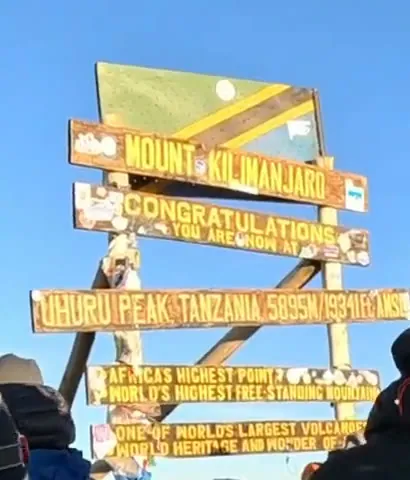
The Uhuru Peak sign at the top of Kilimanjaro. Screen from Fullwood's Bucketlist video.
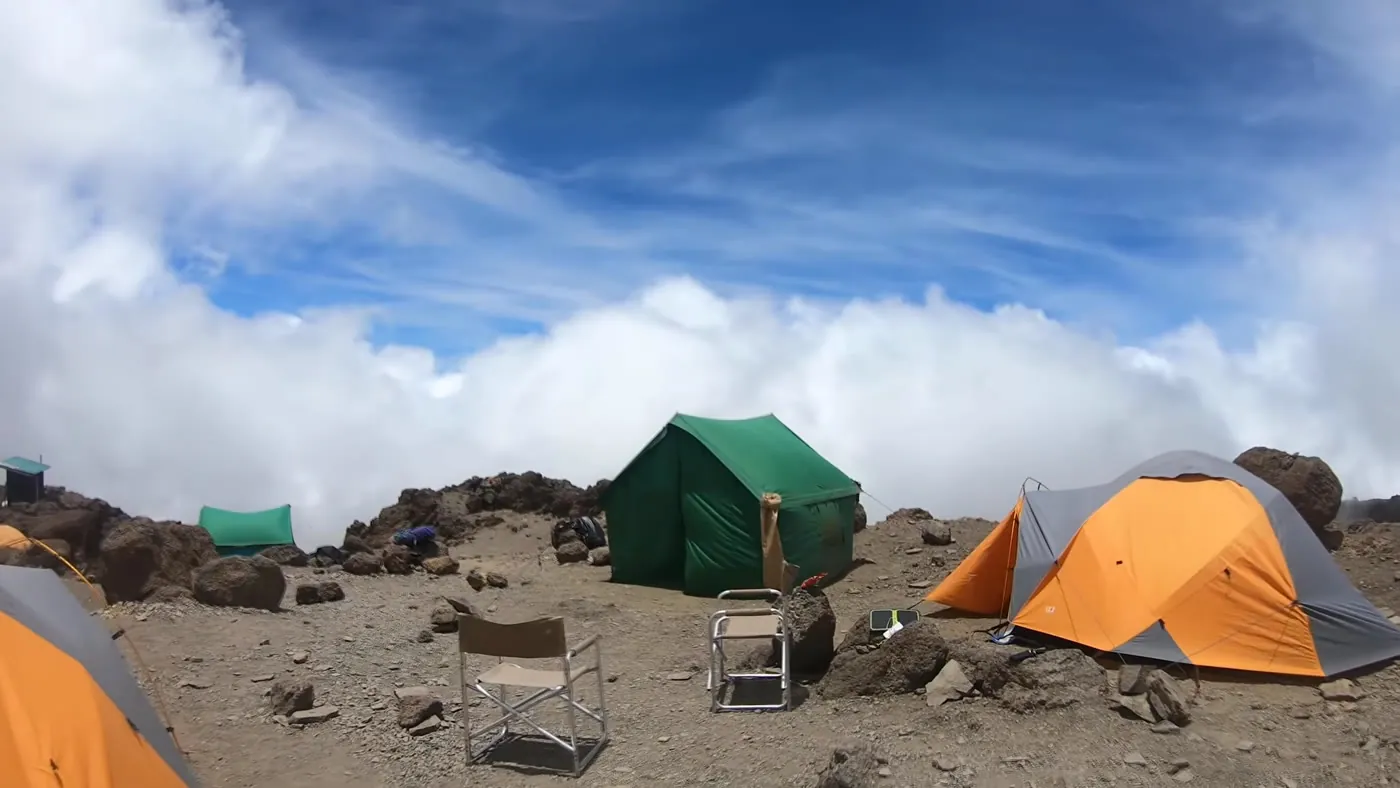
A tent camp high on Kilimanjaro. Screen from Follow Alice's video.
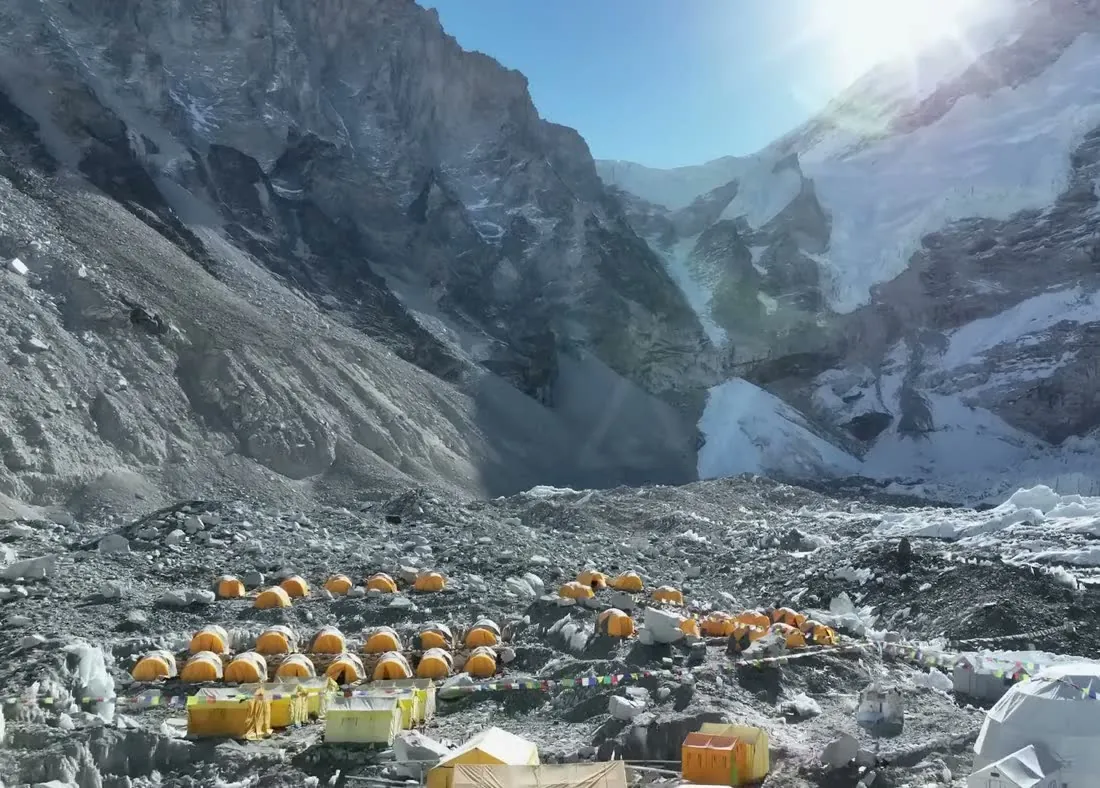
Everest Base Camp is a place in Nepal, not a summit. You walk about 12 days to reach it, sleeping in tea houses, which are simple guesthouses. Base Camp itself is at about 5,364 m (17,598 ft). Some trips add an optional climb of a viewpoint called Kala Patthar, about 5,545 m (18,192 ft).
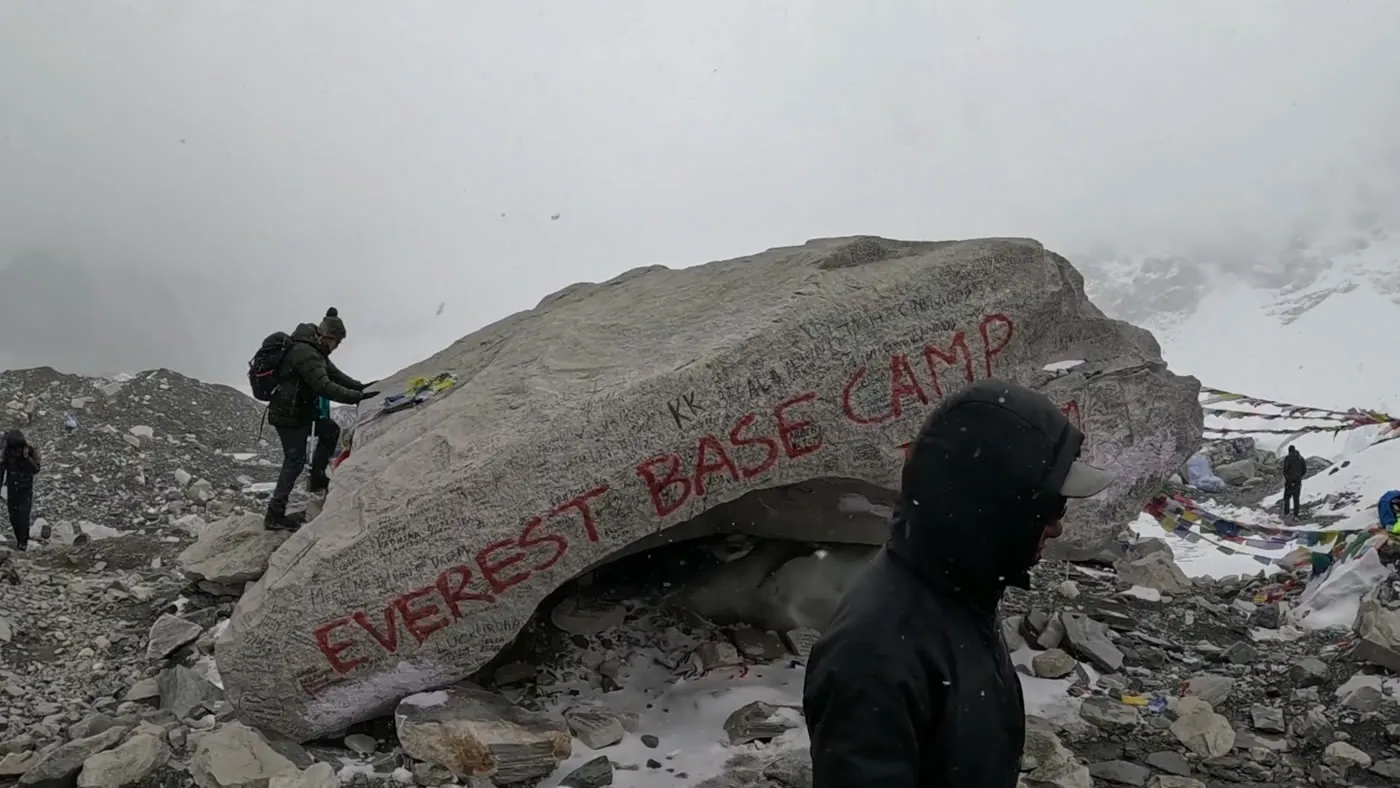
The painted boulder at Everest Base Camp, on a snowy day. Screen from Fullwood's Bucketlist video.
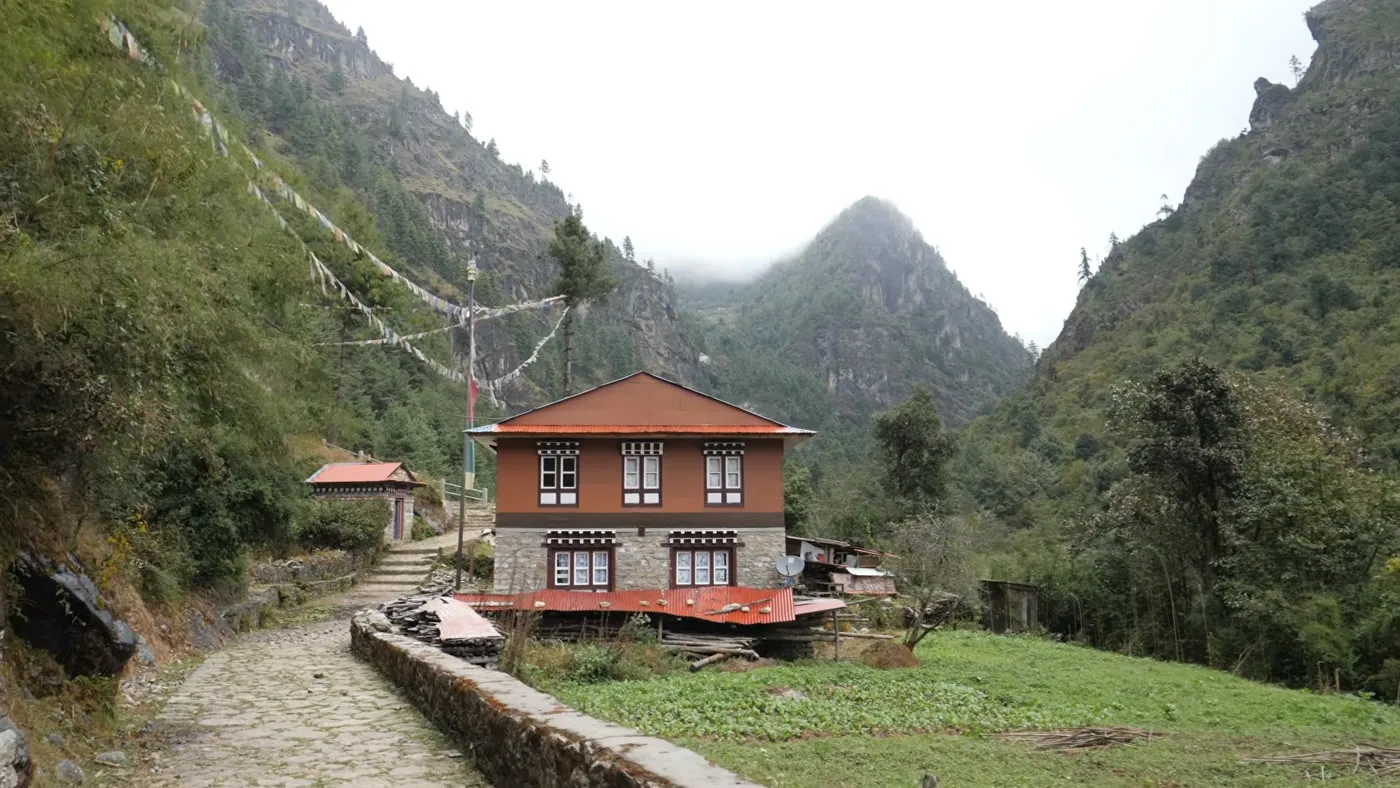
A lodge in the valley on the way to Everest Base Camp. Screen from Follow Alice's video.
How do Kilimanjaro and Everest Base Camp compare on the same facts?
Basically, here are the same facts for both trips, side by side. Guide companies round their heights differently, so treat every number as "about."
| Fact | Kilimanjaro | Everest Base Camp |
|---|---|---|
| Highest point you reach | Uhuru Peak, about 5,895 m (19,341 ft), per the US Centers for Disease Control and Prevention, or CDC. | Base Camp, about 5,364 m (17,598 ft). Optional Kala Patthar, about 5,545 m (18,192 ft), per Himalayan Glacier and Intrepid. |
| Highest sleeping altitude | Barafu Camp, about 4,640 to 4,815 m (15,200 to 15,800 ft), depending on the company. | Gorak Shep, about 5,160 to 5,180 m (about 16,900 to 17,000 ft). The CDC says Everest-region trekkers "routinely sleep" at about 4,267 to 5,150 m (14,000 to 17,000 ft). |
| Trip length | An 8-day trip with 6 climbing days on the Lemosho route. Alpine Ascents runs 7 to 9 days. | A 14-day trip with 12 trekking days at Himalayan Glacier. A 15-day trip with a 12-day trek at Intrepid. An 18-day trip with helicopter flights at Adventure Consultants. |
| Walking per day | Camp days run 4 to 8 hours and 5 to 12 km (3 to 7 miles). | Trek days run 3 to 8 hours and 7 to 20 km (4 to 12 miles) at Himalayan Glacier. They run 3 to 9 hours and 4 to 15 km at Intrepid. |
| The hardest single stretch | Summit day. You start around midnight, per Alpine Ascents, and climb roughly 1,100 to 1,250 m up from Barafu Camp, depending on where the company puts the camp. The day takes 9 to 12 hours and about 15 km (9 miles) at Himalayan Glacier. | No single push. The biggest days gain about 1,090 m and 920 m of climbing, per Intrepid. The whole trek is 55 to 66 hours of walking at Himalayan Glacier. |
| Where you sleep | Tents, carried by porters. | Tea houses. A few trips camp at Base Camp. |
| Technical skills | None. Summit night is cold and windy. | None. |
| Getting there | Fly to Kilimanjaro or Arusha, then drive to Moshi. | Fly to Kathmandu, then take a small plane to Lukla. Weather can delay that plane, and Adventure Consultants builds in one spare day. |
| Best months | January to mid-March and June to October. July to September is the busiest, per Himalayan Glacier. | Spring (March to May) and autumn (September to November), per Himalayan Glacier. |
| Guide required | Yes. Tanzania National Parks says every climb must be guided by a licensed operator. Details are in the Kilimanjaro guide section. | The Nepal Tourism Board lists a licensed guide as required. Details are in the guide rule section. |
| Example operator prices | $2,799 to $7,500 per person on the company pages below, flights not included. | $2,099 to $6,500 per person on the company pages below, international flights not included. |
Keep in mind that the companies' own pages round the heights differently. For example, Himalayan Glacier's page gives Dingboche as 4,360 m in one place and 4,410 m in another. So I round the heights on this page.
So which one is harder?
Now each trip is hard in a different way. That is my reading of the numbers above, not a measured fact.
Why is Kilimanjaro hard?
Kilimanjaro packs the altitude into fewer days. On Himalayan Glacier's 8-day Lemosho trip, you climb from Barafu Camp at about 4,640 m (15,200 ft) to the top at 5,895 m (19,341 ft) in one night. Then you come back down to Millennium Camp at about 3,820 m (12,500 ft) the same day. Summit day is 9 to 12 hours on your feet, starting around midnight.
The CDC says to add at least 1 to 2 days to a planned Kilimanjaro climb. It says extra time to adjust to the altitude is beneficial on routes usually sold as 4 to 6 day trips. So for me, a short Kilimanjaro route asks more of your body than a long one does.
Why is the Everest Base Camp trek hard?
The Everest Base Camp trek spreads the effort out. Himalayan Glacier's 14-day trip has two rest days built in, one at Namche and one at Dingboche. But you walk about 12 days in a row, and you sleep high for many nights. The CDC says Everest-region trekkers routinely sleep at about 4,267 to 5,150 m (14,000 to 17,000 ft) and hike above 5,486 m (18,000 ft).
And on the Everest Base Camp trek you are a long way from a road. The CDC says helicopter evacuation is readily available from most areas of Nepal, often the same day if the weather allows. But a rescue costs about USD 4,000 per hour, and an average of USD 8,000 to 10,000 in total.
How do the sleeping altitudes compare with the CDC's rule?
The CDC says that once you're above 3,000 m (9,800 ft), you should raise your sleeping altitude no more than 500 m (1,650 ft) a night. It also says to add an extra night for every 1,000 m (3,300 ft) of sleeping altitude you gain. I explain that in my altitude sickness guide.
So here is some simple math from Himalayan Glacier's own heights. On its 8-day Lemosho trip, the move from Karanga Camp (about 4,035 m) to Barafu Camp (about 4,640 m) is about 600 m. On its 14-day Everest Base Camp trip, the move from Dingboche to Lobuche (about 4,940 m) is about 530 to 580 m. The range is there because the page gives Dingboche as both 4,360 m and 4,410 m. So each trip has at least one night that goes a bit over the CDC's 500 m guide. That means the 500 m rule alone doesn't sort one trip from the other.
How common is altitude illness on each trip?
Basically, acute mountain sickness, or AMS, is the common form of altitude illness. The CDC says AMS usually shows up as a headache plus at least one of poor appetite, dizziness, tiredness or nausea. The two serious forms are high-altitude cerebral edema, or HACE, which is swelling around the brain, and high-altitude pulmonary edema, or HAPE, which is fluid in the lungs. My altitude sickness guide covers the signs in full.
Something important to note is that these studies are not one clean comparison. They used different routes, different years and different symptom scores. A Lake Louise score is a symptom checklist, and studies use different cutoffs for what counts as AMS. So this page does not claim that one trip has more altitude sickness than the other.
| Source | Trip | Who and how many | Published | What it found |
|---|---|---|---|---|
| CDC Yellow Book | Kilimanjaro | Recent studies of 4-day and 5-day ascents. | Page dated April 23, 2025 | AMS in 75 to 77% of climbers. Acetazolamide made AMS less likely on 5-day ascents, but at least 40% of people taking it still reported symptoms. |
| Marangu route study | Kilimanjaro | 312 trekkers, 181 with complete data. | Wilderness and Environmental Medicine, 2009 | 77% developed AMS. |
| Finnish trekkers study | Kilimanjaro, Marangu route | 112 trekkers. | High Altitude Medicine and Biology, 2008 | 75% developed AMS. |
| Three-itinerary study | Kilimanjaro | 189 climbers on three itineraries. | High Altitude Medicine and Biology, 2010 | 47% had AMS at 4,730 m, and 3% of the 177 checked at 2,743 m had AMS. On those fast schedules, neither the medicine acetazolamide nor a single rest day showed protection. |
| 6-day Rongai study | Kilimanjaro, Rongai route | 175 trekkers with one Australian company, 2012 to 2014. | Wilderness and Environmental Medicine, 2016 | AMS in 52.6% of trekkers using a score of 3 or more, and 22.9% using a score of 5 or more. |
| CDC Yellow Book | Everest Base Camp | Standard schedules on Nepal trekking routes, which the CDC says includes Everest Base Camp. | Page dated April 23, 2025 | The CDC says altitude illness "can approach 30%" at higher elevations, even on standard schedules. |
| Pheriche survey | Everest Base Camp trail | 550 trekkers surveyed at Pheriche (4,234 m) in the fall of 1996. | Aviation, Space, and Environmental Medicine, 1999 | 29.8% were diagnosed with AMS. Each extra night spent between Lukla and Pheriche lowered the risk by 18.7%. This is old data. |
| First-aid knowledge study | Everest Base Camp trail | 366 trekkers interviewed. | International Journal of Environmental Research and Public Health, December 2022 | 40.5% had at least one medical incident, and almost half of those were AMS. For more than half of trekkers, no medical care was available during the trip. The AMS shares are as reported by trekkers, not confirmed in a clinic. |
So the plain reading is that altitude illness is common on both trips. One more finding from the table matters for your planning. On the Everest Base Camp trail, each extra night between Lukla and Pheriche lowered the risk in the Pheriche survey. And for Kilimanjaro, the CDC says to add days.
Do the CDC and Nepal give the same rule for going up slowly?
They're close but not identical, so here are both.
- The CDC says above 3,000 m, sleep no more than 500 m higher each night, and add one extra night for every 1,000 m you gain.
- The Nepal Tourism Board says above 2,500 m, sleep not more than 300 to 500 m higher a day, with a rest day after every 1,000 m gained.
The Nepal Tourism Board page also mentions the Himalayan Rescue Association's aid post at Pheriche (4,250 m), which gives an altitude talk at 3 p.m. each day in spring and fall. And the page mentions Diamox, a brand name for acetazolamide. Ask your own doctor whether that medicine is right for you, and at what dose.
What do the studies say about reaching the top?
How many Kilimanjaro climbers reach the summit?
Now guide company pages print their own success rates, and they don't say how they counted. So I leave those out. Here are three numbers from peer-reviewed studies, with their sizes and dates. They come from different routes, years and companies, so don't read them as one ranking.
| Study | Who and how many | Published | Reached the top |
|---|---|---|---|
| Marangu route | 312 trekkers, 181 with complete data | 2009 | 61% reached the summit |
| Finnish trekkers, Marangu route | 112 trekkers | 2008 | 53% reached Gillman's Point or Uhuru Peak, so this number counts two different finish points |
| 6-day Rongai route, one Australian company | 175 trekkers, 2012 to 2014 | 2016 | 88% reached the summit |
Two more findings are worth knowing. In the 2016 Rongai study, being age 40 or older and being female were linked to lower summit success, but not to a higher chance of AMS. And in the 2009 Marangu study, the body measurements the researchers took were not related to summit success. So in that study, the body measurements didn't predict who would make it.
How many Everest Base Camp trekkers reach Base Camp?
None of the studies on this page counts how many trekkers reach Everest Base Camp. The Pheriche survey and the first-aid knowledge study measure illness, not arrival. Base Camp is a place you walk to, not a summit, and no one can promise you will get there.
What do the two trips cost?
So here are real prices from company trip pages, per person, checked October 16, 2026. Flights to Tanzania or Nepal are not included in any of them. Tips are not included on the Kilimanjaro pages from Ultimate Kilimanjaro and Alpine Ascents. Prices change, so check the linked page before you pay.
| Company and trip | Price per person, checked October 16, 2026 | What the company says is included |
|---|---|---|
| Ultimate Kilimanjaro, group climbs, 2026 | 7-day Machame $2,799 (January to February departures) or $2,939 (September). 8-day Lemosho $3,299. 9-day Lemosho $3,629. 9-day Northern Circuit $3,649. | Park permits, camping and hut fees, rescue fees, VAT, two nights in Moshi, guides, cook, porters, emergency oxygen and tents. |
| Himalayan Glacier, 8-day Lemosho | $3,299 sharing a twin tent. A single tent is $499 extra. | The company's FAQ says permits and rescue registration are included, but its inclusion list doesn't say so. Confirm before you book. |
| Alpine Ascents, 2026-27 and 2027 departures, "climb only" price | Machame $5,290 to $5,950, depending on the season. 8-day Lemosho $6,290. 9-day Lemosho $6,840 to $7,500. | Park fees. The company says recent increases reflect new park entrance fees. |
| Himalayan Glacier, 14-day Everest Base Camp trek | $2,999 in a twin room. Group rates are $2,499 for 2 to 4 people, $2,299 for 5 to 7 and $2,099 for 8 to 10. A single room is $425 extra. | Flights between Kathmandu and Lukla both ways, guide, porters, emergency oxygen, the Sagarmatha National Park and local municipality permits, and the TIMS card. Insurance and international flights are not included. |
| Adventure Consultants, 18-day trek with helicopter flights to and from Lukla | $5,700 (October 2026), $6,250 (spring 2027) and $5,950 (October 2027). | Helicopter flights to and from Lukla, and one spare weather day. |
| Alpine Ascents, Everest Base Camp trek with 15 trekking days | $6,500. | A round-trip helicopter flight to Lukla, park fees and trekking permits. The same page also lists a helicopter departure as optional, so confirm the return flight. |
For a view from outside the guide companies, the adventure marketplace Much Better Adventures published an article on June 16, 2026, on what a Kilimanjaro climb costs. It puts budget climbs at $1,500 to $2,200, mid-range at $2,200 to $3,500, and full service at $3,500 to $6,000 or more. That is one source's view. The article also expects park fees to rise about 15% a year until 2030/31.
And this page is about the base camp trek only. For Everest itself, see my guide to what it costs to climb Everest.
What about travel insurance and rescue?
The CDC's Nepal page says policies generally require the insurer to arrange a helicopter evacuation, and that some insurers no longer cover Nepal. So read the policy before you pay. Himalayan Glacier requires insurance that covers trekking to 6,000 m and includes helicopter evacuation. For Kilimanjaro, the CDC advises confirming that guides are trained and equipped for altitude illness.
What park fees and permits do I pay?
What are Kilimanjaro's park fees?
Tanzania National Parks, the government body that runs Kilimanjaro National Park, posts its fees on its Kilimanjaro tariff page. Here are the adult rates for visitors from outside Tanzania, valid July 1, 2026 to June 30, 2027, checked October 16, 2026.
- Entrance fee, per 24 hours: TZS 178,850. TZS means Tanzanian shillings. The park's tariff overview says its conservation fees are valid for 24 hours from the time you enter, so a longer climb pays this fee more times.
- Public camping fee: TZS 127,750.
- Hut fee, for the huts on the Marangu route: TZS 153,300.
- Rescue fee: TZS 51,100.
The park's main tariff page says fees include 18% VAT where it applies. The Ultimate Kilimanjaro and Alpine Ascents prices above say they include park fees. So when you get a quote, ask the operator to list the park fees, the rescue fee and VAT as included, and get that in writing.
What are Nepal's fees for the Everest Base Camp trek?
These come from the Nepal Tourism Board, checked October 16, 2026.
- Sagarmatha National Park entry: NPR 3,000 per entry for foreigners, per the park entry fees page. NPR means Nepalese rupees.
- TIMS card: NPR 2,000 for people from countries outside South Asia, per the TIMS card page. A TIMS card is a trekker registration card, and a registered trekking agency buys it online for you.
- Khumbu Pasang Lhamu local municipality entry fee: Himalayan Glacier's trip page says NPR 3,000. A 2018 news report said NPR 2,000 when the fee started. The Nepal Tourism Board pages linked here don't list this fee. So treat it as roughly NPR 2,000 to 3,000, and ask your agency. Operators usually include it in their prices.
Do I need a guide for Everest Base Camp?
Yes, by the official rule. The Nepal Tourism Board's TIMS page describes a revised rule in effect since March 31, 2023. In certain protected areas, trekkers must go with a licensed trekking guide and carry a TIMS card issued through an agency. The page lists the Everest Basecamp Trek among those areas.
Now several trekking agency blogs say the Everest area enforces the rule more loosely than it's written. Those blogs don't cite an official source. So I'd go by the official listing, and confirm with a registered agency before you book.
Do I need a guide for Kilimanjaro?
Yes. The Tanzania National Parks visitor guide for Kilimanjaro says all climbs must be guided by a licensed operator, and solo trekking is not permitted. Every Kilimanjaro trip in the price table includes guides.
What gear do I need, and what can I rent?
So start with what you probably own. The hiking boots or shoes you've already broken in, and the layers you wear on cold hikes, will cover a lot of what you need. My guides to hiking boots vs shoes vs trail runners and how to layer for a mountain cover when an upgrade is worth it. The heel blister guide and the downhill knee pain guide matter on both trips, because both end in long descents.
Some items differ between the two trips, so here are the ones the company pages list.
| Item | Kilimanjaro | Everest Base Camp |
|---|---|---|
| Sleeping bag | Ultimate Kilimanjaro rents one for about 130,000 Tanzanian shillings, about $50, checked October 16, 2026. | Himalayan Glacier supplies a sleeping bag and duffel bag "if required." |
| Trekking poles | Ultimate Kilimanjaro rents them for about 50,000 Tanzanian shillings, about $20, checked October 16, 2026. | Bring your own. |
| Bags | Ask your company for its porter bag weight limit. | Intrepid allows one porter bag of up to 10 kg (22 lb). Alpine Ascents says to plan on 10 to 15 lb on your own back. |
The rental prices are on the Ultimate Kilimanjaro price page. The Everest Base Camp items are on the Himalayan Glacier trip page, the Intrepid trip page and the Alpine Ascents training page.
How much training do these trips need?
Alpine Ascents says its Everest Base Camp trek is best for people who train for at least 3 months first. Its training plan builds up to 4 to 6 cardio sessions of 45 to 60 minutes a week, and starts with 2 strength sessions a week. About a month out, the plan has you hike with a 20 lb pack and gain 2,000 to 3,000 ft. The next day you do a longer hike with a lighter pack. And Adventure Consultants says you must train for several months. Keep in mind that this is company advice, not a medical fitness test.
Something to note is that fitness helps you enjoy the walking, but the CDC says training and physical fitness do not affect your risk of altitude illness. Build the fitness with my build-up guide. If you get winded easily on hills, read why you're so out of breath hiking uphill first.
Should I talk to a doctor first?
Yes, I'd talk to a doctor before you book either trip. This matters most if you have a heart or lung condition, you're pregnant, or you've had altitude illness before. The CDC says a helicopter rescue in Nepal depends on the weather, and that some insurers no longer cover Nepal. Ask your own doctor about every condition you have, and about whether any altitude medicine is right for you.
And if you're older, the 2016 Rongai study linked age 40 or older to lower summit success, but not to more AMS. That isn't a reason to skip either trip. It is a reason to pick a longer itinerary and talk to your doctor early.
Which trip should I do first?
Everything in this section is my opinion, built from the facts above. Neither trip is guaranteed, and altitude illness is common on both.
- Pick Kilimanjaro first if you have fewer than about 10 days off and you want one clear top. You also need to be okay with a midnight start and 9 to 12 hours on summit day. Choose the longest route your budget allows, 8 or 9 days, because the CDC recommends adding days.
- Pick Everest Base Camp first if you have two weeks or more, you like steady walking, and you want tea houses, culture and mountain views. You also need to be fine with being a day or more from a road.
- If altitude is your main worry, I'd lean toward Everest Base Camp or a longer Kilimanjaro route. Himalayan Glacier's 14-day Everest Base Camp trip has two rest days built in, and a long Kilimanjaro route has extra days. Both fit the CDC and Nepal Tourism Board rules better than a short Kilimanjaro route does. Neither one prevents altitude illness.
- If cold or food is your main worry, neither trip is a clear winner. Summit night on Kilimanjaro is cold and windy. But the company pages don't compare the cold or the food on the two trips directly.
Whichever trip you pick, I'd do a trial first, like a night or two above 3,000 m (9,800 ft) or a high mountain day hike. The CDC also names Mount Meru, Ngorongoro Crater and Point Lenana on Mount Kenya as places to acclimatize before Kilimanjaro. Acclimatizing means giving your body time to get used to the thinner air. Then read the altitude sickness guide.
Videos worth watching about Kilimanjaro and Everest Base Camp
If you want to see both trips, here are three videos. You can play each one on this page, and YouTube's usual controls work. Under each is a short summary, and the first two and the third disagree on which trip is harder.
A side-by-side from a company that runs both trips, covering scenery, highlights, where you sleep, difficulty, seasons and cost.
- Difficulty: The presenter says most people who have done both call Kilimanjaro harder, because of the summit night and how fast you gain height.
- Summit day: The presenter describes about 1,200 m of climbing that starts at night, then 6 to 8 hours back down.
- Cost: The presenter says Kilimanjaro costs more because of the large crew, and that Everest Base Camp is cheaper by around $1,000 or more.
- Where you sleep: Tents on Kilimanjaro and tea houses on the Everest trail, with a shorter list of comforts on the mountain.
- Worth knowing: Follow Alice sells both trips, and the presenter calls both very doable with a reasonable level of fitness. The CDC says fitness does not change your risk of altitude illness, so read the altitude section above before you take that line.
A podcast. The host and one of the company's guides talk through routes, days, altitude, food and where you sleep.
- Days: The guide says Kilimanjaro is easier day to day until summit night, while Everest Base Camp means about 13 days of walking in a row and longer distances.
- Summit night: Both say it starts between 11 p.m. and 1 a.m. and is one of the longest days of your life.
- Extra day: The guide says adding a day to the 5-day Marangu route almost triples the summit rate. That is their own experience, not a study.
- Their answer: Both say Kilimanjaro is the harder of the two.
- Worth knowing: Both speakers work for the company. Their advice to add a day matches the CDC, which says to add 1 to 2 days to a planned Kilimanjaro climb.
Two travelers compare food, water, beds, summit day and altitude from their own two trips, with footage from each.
- Their trips: The two hosts walked to Everest Base Camp in March 2023 and climbed Kilimanjaro by the 5-day Marangu route in February 2024.
- Their answer: They score Everest Base Camp harder, 4.5 to 2.5, though they call summit night the hardest single thing they did.
- Food and shops: They say Kilimanjaro meals are all included with no shops, while the Everest trail has menus and places to buy snacks.
- Altitude: They say they took acetazolamide, sold as Diamox, the whole way on Kilimanjaro and partway on Everest, and felt altitude more on the Everest trek.
- Worth knowing: This is two people's experience, and the other two videos disagree. A 5-day route is shorter than the CDC advises, so ask your own doctor about any altitude medicine.
What's next after this page?
Now once you've picked a trip, the next step on the path is understanding altitude. My altitude sickness guide covers the warning signs, how fast to go up, and when to go down. After that, build your fitness with the build-up guide. And if a big trip like this makes you want to go further, my Everest cost guide shows what the next step costs. If you're still at the start of the path, see how to start mountaineering from zero.
My take
So ultimately, neither trip is simply harder. Kilimanjaro packs its hardest part into one summit night, and the Everest Base Camp trek spreads it over about 12 days. Altitude illness is common on both, so the schedule matters more than your fitness.
But for me personally, if you have under 10 days off, I'd pick Kilimanjaro on an 8 or 9 day route. And if you have two weeks and like steady walking, I'd pick Everest Base Camp.
And whichever trip you choose, talk to your doctor early, and get the fees and what's included in writing. Then on the mountain, go down if the signs of altitude illness get worse.
Have a question about “Kilimanjaro vs Everest Base Camp: which is harder, and which should you do first?”?
Ask it here. Every question comes to me first. I answer as many as I can, and each answered question goes on this page with my answer so other hikers and climbers can see it too. I don't ask for your email, so check back on this page for the answer.
More big trips guides
- CDC Yellow Book, African Safaris and Climbing Expeditions (page dated April 23, 2025), checked October 16, 2026: Kilimanjaro height, AMS in 4-day and 5-day ascents, adding days, guide training.
- CDC Yellow Book, Nepal (page dated April 23, 2025), checked October 16, 2026: sleeping altitudes of Everest trekkers, helicopter evacuation, insurance.
- Tanzania National Parks, checked October 16, 2026: Kilimanjaro National Park tariff (valid July 1, 2026 to June 30, 2027), park tariffs overview and Kilimanjaro visitor guide.
- CDC Yellow Book, High-Altitude Travel and Altitude Illness (page dated April 23, 2025), checked October 16, 2026: ascent rates, symptoms, going down, altitude illness on Everest Base Camp schedules.
- Nepal Tourism Board, checked October 16, 2026: Safety in the Mountains, park entry fees and TIMS card.
- Peer-reviewed studies, checked October 16, 2026: Marangu route (2009), Finnish trekkers (2008), three itineraries (2010), 6-day Rongai (2016), Pheriche survey (1999) and first-aid knowledge study (2022).
- Company trip and price pages, checked October 16, 2026: Ultimate Kilimanjaro, Himalayan Glacier Kilimanjaro, Himalayan Glacier Everest Base Camp, Alpine Ascents Kilimanjaro itinerary, price schedule, Alpine Ascents Everest Base Camp, its price schedule, its training page, Adventure Consultants and Intrepid.
- Much Better Adventures, How much does it cost to climb Kilimanjaro (June 16, 2026), checked October 16, 2026.
- YouTube videos and screens, checked October 17, 2026: Follow Alice, Kilimanjaro vs Everest Base Camp Trek (July 2023), The Bucket List Company, Kilimanjaro vs Everest Base Camp (December 2024) and Fullwood's Bucketlist, Everest Base Camp vs Kilimanjaro (December 2024). Photos are screens from the Follow Alice and Fullwood's Bucketlist videos.
Everest Buddy is an independent site. No gear maker, store or guide company paid to be on this page. This guide gives general information, not medical advice, so see a doctor before you start a new training plan or travel to high altitude.