
This page is for you if you're thinking about Everest as a real goal and you want the full bill before you commit. If you're still earlier on the path, my guide to starting mountaineering from zero is the place to begin.
Quick picks
How do I read the sources on this page?
Basically, not every number here comes from the same kind of source, so I mark each one. A government figure comes from Nepal's Department of Tourism, the agency that sets the Everest fee. A company figure comes from the climbing company's own page. A survey figure comes only from Alan Arnette's 2026 cost survey. Alan Arnette is a mountaineer who has written about Everest for years. Alan Arnette published that survey in early February 2026 and calls the numbers estimates. When a number is marked "survey only," neither the government nor a company page confirms it.
How much is Nepal's Everest climbing fee?
Now every foreign climber on Everest from Nepal pays a government climbing fee, called a royalty. It depends on the season. These are government figures from the Department of Tourism's mountaineering fee page, in US dollars per person, checked October 16, 2026. The page says the schedule took effect on September 1, 2025.
| Season | Normal route (South Col) | Other route |
|---|---|---|
| Spring | $15,000 | $10,000 |
| Autumn | $7,500 | $5,000 |
| Winter and summer | $3,750 | $2,500 |
Before September 1, 2025, the spring fee was $11,000. The Kathmandu Post reported the increase on January 21, 2025. Spring is when the big guided trips run, so $15,000 is the figure that matters for most readers.
The same Department of Tourism page lists a separate $4,000 garbage management deposit for Everest teams. A deposit is money you put down and can get back. One writer reported in September 2025 that the deposit might become a fee you don't get back, and the official page still says deposit as of October 16, 2026. So ask your company who pays the $4,000, and when and whether it comes back.
What other fees are inside a trip price?
So a full-service package pays these for you, which is why the trip fee is so much bigger than the $15,000 government fee. The first two rows are government figures. Every other row is survey only, per Alan Arnette's 2026 estimates, so ask your company for its own written numbers.
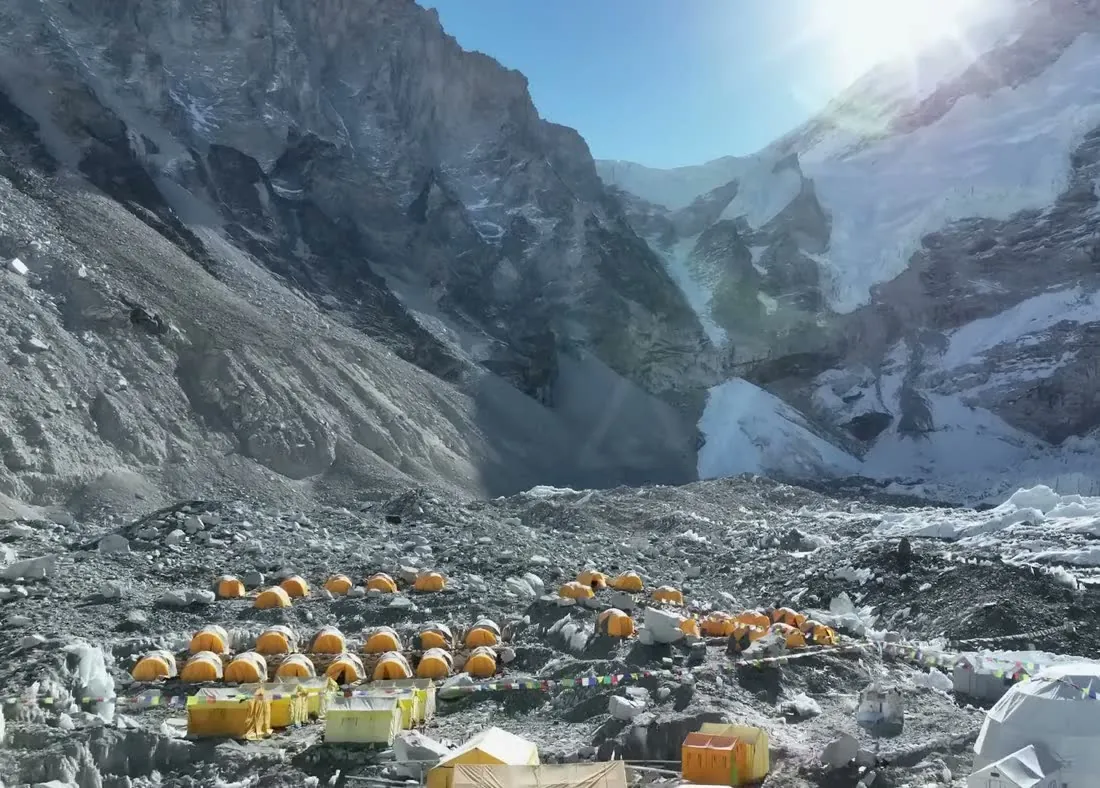
Expedition tents at Everest Base Camp on the Nepal side, with the Khumbu Icefall at the right. Screen from Climbing the Seven Summits' video.
| Charge | Amount | Where it comes from |
|---|---|---|
| Nepal climbing fee, spring | $15,000 per person | Government figure (Department of Tourism) |
| Garbage deposit | $4,000, may be returned | Government figure (Department of Tourism) |
| Nepal agency fee | $3,500 per team | Survey only |
| Liaison officer (a government official who stays with the team) | $5,000 per team | Survey only. The Department of Tourism fee page doesn't list it. |
| Icefall Doctors (the team that fixes the route through the Khumbu Icefall) | $2,500 per team or $600 per climber | Survey only |
| Fixed ropes above the Icefall | $200 per climber | Survey only |
| Base camp medical clinic, puja ceremony, weather forecast | $100, $300, and $0 to $1,000 | Survey only |
| Required Sherpa guide | At least $5,000 added to the lowest costs | Survey only |
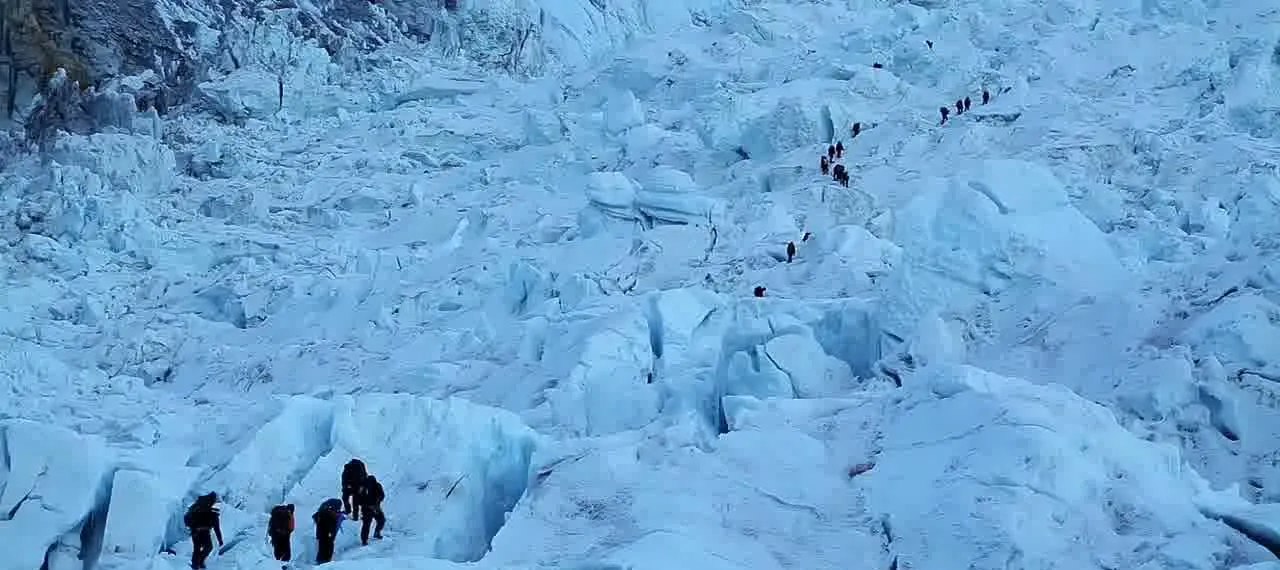
Climbers walking up through the Khumbu Icefall, the section where the Icefall Doctors fix the route. Screen from Climbing the Seven Summits' video.
Keep in mind that a director of one Nepali company, quoted in that survey, said the royalty and tax increases raised the total cost by $5,000 to $6,000 per climber. That is one company's statement.
What do climbing companies charge for Everest?
Now here are six companies' own prices for 2027, from each company's page, checked October 16, 2026. Furtenbach's page doesn't show a season year. These are "from" prices and they change. A company price is for one person, in US dollars unless it says euros. Furtenbach lists its prices in euros, so they stay in euros here.
| Company and version | Price | Length | What the company's page says |
|---|---|---|---|
| Wild Yak Expeditions, a Nepal-based company | From $59,500 | 54 days | Groups of 4 to 6. The listing page doesn't say what is included or left out, so ask for the written list. |
| Climbing the Seven Summits, Sherpa Supported | From $62,995 | 58 days | A Sherpa joins the climber only above Camp 2. The page asks for extensive high-altitude experience. |
| Climbing the Seven Summits, Western Guided Team | $79,995 | 58 days | The same page lists a private international guide version at $134,995. Speed ascents add $10,000 to $14,000. |
| Alpine Ascents, South Col | $80,000 | About 7 weeks | Priced for a team of five. Full oxygen and one Sherpa per climber on summit day are in the price. Everest plus Lhotse is $97,000. |
| Adventure Consultants | $83,000 | 52 days | One international guide per four climbers and one Sherpa per climber on summit day. The Fast Track version is $95,000 for 30 days. |
| Mountain Madness, South Col | $86,500 | 57 days | One Sherpa per climber. The page lists oxygen, permits and guides as included. Its "does not include" list was collapsed on the page. |
| Furtenbach Adventures, Classic (north or south side) | EUR 77,400 | 42 days | Eight oxygen bottles and one climbing Sherpa per member. Flash versions run EUR 105,900 for 21 days and EUR 149,900 for 14 days. The page lists no exclusions. |
Alpenglow Expeditions has a Tibet-side Everest trip for 2027, and its public page doesn't list a price.
Basically, the Western companies' published prices sit between about $63,000 and $87,000 for the regular versions. Furtenbach's Classic is the one listed in euros.
What do cheaper Nepali companies charge?
Wild Yak is the only Nepali company in the table above with a published price, so the cheaper end comes from the survey. These are survey only. Alan Arnette collected operator prices and reported these middle values for 2026 on the Nepal side.
- Nepali guide service: $45,250.
- International company with a Sherpa guide: $54,000.
- International company with an international guide: $76,000.
The same survey says Sherpa-supported Nepali companies run roughly $30,000 to $55,000, with the lowest price seen in 2025 about $30,000. It also gives minimums for climbers who organize more themselves. That's about $41,000 for one person with no oxygen and no support, and about $49,000 with Sherpa support. Both minimums include permits and insurance.
And at the top, the survey says luxury and private versions run $120,000 to $300,000 or more. The $300,000 figure for one company's top package is the survey's estimate, not that company's price.
How do I compare one Everest quote with another?
Now a lower price isn't automatically worse, and a higher price isn't automatically better. A cheaper quote just may include less. So ask each company for a written, itemized quote, and compare these things line by line.
- Oxygen. How many bottles are in the price, and what does an extra bottle cost? Furtenbach Classic lists eight bottles. Climbing the Seven Summits says oxygen beyond the included amount costs extra. Alpine Ascents says full oxygen is included. The survey puts a bottle at about $650, survey only.
- Sherpa support. How many Sherpas per climber, and how high do they climb with you? Climbing the Seven Summits' Sherpa Supported version has a Sherpa only above Camp 2.
- Guides. Is there an international guide, and how many climbers does each guide lead?
- What the price leaves out. Ask for the list in writing.
- Payment and refund terms. See the next section.
- What happens if the route is closed. Ask what happens to your money.
When do I have to pay, and can I get a refund?
So the money comes due long before you leave. These are two companies' published terms for 2027, checked October 16, 2026.
- Adventure Consultants: a $15,000 deposit that can't be refunded, then the $68,000 balance in two payments of $34,000. Both payments fall on fixed dates in the trip notes, months before the April 2027 start. If you cancel before the second payment date, the company refunds half of the first $34,000 payment. After the second payment date, it refunds nothing.
- Mountain Madness: a $5,000 deposit that can't be refunded, then $45,000, also not refundable, due 180 days before the trip. The rest of the price is due 120 days before the trip.
Keep in mind these are two companies. Read the terms of the company you pick.
What does the Everest trip fee not cover?
Basically, the trip fee covers the mountain. It doesn't cover getting there, your own equipment or your safety net at home. Adventure Consultants and Climbing the Seven Summits list most of the following as not included. Alpine Ascents' page lists no exclusions.
- International flights. Adventure Consultants and Climbing the Seven Summits list them as not included.
- Kathmandu hotel and meals. Adventure Consultants lists them as not included.
- Nepal visa. Adventure Consultants lists visas as not included. The survey puts the 90-day visa at $125.
- Personal clothing and climbing gear. Adventure Consultants and Climbing the Seven Summits both list personal gear as not included.
- Insurance. Adventure Consultants and Climbing the Seven Summits both require your own insurance that includes rescue.
- Tips. Adventure Consultants and Climbing the Seven Summits both list gratuities as not included.
- Extra oxygen and phone calls. Climbing the Seven Summits charges for oxygen beyond the included amount. Adventure Consultants charges $3.00 a minute for phone calls and includes Wi-Fi.
What do the extras actually cost?
Now these are survey only, from Alan Arnette's 2026 estimates, except where I say otherwise. The categories come from the company pages above. The dollar amounts come from the survey.
| Extra cost | Estimate (survey only) | What to know |
|---|---|---|
| Flights and travel | $2,725 to $8,625 | That range is my sum of the survey's travel items. A flight to Kathmandu runs $1,500 to $7,000. The Kathmandu to Lukla flight is near $500 round trip, unless your company flies you by helicopter. A Kathmandu hotel and food run $400 to $800, the visa is $125 and immunizations are about $200. |
| Personal climbing gear | At least about $21,000 from scratch | That figure assumes you own none of it. It includes mountaineering boots near $1,200, a down suit at $2,000 or more and a sleeping bag rated to minus 20 Fahrenheit at $1,000 or more. Someone who already owns mountaineering gear pays much less. |
| Extra oxygen | About $650 per bottle | The survey also prices a personal Sherpa on a lower flow rate at $4,000 to $10,000 more. |
| Insurance with rescue | About $500 up to $3,000 or more | The survey also lists comprehensive policies with rescue, medical and trip cancellation at $3,000 to $15,000. Private helicopter evacuation from the south side is quoted at $5,000 to $20,000. |
| Tips | At least 10% of the trip fee | The survey says some companies suggest 15% to 20%. Tips for individual Sherpas, cooks and staff run $600 to $4,500 or more. |
| Own satellite phone | $1,000 to $3,000 | Optional if your company's per-minute calls are enough for you. |
One thing to read carefully is the insurance policy itself. Check its wording for the altitude limit and for helicopter evacuation, and confirm both with the insurer in writing.
What does the whole Everest trip cost, added up?
So here is a worked example. It is my arithmetic from the figures above, not a quote from anyone. Change any line to match your own situation.
| Line | Low example | High example |
|---|---|---|
| Trip fee | $45,000 | $85,000 |
| Flights and travel | $2,725 | $8,625 |
| Insurance with rescue | $500 | $3,000 |
| Tips at 10% of the trip fee | $4,500 | $8,500 |
| Personal gear | $0 (already owned) | $21,000 (from scratch) |
| Total | $52,725 | $126,125 |
That total leaves out extra oxygen, upgrades, the lost income from about two months away, and the cost of the climbs that come before Everest. Fast versions and private guides cost more than the high example.
What experience do Everest companies ask for?
Now the companies ask for climbing experience before they take your money. These are the companies' own statements, checked October 16, 2026.
- Adventure Consultants: at least five seasons in the mountains, with ascents up to 5,500 to 6,000 meters. Its trip notes name Denali, Aconcagua and Mexican volcanoes as common training climbs, and they ask for crevasse rescue and glacier skills. The notes say age is no barrier, and members aged 20 to 66 have summited with the company.
- Alpine Ascents: previous high-altitude climbs and strong mountaineering skills. Its page names Denali, Aconcagua, Cho Oyu and Vinson as good preparation.
- Climbing the Seven Summits: it varies by version. Sherpa Supported asks for extensive high-altitude experience, ideally earlier 8,000 meter climbs. Western Guided recommends earlier high-altitude experience.
- Alpenglow Expeditions: it recommends at least one earlier attempt on an 8,000 meter peak, or extensive experience on many high-altitude, expedition-style peaks.
Wild Yak's listing page doesn't state experience requirements, so ask before you pay.
Does Nepal require a 7,000 meter peak before Everest?
No. As of October 16, 2026, that rule is a proposal in a bill, and it is not law. The bill is Nepal's Integrated Tourism Bill. A July 22, 2026 report from the Asia News Network, which carries Kathmandu Post stories, says the bill entered a parliamentary committee, where 58 lawmakers filed 263 amendments. The bill still has to return to Parliament for final debate and a vote.
Several lawmakers proposed different versions of an experience rule. One proposal asks for proof of one climb above 7,000 meters in Nepal before an Everest permit. Others ask for more, including climbs above 8,000 meters. No report after July 22, 2026 says the bill passed. One travel company's site says the rule already applies, and the parliamentary report doesn't support that.
So the companies' own experience requirements above are what you can plan around today. China is a separate case. Alan Arnette reported on January 28, 2026 that China announced a 7,000 meter rule for 2026 and that it was unclear whether it was enforced.
What does the Tibet side cost?
Companies price the north side in a similar range. Furtenbach's Classic is the same EUR 77,400 on the north or south side. The survey's 2026 middle values for Tibet are $47,000 for Nepali companies and $90,800 for international guides, survey only.
The survey also says China's permit costs $15,800 to $18,000 per person for teams of four or more, including transport, hotels and a liaison officer. That is survey only.
Access from Tibet can change with little notice. One Nepali news outlet, Himal Press, reported on May 11, 2026 that China closed the north side for spring 2026. Alan Arnette wrote in January 2026 that operations had returned to normal. No second outlet reported the closure, so treat it as unconfirmed. Either way, ask a north-side company what happens to your money if the route closes.
How long does an Everest trip take?
Basically, plan on about seven to eight weeks. The companies above list 52 days (Adventure Consultants), 54 days (Wild Yak), 57 days (Mountain Madness), 58 days (Climbing the Seven Summits) and about 7 weeks (Alpine Ascents). Furtenbach Classic is 42 days.
Shorter versions exist. Furtenbach's Flash versions run 14 and 21 days, and Adventure Consultants' Fast Track runs 30 days. Fast versions need weeks of sleeping in an altitude tent at home before the trip. Furtenbach Classic asks for 4 weeks of home tent use, and Climbing the Seven Summits asks for up to 8 weeks for its speed ascents. Altitude affects people differently, and my altitude sickness guide covers the warning signs and when to go down.
Videos from a company that guides Everest
If you want to see what the trip fee pays for, here are three videos from Climbing the Seven Summits, one of the companies above. You can play each one on this page, and YouTube's usual controls work. Each is the company's own video, so it shows its own trips and not a neutral review.
A company walk-through of its base camp, from the dining dome to the sleeping tents.
- Dining and comfort: The presenter shows a heated lounge dome, a cook and a coffee bar.
- Sleeping: The video shows several kinds of sleeping tent, from the company's standard included tent up to private upgrades.
- Why they do it: The company says rest and good food are part of how it tries to help climbers succeed.
- Worth knowing: This is the company's own promotion. Other companies set up camp differently, so ask each one in writing what its quote includes.
A guide films a climb through the Khumbu Icefall, the first dangerous stretch above base camp.
- The route: The guide says the Icefall Doctors, climbing Sherpa, fix the lines and bridge the crevasses.
- Timing: The team leaves well before sunrise, because the glacier is more stable while it is frozen.
- Danger: The guide calls the icefall a river of falling ice and says ice that falls from high above is the main danger.
- Worth knowing: The video is from 2020, and the guide describes what that team saw on that day.
A guide from the company explains why oxygen gear matters on summit day.
- Practice: The guide says the teams train with their masks at base camp so troubleshooting becomes second nature.
- Cold: Valves can freeze and ice can form on the mask in the extreme cold.
- Backup: The company says it keeps spare masks, regulators and extra bottles close at hand on summit day.
- Worth knowing: The video gives no prices, and the page above is where the oxygen costs are.
What should I do next?
So the companies above want years of mountain experience before they accept you. The cheapest way to learn what high altitude is like for you is a smaller trip first. My guide to Kilimanjaro vs Everest Base Camp compares those two trips. And my altitude sickness guide covers the warning signs, and when to go down.
My take
So ultimately, plan on about $53,000 to $126,000 all in for a guided Everest climb from Nepal in spring. And ask every company for an itemized written quote before you compare prices. The government's $15,000 fee is fixed, so the price differences between companies come from oxygen, Sherpa support, guides and what the quote leaves out.
That budget is my reading of the figures above, and the choice of company is yours. If the number is more than you can spend, a smaller trip first costs far less and tells you a lot.
Have a question about “What does it cost to climb Everest in 2026, and where does the money go?”?
Ask it here. Every question comes to me first. I answer as many as I can, and each answered question goes on this page with my answer so other hikers and climbers can see it too. I don't ask for your email, so check back on this page for the answer.
More big trips guides
- Nepal Department of Tourism, mountaineering fee page, checked October 16, 2026: Everest fee by season, effective September 1, 2025, and the $4,000 garbage deposit.
- Kathmandu Post, Nepal hikes Everest climbing fee to $15,000, January 21, 2025, checked October 16, 2026: the earlier $11,000 spring fee.
- Alan Arnette, How Much Does It Cost To Climb Everest? 2026 Edition (early February 2026), checked October 16, 2026: every figure marked "survey only." Also Arnette's September 3, 2025 post on the fee increase and Arnette's January 28, 2026 post on China's 7,000 meter rule.
- Company pages, checked October 16, 2026: Wild Yak Expeditions, Climbing the Seven Summits, Alpine Ascents, Adventure Consultants 2027 trip notes and Everest page (Fast Track price), Mountain Madness, Furtenbach Adventures and Alpenglow Expeditions.
- Asia News Network, report of July 22, 2026 on Nepal's Integrated Tourism Bill, read October 16, 2026.
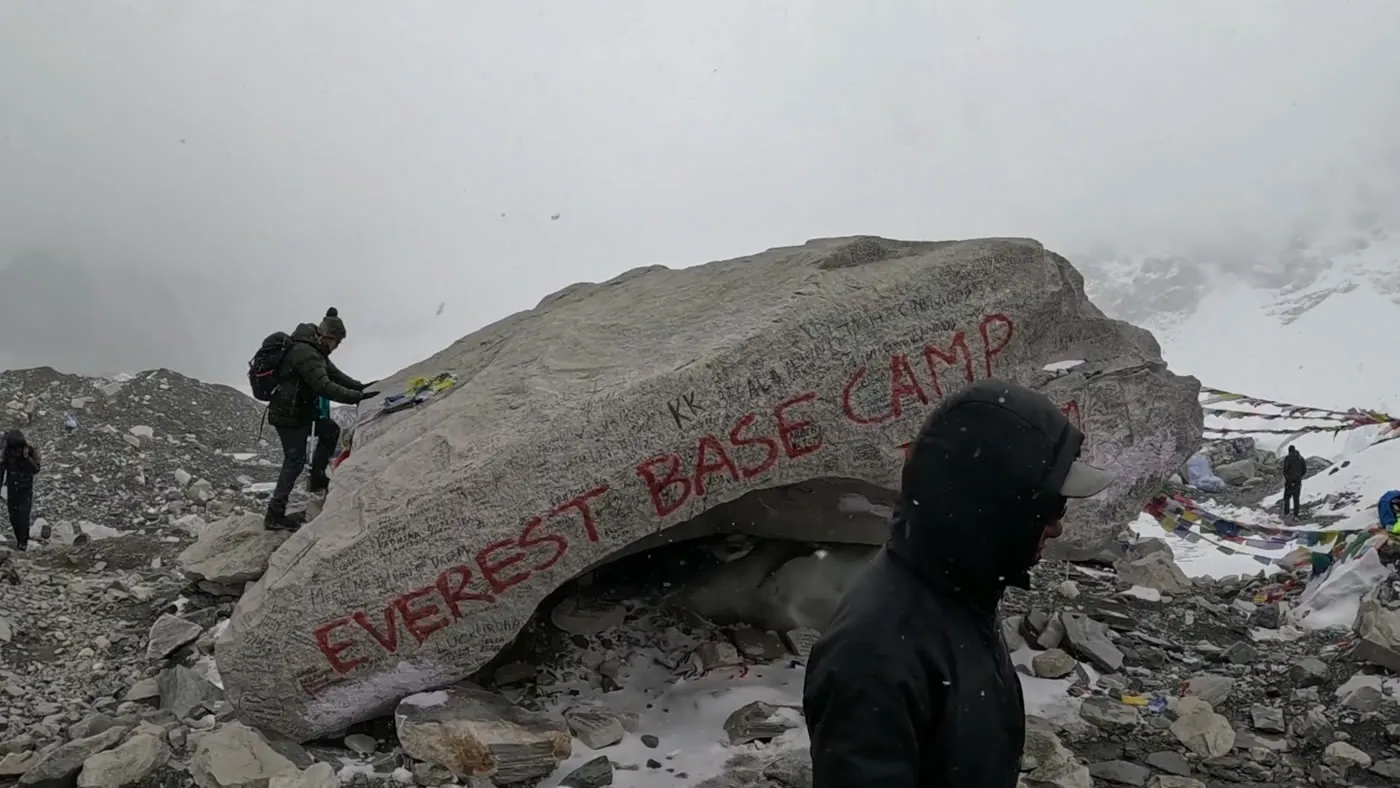
- Climbing the Seven Summits on YouTube, checked October 17, 2026: A Tour of Everest Base Camp (August 2023), Route Breakdown, Stage 2: Khumbu Icefall (June 2020) and Using Oxygen on Everest (July 2020). The two photos on this page are screens from the first two.
- Himal Press, Everest set for record season with 492 permits issued, May 11, 2026, checked October 16, 2026: the single-source report on the north side closure.
Everest Buddy is an independent site. No gear maker, store or guide company paid to be on this page. This guide gives general information, not medical advice, so see a doctor before you start a new training plan or travel to high altitude.