
This page is for you if you've done a first walk or two and are about to buy your first real hiking footwear. If you haven't started yet, my guide to starting mountaineering from zero covers the steps before this one.
Quick picks
Can you hike in running shoes or sneakers?
Yes, for your first short, easy hikes. So if you already own a pair of running shoes, wear them on your one mile and five mile walks and save your money. That is common guidance from gear experts, not a rule. REI is a big outdoor store. A gear expert on its video channel says that when someone asks about hiking in trail runner shoes, "the answer is absolutely." Keep in mind that is a store's opinion, from a video made in 2018.
Now there is one thing to keep in mind. The Appalachian Mountain Club is a hiking group in the northeastern US. Its footwear article says trail runners can bruise your foot on sharp rock such as scree and talus. Scree is loose small rock on a slope. Talus is a pile of larger broken rock. So if your first hikes cross a lot of loose rock, a shoe with a firmer sole is worth thinking about. You can read the group's article here: Appalachian Mountain Club on boots vs trail runners.
What is the difference between a hiking boot, a hiking shoe and a trail runner?
- Trail runner: A shoe built like a running shoe, with a grippy sole for dirt and rock. It is the lightest and gives the least support of the three, according to OutdoorGearLab, a gear review site.
- Hiking shoe: A low shoe, like a sneaker, with a stiffer sole than a trail runner. OutdoorGearLab says hiking shoes lack the high cuff of a boot but are usually lighter and more breathable than boots, and can have similar waterproofing and grip.
- Hiking boot: A shoe that comes up over your ankle. The cuff is the part around the ankle. OutdoorGearLab says the higher cuff adds ankle stability. Boots are also the heaviest of the three.
Keep in mind the lines between the three kinds are blurry. HikingGuy.com, a YouTube reviewer, says a hiking shoe and a trail runner can be hard to tell apart, and that trail runners differ a lot from each other.
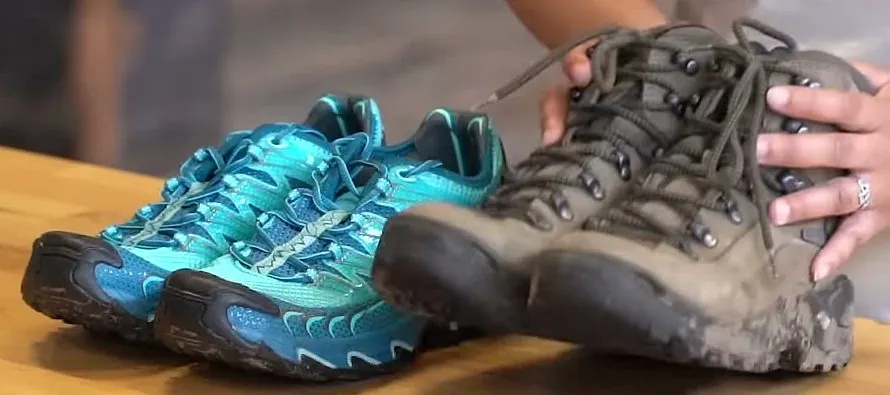
A pair of trail runners next to a leather hiking boot, so you can see the difference in height and sole thickness. Screen from REI's video.
Why are trail runners the best first upgrade?
Basically, a trail runner gives you better grip than a road running shoe, it weighs less than a boot, and it breathes well. Now here is how each of those plays out.
- Weight: HikingGuy.com says a typical pair of hiking shoes weighs just under 2 pounds, and the pair of trail runners he compared weighs just over 1 pound. His on-screen labels show about 1 pound 15 ounces against about 1 pound 5 ounces.
- Feel: He says a trail runner fits like a sock and lets your foot spread out as you step. He says a hiking shoe feels more like a cast. That is his opinion after hiking 100 miles in the hiking shoes.
- Breathing and drying: Tom's Outdoors Gear Guide, a YouTube gear channel, says trail runners that aren't waterproof can dry in about 30 minutes in hot weather.
- Testing: OutdoorGearLab says it has tested over 300 pairs of trail running shoes, at least 60 miles each. The three trail runners in the picks table below all come from that test.
Now trail runners do have downsides, and I'd rather you hear them before you buy.
- They wear out faster: HikingGuy.com estimates a trail runner lasts about 300 to 500 miles and a hiking shoe about twice that. That is one reviewer's estimate, not a test.
- They protect less: The REI expert says trail runners give less support than boots. HikingGuy.com says hiking shoes win on rocky, off-trail ground where you want more grip and protection.
- They need little break-in: Break-in means wearing new shoes until they feel comfortable, and trail runners usually need little of it. That is good news. Even so, OutdoorGearLab says to try new footwear on short hikes before a long one.
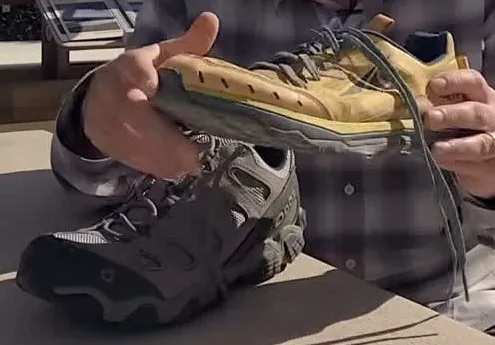
A light trail runner held above a hiking shoe with a stiffer sole, from the weight comparison. Screen from HikingGuy.com's video.
When are hiking shoes or hiking boots worth the extra money?
So I'd step up from trail runners when one or more of these is true. This list is my opinion, and each point names the source behind it.
- Your pack gets heavy. The REI expert says to go with a hiking boot for a heavy pack of 40 to 50 pounds when you are going far and high. And the same expert says to go with a trail runner when you want to go light and fast with little weight on your back.
- The ground is rough, loose or steep. Tom's Outdoors Gear Guide says boots grip better than trail runners on steep ground with a heavy load. The Appalachian Mountain Club recommends boots for rough or uneven trails and heavier packs.
- The weather is wet and cold. A waterproof boot keeps your feet drier. I cover that in the next section.
- You want more ankle support. The Appalachian Mountain Club says boots give the most ankle support. It says trail runners are reasonable on gentle to moderate ground with a light pack and strong, injury-free ankles.
And if you've hurt an ankle before, my suggestion is to ask a doctor or physical therapist what footwear makes sense for you. Keep in mind the sources disagree on whether boots prevent a twisted ankle, and no medical body has settled the question.
Something to note is that a hiking shoe sits in the middle. So if you want a firmer sole than a trail runner without the weight of a boot, a hiking shoe is the middle ground.
Should your hiking shoes be waterproof?
It depends on where you hike. Waterproof shoes use a thin lining called a membrane, and Gore-Tex is a well-known one. OutdoorGearLab says waterproof membranes breathe less, and that non-waterproof shoes suit dry or hot places. The Appalachian Mountain Club says the membrane keeps water out "at the expense of ventilation."
- Wet, cold, muddy or snowy trails: A waterproof shoe or boot is the better pick.
- Hot, dry trails, or trails with many stream crossings: A shoe that isn't waterproof dries faster and breathes better.
- Water over the top: Tom's Outdoors Gear Guide says that once water gets in over the top of a waterproof boot, the boot can take days to dry. A trail runner that isn't waterproof can dry in about 30 minutes in hot weather.
- Low shoes and mud: The Appalachian Mountain Club says low-cut shoes leave your ankles open to mud and that gaiters help. A gaiter is a cloth cover that goes over the top of your shoe and around your lower leg.
How should hiking shoes fit?
Basically, fit matters more than the type. OutdoorGearLab gives these steps for trying on a pair.
- Wear the socks you will hike in when you try on shoes.
- Leave some room at the toes, because your feet swell and steep downhills push your toes forward.
- Point your toes, climb stairs and walk on an unstable surface to see how the shoe behaves.
- Buy a few sizes from a store with good returns and send back the ones that don't fit.
Sizing differs by maker. Hoka's product pages for the Speedgoat 7 and the Kaha 3 GTX say to go up a half size from your usual. And Merrell's page offers a 30 day return on shoes that are unworn, unwashed and unaltered, but a banner on the page says some sizes and colors can't be returned. So check the return policy at checkout before you pay.
Break-in means wearing new footwear until it feels comfortable. OutdoorGearLab says light, soft boots need little, leather boots take longer, and midweight boots vary. Its tester said the Merrell Moab 3 Mid was ready after about 10 miles. My guide to stopping heel blisters covers socks, lacing and heel slip.
Which exact shoes should you buy?
So here are budget and step-up picks in each kind. Prices were checked October 16, 2026. Where a price says "check the maker's page," confirm that price on the maker's page before you buy. The test notes are from OutdoorGearLab, which updated its trail runner guide April 22, 2026, its hiking shoe guide May 6, 2026 and its hiking boot guide June 3, 2026. Weights are per shoe unless the table says per pair.
| Pick | Good for | Price, checked Oct 16, 2026 | Weight and key facts | What testers said |
|---|---|---|---|---|
| Budget trail runner: Hoka Torrent 5 (this link opens Hoka's Torrent page, not a page for the Torrent 5 alone), which replaces the Hoka Torrent 4 | First upgrade from running shoes, on dry or mixed trails | $130 for the Torrent 5, check the maker's page. The Torrent 4 listed at $175 and is sold out on Hoka's US site. | Torrent 4: 9.8 oz per Hoka, 9.4 oz measured by OutdoorGearLab (men's 10.5). 5 mm drop, which is the height difference between heel and toe. Regular width only. The Torrent 5 weight isn't confirmed on the maker's page. | OutdoorGearLab named the Torrent 4 Best Value, but called it average on tricky terrain. OutdoorGearLab's test covers the Torrent 4, not the Torrent 5, so compare the two before you buy. |
| Step-up trail runner: Hoka Speedgoat 7 | Rougher trails, more grip and cushion | $165, check the maker's page | 9.7 oz per Hoka, 9.98 oz measured (men's 10.5). Sticky rubber sole with 5 mm lugs, which are the bumps on the sole. 5 mm drop. Regular and wide widths. | Both OutdoorGearLab's hiking and trail running teams liked it, and the site recommends it for hiking. It named the Speedgoat 7 Women's Best Overall. The tongue is minimal. |
| Wide toe box trail runner: Altra Lone Peak 9 | Wide feet, long trail days | $145, from Altra's own page | 11.15 oz (316 g) per Altra. Zero drop, which means the heel and toe sit at the same height. Roomy toe box, which is the front of the shoe where your toes sit. | OutdoorGearLab named it Best for Wide Feet and recommends it to thru-hikers, meaning people who hike a whole long trail end to end. It says the shoe has less protection overall, and zero drop takes a training period to get used to. |
| Budget hiking shoe: Columbia Crestwood (not waterproof). A waterproof Crestwood also exists. | Easy to moderate day hikes | $80, from Columbia's own page, in stock on October 16, 2026. The waterproof version is $90, check the maker's page. | 1.83 lb per pair, men's size 11, per OutdoorGearLab. The waterproof version is about 12.6 oz per shoe. | OutdoorGearLab named it Best Buy under $100 among hiking shoes. |
| Step-up hiking shoe: Salomon X Ultra 5 GTX. A taller mid version also exists. | All-round waterproof shoe for bigger days | $175, from Salomon's own page. The mid version is $190, also from Salomon's page. | About 13 oz per shoe per Salomon. Gore-Tex waterproof lining. The mid version weighs 16 oz. | OutdoorGearLab named it Most Versatile, at 2.1 lb per pair in men's size 14. |
| Budget hiking boot: Merrell Moab 3 Mid Waterproof | Heavier packs and rough trails, with a waterproof boot | $175, from Merrell's own page, in stock on October 16, 2026 | 495 g (1 lb 1.45 oz) per boot per Merrell. The wide version is a separate product. | OutdoorGearLab named it Best Value boot. It scored comfort 8, support 7 and traction 6 for men's. Cons: poor mud traction, lacing durability and "heavy and bulky." |
| Step-up hiking boot: Hoka Kaha 3 GTX | Long days with a cushioned, supportive boot | $240, check the maker's page | Hoka's pages list about 18 to 20 oz per boot, so confirm the weight on the page. OutdoorGearLab weighed 3 lb per pair (men's 14). Gore-Tex lining. | OutdoorGearLab named it Best Overall for men, scoring comfort 9, support 9 and traction 8. Cons: a minor break-in period, the price, and it may be too much boot for day hikes. |
| For very heavy loads: Salomon Quest 5 Gore-Tex. REI also sells the men's Salomon Quest 5 Gore-Tex. | Very rough ground with a heavy pack | $240 at REI, in stock on October 16, 2026. OutdoorGearLab lists the same price. | 3.15 lb per pair per OutdoorGearLab. | OutdoorGearLab named it Best Support. |
The full test notes are in OutdoorGearLab's trail running shoe guide, hiking shoe guide and hiking boot guide.
For me personally, if it fits your budget, I'd start with a trail runner from the top of the table. And I'd move up to a waterproof boot like the Moab 3 Mid once you're carrying a heavy pack on rough ground. That is my take, not a test result.
When do you need mountaineering boots?
Only when you walk on snow and ice with crampons, which is later on this path. Mountaineering boots are stiff boots made to take crampons. Boots are rated from B0, which is flexible, to B3, which is the stiffest. Crampons are rated C1 to C3 the same way. Each boot rating only works with certain crampon ratings.
For example, Scarpa's crampon guide says its B0 boots don't take crampons at all. It says its B1 boots only take C1 crampons, B2 boots take C1 or C2, and B3 boots take C2 or C3. Scarpa is a boot maker.
Keep in mind that other guides disagree on a few pairings, such as a B1 boot with a C2 crampon. So check the compatibility notes from the maker of your boot and the maker of your crampons before you buy either. And note that OutdoorGearLab's mountaineering boot guide was last updated March 13, 2023, so its prices are out of date.
Videos worth watching about boots vs trail runners
And if you want to see the shoes, here are three videos. You can play each one on this page, and YouTube's usual controls work, including skipping ahead, changing the speed and going full screen. Under each video is a short summary so you can decide if it's worth your time.
A short rundown from a store gear expert on what each kind of footwear does well.
- Boots: The REI expert says boots are more durable and stable, but they need a break-in period and weigh more.
- Trail runners: The expert says trail runners are lighter and breathe better, but they wear out sooner and give less support.
- How to choose: Boots for heavy packs of 40 to 50 pounds, going far and high. Trail runners for going light and fast. The expert adds that having both is best if you can.
- Worth knowing: The video is from 2018 and comes from a store that sells both kinds, so use it for the idea and not for prices.
A hiker compares a hiking shoe with a trail runner after wearing the hiking shoe for 100 miles.
- Weight: He shows the hiking shoe at just under 2 pounds per pair and the trail runner at just over 1 pound.
- Lifespan: He estimates 300 to 500 miles for a trail runner and about double for a hiking shoe, which is his estimate, not a test.
- Feel: He says the trail runner fits like a sock and the hiking shoe feels like a cast, but the hiking shoe wins on rocky, off-trail ground.
- Worth knowing: The two shoes in the video are older models than the ones in the table above, so treat his picks as his opinion.
A gear channel host goes through weight, durability, water and breathability, using a pair of boots and a pair of trail runners.
- Boots win on: Durability, grip on steep ground with a heavy load, and waterproofing.
- Trail runners win on: Weight and breathability. The host says ones that aren't waterproof dry in about 30 minutes in hot weather.
- Water: The host says once water gets in over the top of a waterproof boot, the boot can take days to dry.
- Worth knowing: The boots and trail runners in the video are older models than the ones in the table above.
What's next after you pick your footwear?
- Wear your new shoes on short hikes first, and walk your usual routes until they feel right.
- Read my guide to layering for a mountain, which is the next step in gear.
- Read my guide to stopping heel blisters for socks, lacing and heel slip.
- As your hikes get longer and higher, my guide to building up to big elevation days shows how distance and pack weight grow together.
My take
So ultimately, wear your running shoes for your first short, easy hikes. Then buy a trail runner as your first upgrade, such as the Hoka Torrent 5 at $130 or the Hoka Speedgoat 7 at $165, both checked October 16, 2026. Confirm both prices on Hoka's page before you buy.
But I'd move to a hiking shoe or a waterproof boot when your pack gets heavy, the ground gets rough, or the weather turns wet and cold. And if you're ever unsure, try a few pairs from a store with good returns, because the right fit matters more than the type.
Have a question about “Hiking boots vs hiking shoes vs trail runners: what to wear on a first hike, and when to upgrade”?
Ask it here. Every question comes to me first. I answer as many as I can, and each answered question goes on this page with my answer so other hikers and climbers can see it too. I don't ask for your email, so check back on this page for the answer.
More gear guides
- OutdoorGearLab, checked October 16, 2026: best trail running shoes (updated April 22, 2026), best hiking shoes (updated May 6, 2026), best hiking boots (updated June 3, 2026) and best mountaineering boots (updated March 13, 2023).
- Appalachian Mountain Club, checked October 16, 2026: Hiking boots vs trail runners. The article has no date.
- Maker pages, checked October 16, 2026: Hoka Torrent 5, Hoka Torrent 4, Hoka Speedgoat 7, Hoka Kaha 3 GTX, Altra Lone Peak 9, Columbia Crestwood, Columbia Crestwood Waterproof, Salomon X Ultra 5 GTX, Salomon X Ultra 5 Mid GTX and Merrell Moab 3 Mid Waterproof, Salomon Quest 5 Gore-Tex, and REI's Salomon Quest 5 Gore-Tex listing.
- Scarpa's crampon guide, checked October 16, 2026, for boot and crampon ratings.
- Videos, checked October 16, 2026: REI (September 2018), HikingGuy.com (May 2022) and Tom's Outdoors Gear Guide (December 2022).
Everest Buddy is an independent site. No gear maker, store or guide company paid to be on this page. This guide gives general information, not medical advice, so see a doctor before you start a new training plan or travel to high altitude.