
Not medical advice. This guide gives general information. If you have a health condition, or symptoms that worry you, see a doctor before you hike or climb.
Now this page is for you if you've started hiking, your knees ache on the way down, and you want to know what's normal and what helps. If you're brand new, start with my guide to starting mountaineering from zero. This page can't tell you what is wrong with your knee. Only a doctor or physical therapist can do that.
- A knee that is very painful.
- A knee you can't move or put any weight on.
- A badly swollen knee, or a knee that has changed shape.
- A knee that locks, gives way or clicks painfully. The NHS says painless clicking is normal.
- A very high temperature, or feeling hot, cold or shivery, with redness or heat around the knee. The NHS says this can be a sign of infection.
Quick picks
How to read the labels on this page
So I mark where each statement comes from. A medical source is a medical group, a government health service or a medical journal, and I link it. A study is research published in a journal, and I give its size. Opinion is advice from a physical therapist, trainer, guide or gear tester, or my own view. Opinion can be useful, but nobody has proven it. Keep in mind that none of this replaces a visit to your doctor.
Why do my knees hurt going downhill?
Here is the honest answer. Medical groups like the AAOS and the NHS don't say plainly that walking downhill does a particular thing to your knee. What I can say is that it's common experience. Lots of hikers feel their knees on the way down and not on the way up.
Basically, the common explanation is about your thigh muscles. Physical therapy clinic blogs, like Backcountry Physio and Trail Hiking Australia, say your thigh muscles act like brakes going downhill. They stretch out while they hold your body back with every step. That is opinion from clinic and trekking company blogs, and it hasn't been through a medical review.
The medical groups say more about two other things.
- Doing too much, too soon. The AAOS page on kneecap pain and its page on IT band syndrome both name sudden increases in training as a cause. For hiking, that means jumping from short hikes to long ones. My guide to building up from short hikes to big elevation days shows a way to build up slowly.
- Weak or uneven thigh and hip muscles. Both AAOS pages list weak hip muscles as a cause, and the kneecap pain page adds weak thigh muscles.
What knee problems do hikers hear about?
Two names come up a lot. I'm giving them so you can ask your doctor about them, not so you can decide you have one.
- Pain at the front of the knee, around the kneecap. The medical name is patellofemoral pain syndrome, and people also call it runner's knee. The AAOS says it's common in people who play sports, and it happens in people who don't play sports too. It lists a dull, aching pain that comes with activity, and pain on stairs, when squatting, and after sitting a long time with the knee bent. AAOS says that in most cases it can be treated without surgery.
- Pain on the outside of the knee. The medical name is iliotibial band syndrome, or IT band syndrome. The AAOS calls it an overuse injury, from rubbing between the IT band and the outside of the knee. It says most cases are managed without surgery, and most people recover within about 6 weeks with that care. MedlinePlus, the US National Library of Medicine's health site, lists running downhill as something that can make IT band pain worse. That page is written about running, not hiking.
Now there are other causes too. The NHS lists sprains and strains, tendon pain, a torn ligament or meniscus, arthritis, bursitis and others. The NHS says, "do not self-diagnose" and see a doctor if you're worried. A meniscus is the cushion inside the knee. So if you already have arthritis, a past meniscus tear or a knee replacement, ask your doctor before you plan a big descent. This page doesn't give advice for those cases.
How should I walk downhill to protect my knees?
Now none of these tips comes from a medical group. They are common advice from physical therapists, guides and trainers, so treat them as opinion. Here are the steps, in the order I'd try them.
- Take shorter steps and keep your knees slightly bent. The Map Reading Company, a UK navigation school, says bent knees let your thighs and buttocks absorb each landing. It says to "bounce" down instead of stamping.
- Land with your foot flat or on your heel, then roll forward. The Map Reading Company's video says never to land on the front of your boot. It says to step down, not slide down.
- Bend at the ankles, knees and hips, and don't lean back. The trainer at WILDR Online Fitness Training says to bend all three joints, not only the knees.
- Zigzag down steep sections, and face the way you're walking. The Map Reading Company says to switch back and forth across a steep bit with your whole boot on the slope. It says not to walk sideways down, because that puts the load on one ankle.
- Slow down and rest when your legs are tired. That is plain common sense. No medical source gives a rule for it.
Do trekking poles help sore knees going downhill?
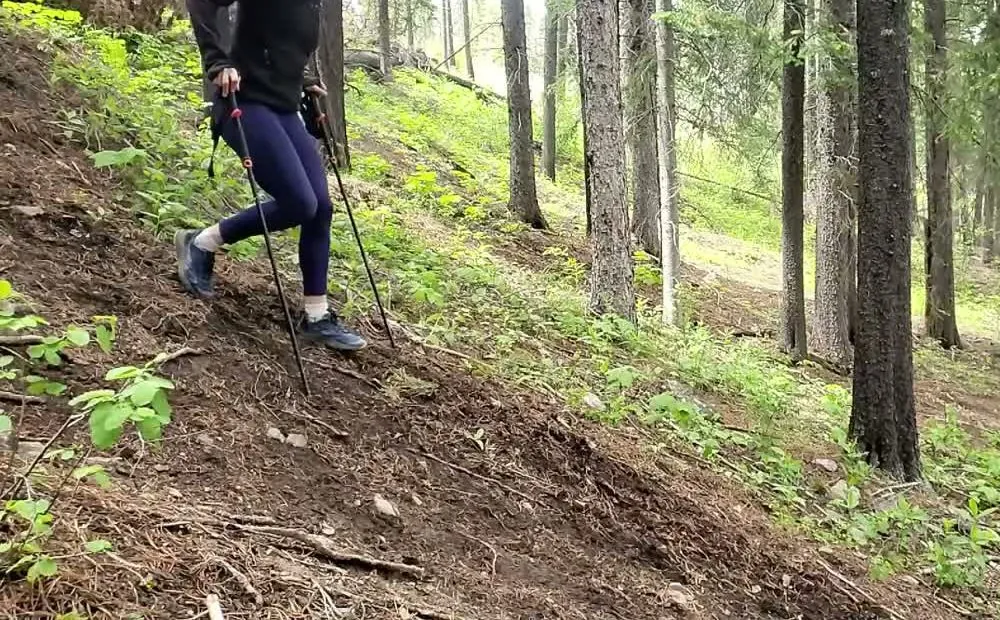
A hiker steps down a steep dirt slope with a trekking pole in each hand, the poles planted on the slope below. The face is cropped out. Screen from WILDR Online Fitness Training's video.
So the studies say yes, with a big warning. They are small, they were done in labs, and none of them measured whether poles reduce pain on a real trail. Here is what each one found.
- An 8 man study from 1999. Schwameder and four co-authors had 8 men walk down a ramp tilted 25 degrees, in a lab. In the Journal of Sports Sciences, they report that poles lowered the force of the foot hitting the ground and the turning force on the knee. Poles also lowered the squeezing and sliding forces between the thigh bone and the shin bone. Those drops were 12 to 25%. Forces on the kneecap and the thigh tendon dropped too, but the drop was not statistically significant because the results varied a lot.
- A 15 hiker study from 2007. Bohne and Abendroth-Smith tested 15 experienced male hikers in a lab. The hikers carried no pack, a day pack of about 15% of their body weight, or a large pack of about 30%. In Medicine and Science in Sports and Exercise, they report that poles lowered the turning force at the ankle, knee and hip. Poles also lowered the peak power the ankle and knee absorbed, and the results held with every pack weight.
- A review from 2020. In Wilderness and Environmental Medicine, the journal of the Wilderness Medical Society, Hawke and Jensen reviewed the research. They say poles lower the loading and forces on the legs but raise how hard your heart and lungs work. They say that with a large load, poles may reduce leg muscle work and improve balance.
Keep in mind that both studies used men only. Neither tested women, older hikers or people who already have knee pain. So poles are a reasonable thing to try, and the studies don't promise they'll fix your knees.
How do I use trekking poles going downhill?
These steps are opinion, from two videos below by a physical therapist and a trainer.
- Swing each pole out in front of you. Ausinheiler Physical Therapy says to hold the pole with your palm over the top of the handle.
- Plant each pole just before the opposite foot lands. That is the timing the Ausinheiler physical therapist shows in the video.
- On a steep drop, try the "two poles, three steps" pattern. WILDR Online Fitness Training describes it as planting both poles together, then taking three steps. The video ties this pattern to the 1999 study, and the study's published summary doesn't describe the pattern.
- Going uphill, change your grip. The Ausinheiler physical therapist says to put your hand up through the strap and grip lower down.
No medical source gives a pole length. The maker's fit guide for the pole you buy is the place to check.
Which trekking poles should I buy?
So you don't need poles to start. If your knees ache on the way down and you want to try poles, a budget pair is enough to find out whether you like them. In my opinion, a lighter, more expensive pair is worth the money on long days with a lot of walking. Prices were checked October 16, 2026. The test notes come from OutdoorGearLab's trekking pole review, updated October 2, 2026, by review editor Kate Pitts. OutdoorGearLab tested 15 poles, chosen from about 70 pairs it has bought since 2012. Weights are for a pair.
| Pick | Good for | Price, checked Oct 16, 2026 | Weight and key facts | What testers said |
|---|---|---|---|---|
| Budget: Trekology Trek-Z 2.0 with the foam handle | First poles, if you aren't sure you'll like poles | $55.99 on the maker's page, in stock. The maker ships free over $50. | 19.1 oz measured by OutdoorGearLab. Aluminum, folds down. Two lengths, 100 to 120 cm and 115 to 135 cm. The maker gives a 1 year warranty. | OutdoorGearLab named it Best on a Tight Budget. It's heavier than carbon poles. |
| Value: Black Diamond Trail Back | Poles that last through years of day hikes and trips | $99.95 on the maker's page, in stock in both colors on October 16, 2026. | 18.25 oz measured by OutdoorGearLab, and Black Diamond advertises 18.4 oz. Aluminum with a FlickLock, a lever that clamps the sections. Three sections, adjusts from 100 to 140 cm, packs down to 61.5 cm. The maker gives a 2 year warranty. | OutdoorGearLab named it Best Bang for the Buck and called it one of the most durable trekking poles on the market. Cons: heavy, bulky when packed, little shock absorption and basic grips. It scored 76 and ranked fourth of 15, on a page dated September 10, 2025. |
| Step-up: MSR DynaLock Ascent Carbon | Lighter poles for long days | $189.95 on the maker's page. Out of stock with a waitlist on October 16, 2026. | 15.7 oz a pair in OutdoorGearLab's table. Carbon, folds down, with a tool-free lever lock. The maker lists 1 lb 0 oz for the small and 1 lb 1 oz for the large, and the page doesn't say whether that's a pair or one pole. | OutdoorGearLab gave it its Editors' Choice award and Best Overall. It called the pole "simple, elegant, and well-built" and praised the lever lock. |
| Step-up that's easier to find: Leki Legacy Lite | A mid-price pole with an easy lock, while the MSR is out of stock | $109.95 at Campmor, a store, in stock on October 16, 2026. Leki's own page didn't open when checked. | 16.45 oz measured by OutdoorGearLab. Aluminum with Leki's Speed Lock Plus. | OutdoorGearLab called it "durable, easy-to-adjust" and gave it no award. |
My take, which is opinion: I'd pick the Trekology Trek-Z 2.0 if you're still finding out whether poles help your knees. And I'd pick the Black Diamond Trail Back if you already know you'll use poles for years. The MSR is the one to look at for long days if it comes back in stock.
What strength work helps knees on the way down?
Now strong thigh and hip muscles are the part that medical sources back the most. A 2018 statement in the British Journal of Sports Medicine came from 41 experts voting at the 5th International Patellofemoral Pain Research Retreat. They supported exercise therapy, especially hip exercises combined with knee exercises, for people with kneecap pain. Keep in mind that statement is about people who already have kneecap pain. It isn't about preventing knee pain in healthy hikers.
The AAOS knee conditioning program is a rehab sheet for people with knee problems. It starts with a 5 to 10 minute warm-up and some stretches. Then it lists strengthening moves. Here are four of them.
- Half squats: 3 sets of 10.
- Calf raises: 2 sets of 10.
- Straight leg raises: 3 sets of 10.
- Hip abduction, which means lifting your leg out to the side: 3 sets of 20.
AAOS says to do the program for 4 to 6 weeks, then 2 to 3 days a week to keep your strength. It also says, "You should not feel pain during an exercise," and to do the program under your doctor's supervision. A physical therapist can adjust the moves for you. The AAOS sheet lists more moves than these four, so use the full sheet and not my short list.
Does a heavy pack make knees hurt more going down?
Clinic blogs say a heavier pack adds load to your knees. That is opinion. No medical source gives a safe pack weight for knees. The 2007 study I described above tested poles with packs up to about 30% of body weight, and poles helped at every weight. That study doesn't say how much weight is safe. So a lighter pack is a reasonable way to take load off your knees, but no source says how light it needs to be.
Should I wear a knee brace or sleeve?
I don't recommend one, because the evidence is weak. A 2015 Cochrane review of knee braces for kneecap pain found five small trials with 368 people in total. Cochrane is a group that reviews medical research. It rated the quality of the evidence as very low, and all five trials had a high risk of bias. It found no clinically important difference in pain or function. In one trial, 36% of the knees given sleeves had discomfort or skin rubbing.
The 2018 British Journal of Sports Medicine statement I mentioned above says its experts were uncertain about taping and bracing. If you've had a knee injury, your doctor or physical therapist should decide whether a brace makes sense.
When should I stop and see a doctor about knee pain?
So first, the list in the box near the top covers the urgent signs from the NHS knee pain page. For those, get medical advice now, which in the US means calling your doctor or going to an urgent care center.
Now for ordinary aching that doesn't have those signs, the sources give different waiting times.
- The NHS knee pain page says to see a GP, which is a family doctor, if knee pain doesn't improve within a few weeks.
- MedlinePlus says to call your provider if the pain gets worse or doesn't improve within a few weeks.
- The NHS page on knee pain and other running injuries is shorter. It says to see a GP straight away if pain is severe or the knee is swollen. If the pain isn't severe, it says to stop and see a GP or physiotherapist if the pain doesn't go away after a week. Physiotherapist is the UK word for a physical therapist.
- The AAOS says to contact your doctor if the pain persists or it becomes more difficult to move your knee.
So the sources differ, from one week to a few weeks. My opinion is to go sooner when you're unsure.
The NHS knee pain page also lists self-care to try first. That means putting as little weight as possible on the knee and taking painkillers. It also means using an ice pack wrapped in a towel for up to 20 minutes every 2 to 3 hours. MedlinePlus says to talk with your provider before using any pain medicine if you have heart disease, high blood pressure or kidney disease. The same goes if you've had stomach ulcers or internal bleeding.
Which videos show how to walk downhill and use poles?
So here are three videos, one on each part of the technique above.
A UK navigation instructor shows how he walks down a slope, in a clear, step-by-step way.
- Posture: He keeps his knees slightly bent so his thighs and buttocks absorb each landing, and he "bounces" down.
- Foot landing: He lands flat or on the heel, never on the front of the boot, and steps down instead of sliding.
- Steep sections: He zigzags and faces the way he's walking, and never walks sideways down a slope.
- Worth knowing: He is a navigation instructor, not a doctor, so this is opinion.
A fitness trainer shows how to bend and use poles on a descent, in a short, practical way.
- Posture: The trainer bends at the ankles, knees and hips and doesn't lean back.
- Poles: The trainer adds poles and shows the "two poles, three steps" pattern, which the video ties to the 1999 study.
- When to get help: The trainer tells viewers to see a physio, which is a physical therapist, for sudden or worsening pain.
- Worth knowing: The presenter is a trainer, not a doctor. The video also gives a force figure that no source backs, so I don't repeat it.
A physical therapist shows when to plant a trekking pole, in a quick demonstration with a pack on.
- Going downhill: The pole swings out in front, with the palm over the top, and plants just before the opposite foot lands.
- Going uphill: The hand goes through the strap and grips lower, so the wrist angle is different from downhill.
- Worth knowing: The video is from 2017 and is a vertical clip with low picture quality. The advice is one physical therapist's opinion.
What's next after this page?
Now the next step on the path is your footwear. My guide to hiking boots vs hiking shoes vs trail runners covers which kind fits your hikes. And if your heels hurt on the way down, my guide to stopping heel blisters is the one to read. If you're gasping on the way up instead, read why you're so out of breath hiking uphill. And if you're planning a long trek with long descents, my guide to Kilimanjaro vs Everest Base Camp compares the two. My altitude sickness guide covers the warning signs on the way up.
My take
So ultimately, sore knees on the way down are common. The best-supported fixes are building up slowly and strengthening your thighs and hips. Shorter, softer steps on the way down are worth trying too. Poles are worth trying, and the two small studies point the same way.
But for me personally, the most useful habit is going to the doctor early when you're unsure. Knee pain that is very bad, swells the knee, locks it, or doesn't get better within a few weeks should be checked by a doctor.
And I'd skip the knee brace, because the studies haven't shown that it helps.
Have a question about “Why your knees hurt going downhill, and how to fix it”?
Ask it here. Every question comes to me first. I answer as many as I can, and each answered question goes on this page with my answer so other hikers and climbers can see it too. I don't ask for your email, so check back on this page for the answer.
More health and safety guides
Altitude sickness: how to avoid it, the warning signs, and when to go down
A plain guide for Kilimanjaro, Everest Base Camp and any trek that sleeps above 2,500 m (8,200 ft).
How to stop getting blisters on your heels when hiking
Why heel blisters form, what actually helps, what to do on the trail, and when a blister needs a doctor.
- American Academy of Orthopaedic Surgeons, Patellofemoral Pain Syndrome, checked October 16, 2026: causes, symptoms and treatment of kneecap pain.
- American Academy of Orthopaedic Surgeons, Iliotibial Band Syndrome, checked October 16, 2026.
- American Academy of Orthopaedic Surgeons, Knee Conditioning Program, checked October 16, 2026.
- NHS, Knee pain (last reviewed December 21, 2023, next review due December 21, 2026), checked October 16, 2026: causes, urgent signs, when to see a doctor and self-care.
- NHS, Knee pain and other running injuries, checked October 16, 2026.
- MedlinePlus, Iliotibial band syndrome, aftercare, checked October 16, 2026.
- Schwameder H, Roithner R, Mueller E, Niessen W, Raschner C. Knee joint forces during downhill walking with hiking poles. Journal of Sports Sciences 1999, checked October 16, 2026 (abstract).
- Bohne M, Abendroth-Smith J. Effects of hiking downhill using trekking poles while carrying external loads. Medicine and Science in Sports and Exercise 2007, checked October 16, 2026 (abstract).
- Hawke AL, Jensen RL. Are Trekking Poles Helping or Hindering Your Hiking Experience? A Review. Wilderness and Environmental Medicine 2020, checked October 16, 2026 (abstract).
- British Journal of Sports Medicine, consensus statement from the 5th International Patellofemoral Pain Research Retreat (2018), checked October 16, 2026.
- Cochrane, Knee orthoses for treating patellofemoral pain syndrome (2015), checked October 16, 2026.
- Opinion sources on thigh muscles acting as brakes: Backcountry Physio and Trail Hiking Australia, checked October 16, 2026.
- Trekking pole tests: OutdoorGearLab, Best Trekking Poles (updated October 2, 2026), checked October 16, 2026.
- Pole prices and details from the makers, checked October 16, 2026: Trekology Trek-Z 2.0, Black Diamond Trail Back and MSR DynaLock Ascent Carbon. The Leki Legacy Lite at Campmor, a store, was $109.95 on October 16, 2026.
- Videos, checked October 16, 2026: The Map Reading Company, WILDR Online Fitness Training and Ausinheiler Physical Therapy.
Everest Buddy is an independent site. No gear maker, store or guide company paid to be on this page. This guide gives general information, not medical advice, so see a doctor before you start a new training plan or travel to high altitude.