
Now this page is for you if you've done a first short hike and the climbing was harder than the distance. My guide to starting mountaineering from zero covers that first hike. If you got passed on the trail, reached the top to find your friends already rested, or wondered if you're just not built for this, you're in the right place. Nothing on this page is a test of whether you belong out there.
- Call 911 or go to the emergency room if your breathing trouble starts suddenly, if it seriously interferes with your breathing and even talking, or if someone stops breathing. This comes from MedlinePlus, a health information service of the US National Library of Medicine.
- Call 911 right away for chest discomfort that lasts more than a few minutes, or goes away and comes back, with or without shortness of breath. The CDC's heart attack page says the discomfort can feel like pressure, squeezing, fullness or pain.
- See a doctor for the other signs in the section on when breathlessness needs a doctor.
Quick picks
Why does uphill make me so out of breath?
Basically, walking uphill means lifting your whole body weight against gravity with every step. That takes more energy than walking on flat ground, so your heart beats faster and you breathe harder. Fit hikers breathe harder on hills too. Being out of breath on a climb is about how hard you're working, not a flaw in you.
The most common cause hikers point to is going too fast. Hikers on forums such as Walkhighlands and Oregon Hikers give the same first advice: slow down until your breathing settles into a pace you can keep going. That is opinion from hikers, not a medical rule. But the idea is simple, and it matches the CDC's talk test below.
Now hiking only on weekends may not be enough to change this. Rowan Smith, a coach on the Training for Trekking podcast, says adding two kinds of weekly aerobic exercise plus strength work helps more than weekend hikes alone. That's one coach's opinion. Aerobic exercise means anything that raises your breathing and heart rate for a while, like brisk walking, biking or running.
Is a high heart rate on a hill a bad sign?
A watch will show a much higher heart rate on a hill than on flat ground. A high number on a steep climb is not a problem by itself. What matters is how you feel, and the warning signs in the section on when breathlessness needs a doctor. If you take heart medicine, ask your doctor what effort level to aim for.
How do I find the right pace on a hill?
So the free tool is the talk test. The CDC describes it like this. At moderate effort you can talk but not sing. At hard effort you can't say more than a few words without pausing for a breath. The CDC also gives a 0 to 10 effort scale, where moderate is about a 5 or 6 and hard starts around a 7 or 8.
On a climb, here is how I'd use that. Aim to be able to say a short sentence. If you can only get out a few words, you are working harder than you need to for building fitness, so slow down.
- Start slower than feels necessary. The first part of a hill is where most beginners rush. A guide in the Mammut video below says to go slower for the first hour to warm up.
- Say a short sentence out loud. Try "I'm doing fine, this hill is long." If you can't finish it, shorten your steps and slow down.
- Take short steps. The Mammut guide says long steps use more oxygen. Walkhighlands posters say short steps are like shifting down a gear on a bike.
- Keep your breathing in step with your feet. The Mammut guide says that if your breathing is faster than your steps, you need to slow down. For example, breathe in for two steps and out for two steps.
- Stop when you need to. Standing still for a minute to catch your breath is fine. Nothing says a hike has to be done without stopping.
Keep in mind that the right pace may feel embarrassingly slow at first. Being passed on the trail by someone fast doesn't mean your pace is wrong. Their body is working at a different level than yours.
How should I breathe on a climb?
Now the simplest breathing tip is belly breathing. Rowan Smith, the Training for Trekking coach, says to breathe in through your nose and feel your belly expand, rather than lifting your shoulders. And matching your breath to your steps, as in step 4 above, is something several hikers and coaches mention.
You may also hear about breathing out through pursed lips. That means your lips are nearly closed, with a small opening, like you're blowing out a candle. Mountain guides teach a firmer version, where you push the air out. Here is the disagreement, so you can decide.
- Mountain guides: The Mammut guide says to empty your lungs forcefully once in a while so you can take in more air.
- A hospital patient guide: UF Health, a university hospital system, gives pursed-lip breathing advice to people with lung problems. It says not to force the air out. It says to breathe in through your nose for about 2 counts and out through pursed lips for 4 or more counts.
So here's my take, and this part is opinion. Breathe out steadily through pursed lips, not hard. How much the firm push helps is still debated, and a steady breath out costs you nothing.
What is the rest step, and should I use it?
The rest step is a way of walking uphill that mountain guides teach, usually on long, steep climbs. Basically, you straighten the leg that is behind you, so your weight rests on your leg bones instead of your muscles. Then you pause for a moment before the next step.
The American Alpine Institute, a guide service, explains it this way. The straight leg lets "your body rest on your skeletal system instead of on your muscles." The author, Jason D. Martin, admits the rest step slows you down. Martin's view is that it's better to go slower and stop less than to go fast and stop a lot.
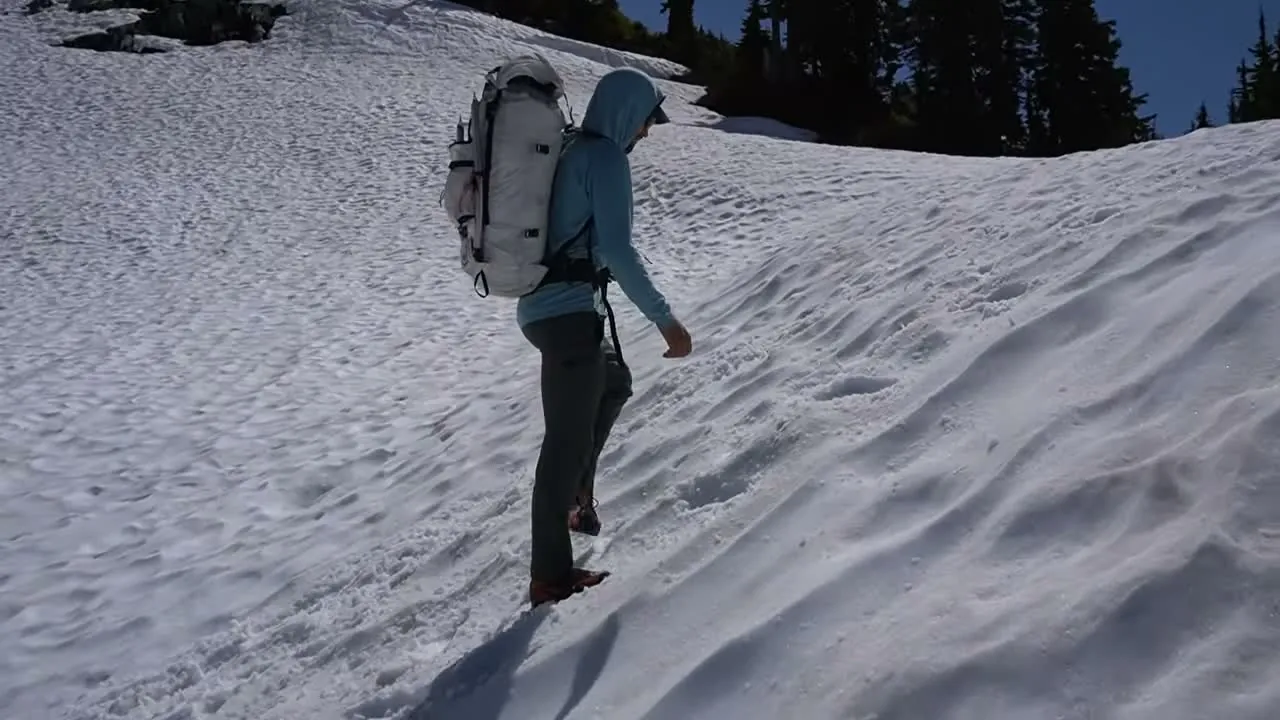
This climber is on a snow slope with the downhill leg straight and the body upright, the position the rest step uses. Screen from Blackbird Mountain Guides' video.
Now the guide video above gives the key points. Stand upright with your weight on the straight back leg. Place each foot on a solid spot. Move your feet quickly, and change how long you rest between steps to change your pace.
Keep in mind that guides don't all agree on this for everyday hikers. Rowan Smith, the coach mentioned above, advises everyday hikers not to use the rest step. In Smith's video below, Smith says that repeatedly locking the knee could risk hyperextension if you're tired, heavier or on unstable ground. No medical source on this page backs that claim up or rules it out.
So here is my advice, and this part is opinion. Lock the knee gently, not forcefully. Stop if your knee hurts. And skip the rest step on loose ground. If you get knee pain on the way down instead, read my guide to why your knees hurt going downhill.
What is a sample plan to get better at hills?
The CDC's activity guidelines for adults say 150 minutes a week of moderate activity, plus muscle-strengthening on at least 2 days a week. It also says some activity is better than none. Treat the 150 minutes as something to work toward, not what you must do in week one.
The plan below is a sample from me, and it's opinion. It is a common shape for a beginner plan and not a prescription. Move to the next step only when the step you're on feels easy, and repeat a week if you need to. Your doctor can adjust it if you have health conditions.
- Weeks 1 and 2: Walk 20 to 30 minutes at a pace where you can chat, 3 days a week. Use mostly flat ground and a few easy hills.
- Weeks 3 and 4: Add a fourth day, or make your walks 40 to 45 minutes. Include one gentle hill.
- Weeks 5 and 6: Do one longer weekend walk with some climbing, and one hill or stair session during the week. Add strength work for your legs on 2 days a week.
Now what counts as easy? The coaches at Uphill Athlete, a mountain training site, say that in their easiest zone you could tell a whole story without pausing for breath. In their next zone you can hold a conversation but need a breath every four or five sentences. They say to keep most of your training easy. That's their opinion, and it matches the idea of walking at a chatting pace.
Hill and stair practice helps too. Oregon Hikers posters and the coaches mentioned above suggest a steady hill or stairs, and some add biking or running two or three times a week. Weight loss isn't part of this plan. One Oregon Hikers poster said simply slowing to a comfortable pace made hiking more enjoyable.
When you're ready to build to long, high days, my guide to building up from short hikes to big elevation days picks up where this plan stops.
Will I be more out of breath at high places?
Yes, and that alone is expected. The CDC's Yellow Book, its travel health guide for doctors, says there is less oxygen available at altitude, so your breathing rate goes up. It also says even people used to the height can't exercise as hard as they can at low altitude.
The CDC also says training and fitness don't change your risk of altitude illness. Headache, nausea or dizziness are different from simple breathlessness. If you get those, read my guide to altitude sickness.
When does being out of breath need a doctor?
Being out of breath on a hill and settling after a minute or two of rest is common. This section is not a way to diagnose yourself. It lists what MedlinePlus and the CDC say to act on.
When should I call 911?
- Breathing trouble that starts suddenly. MedlinePlus says to call 911 or go to the emergency room.
- Breathing trouble that seriously interferes with breathing and even talking. MedlinePlus says to call 911 or go to the emergency room.
- Someone who stops breathing. MedlinePlus says the same.
- Chest discomfort that lasts more than a few minutes, or goes away and comes back. The CDC says the discomfort can feel like pressure, squeezing, fullness or pain, and says to call 911 right away.
- Other heart attack signs. The CDC lists feeling weak, light-headed or faint, a cold sweat, pain in the jaw, neck, back, arms or shoulders, and unusual tiredness and nausea or vomiting. It says shortness of breath often comes with chest discomfort but can also happen before it. It also says women are more likely to have the tiredness and nausea or vomiting signs.
When should I see a doctor, even if it's not an emergency?
MedlinePlus says to see your health care provider if breathing trouble comes with any of these:
- Chest discomfort, pain or pressure.
- Fever.
- Shortness of breath after only slight activity, or at rest.
- Shortness of breath that wakes you at night, or means you need to sleep propped up.
- Shortness of breath when you are simply talking.
- Throat tightness or a barking cough.
- You breathed in or choked on an object.
- Wheezing.
- A significant worsening of your usual shortness of breath.
This next part is my own advice, not from those pages. Check with your doctor before ramping up exercise if you have a heart or lung condition or take heart medicine. A doctor can tell you what is safe for you. A website can't.
Do I need a heart rate monitor?
No. The talk test above costs nothing and works on every hill. Gear is for people who want a number on a screen. Keep in mind that heart rate gear doesn't diagnose anything, and this page gives no heart rate number to aim for.
Here is why I don't print a target. Uphill Athlete says maximum heart rate varies widely between people of the same age, often by 10 to 20 beats a minute. So a formula based on age can point you to the wrong zone. And if you take heart medicine, your doctor is the right person to set your effort level.
So the order I'd go in is talk test first, a chest strap if you want accurate numbers, and a watch only if you also want GPS. Polar, a heart rate gear maker, says on its support page that wrist sensors may be less accurate with vigorous hand movement, and that chest straps are very reliable. That is the maker's claim.
Prices change, so check the linked page before you buy. I checked these on October 16, 2026.
| Pick | Price, checked October 16, 2026 | Weight and key specs | Good at, and not good at |
|---|---|---|---|
| Free option: the talk test (from the CDC) | Free. | Nothing to carry. | Good: works on any hill, needs no battery or phone. Not good: gives no number to track over time. |
| Budget chest strap: Polar H10 | $104.95. Polar's shop page showed a planned maintenance banner that day. | 2.1 oz (0.7 oz without the strap). Bluetooth and ANT. A CR2025 coin cell battery, up to 400 hours, from the maker. | Good: Polar's support page calls chest straps very reliable, and Outdoor Gear Lab used an H10 as its reference when testing watches in July 2024. Not good: it needs a phone or watch to show the numbers, and some people dislike a strap around the chest. |
| Budget watch: COROS PACE 3 | COROS still listed the PACE 3 for sale on October 16, 2026, but its page showed no price. Outdoor Gear Lab listed $229 in July 2024. Check the maker's page for the current price. | About 30 g with the nylon band (35 to 36 g with the silicone band). 38 hours of full GPS. Wrist heart rate sensor with SpO2. | Good: Outdoor Gear Lab tested the PACE 3 on a half mile run, on each wrist. Its heart rate stayed within plus or minus 1.54 beats a minute of a Polar H10. Not good: that test was a run, not a hike. |
| Step-up watch: Polar Pacer | $299.90. | 1.4 oz (0.8 oz without the band). GPS and Polar's wrist heart rate sensor. 32 hours of full GPS, though Polar's FAQ says up to 35 hours. | Good: a current Polar model with the same maker's strap pairing. Not good: every figure above comes from Polar itself, not from an independent test. |
Shoes are a separate question. If you're wondering whether your running shoes are fine for now, see my guide to hiking boots vs hiking shoes vs trail runners.
Videos worth watching about uphill breathing and the rest step
And if you want to see more, here are three videos. You can play each one right here on the page, and YouTube's usual controls work, including skipping ahead, changing the speed and going full screen. Under each video is a short summary so you can decide if it's worth your time.
A very short guide demonstration of the rest step on a snow slope.
- Body position: The guide says body position is the key. The downhill leg is locked straight and the body is upright, so weight rests on the skeleton and not the muscles.
- The foot: Each step needs a solid platform for the heel.
- The pace: The feet move quickly, and you change how long you rest between steps to change your pace.
- Worth knowing: The video is on snow and says nothing about breathing. A guide company made it, so it's one view of the technique.
A guide talks a client through pace, step length and breathing for walking uphill.
- Pace: Go slower for the first hour to warm up.
- Steps: Take short steps, because long steps need more oxygen.
- Breathing: Match your breathing to your steps. If your breathing is faster than your steps, slow down.
- Worth knowing: The guide says to empty your lungs forcefully once in a while. The hospital advice above says not to force the air out, so breathe out steadily. Mammut is a gear company, so this is its guide's opinion.
A coach explains the rest step, then says everyday hikers are better off without it.
- The technique: Smith describes locking the knee and pausing from 1 to 10 seconds, with a couple of breaths between steps. Smith says the rest step was made for mountaineers at altitude.
- Smith's caution: Smith says locking the knee over and over could risk hyperextension if you are tired, heavier or on unstable ground.
- What Smith suggests instead: Strength training, aerobic intervals, hill repeats and belly breathing.
- Worth knowing: This is one coach's opinion, with no medical source for the knee claim. The video ends with a pitch for Smith's Facebook group.
What's next after this page?
Now once your pace feels comfortable on hills, the next step on the path is longer, higher days. My guide to building up from short hikes to big elevation days shows how to add distance and climbing a little at a time. And when you plan to go high, my guide to altitude sickness explains the warning signs. If your knees start to hurt on the way down, my guide to knee pain going downhill is the next problem to look at.
My take
So ultimately, being out of breath on a hill mostly means you're walking faster than your body is ready for. Slow down until you can say a short sentence, take short steps, and build up with easy walking a few days a week.
But for me personally, the talk test beats any gadget for a beginner. Gear can wait.
And if you have chest pain, breathing trouble that starts suddenly, or any of the signs in the doctor section, stop and get help.
Have a question about “Why you're so out of breath hiking uphill, and how to get better at it”?
Ask it here. Every question comes to me first. I answer as many as I can, and each answered question goes on this page with my answer so other hikers and climbers can see it too. I don't ask for your email, so check back on this page for the answer.
More training guides
- CDC, Measuring physical activity intensity (page dated December 4, 2025), checked October 16, 2026: the talk test and the 0 to 10 effort scale.
- CDC, Physical activity guidelines for adults (December 20, 2023), checked October 16, 2026: weekly minutes and muscle-strengthening.
- MedlinePlus, Breathing difficulty (reviewed April 1, 2025), checked October 16, 2026: when to call 911 and when to see a provider.
- CDC, Heart attack signs and symptoms (October 24, 2024), checked October 16, 2026.
- CDC Yellow Book 2026, High-Altitude Travel and Altitude Illness (April 23, 2025), checked October 16, 2026.
- UF Health, How to breathe when you are short of breath (updated June 6, 2025), checked October 16, 2026: pursed-lip breathing.
- Jason D. Martin, American Alpine Institute, The Mountaineer's Rest Step (May 19, 2020, modified October 9, 2025), checked October 16, 2026.
- Uphill Athlete, training zones and heart rate (June 7, 2026), checked October 16, 2026.
- Training for Trekking podcast, TFT23, Always out of breath when hiking up hills (September 29, 2019), checked October 16, 2026.
- Hiker forum threads, checked October 16, 2026: Oregon Hikers, tips for improving endurance on steep hikes (April 2011) and Walkhighlands (2018).
- Gear, from the makers, checked October 16, 2026: Polar H10, COROS PACE 3 and Polar Pacer. Test of the PACE 3: Outdoor Gear Lab (July 3, 2024).
- Videos, checked October 16, 2026: Blackbird Mountain Guides, MAMMUT and Summit Strength.
Everest Buddy is an independent site. No gear maker, store or guide company paid to be on this page. This guide gives general information, not medical advice, so see a doctor before you start a new training plan or travel to high altitude.