
Not medical advice. This guide gives general information. If you have a health condition, or symptoms that worry you, see a doctor before you hike or climb.
Now this page is for you if you're planning a trek or climb that sleeps above about 2,500 m, like Kilimanjaro, Everest Base Camp or your first very high peak. If you're still building up to that, start with my guide to building up from short hikes to big elevation days. This page can't tell you what you have. It tells you what the CDC and the UIAA say to watch for and do. Prices on this page change, so check the linked page before you buy anything.
- Confusion or odd behavior. The UIAA lists confusion, seeing things that aren't there, and irrational behavior as signs of swelling around the brain, called HACE. The person may insist they feel fine.
- Loss of balance. The CDC lists loss of coordination as a sign of HACE. A person who can't walk a straight line, heel touching toe, is showing this sign.
- A severe headache that normal painkillers don't touch. The UIAA lists this as a HACE sign.
- Breathlessness while resting, a cough that brings up bloody or frothy spit, or blue lips. The CDC and the UIAA list these as signs of fluid in the lungs, called HAPE. The CDC calls going down "urgent and mandatory" for HAPE.
- Any altitude sickness symptoms that get worse while you rest at the same height. The CDC says to go down in that case.
Quick picks
What is altitude sickness?
Basically, the air at high places has less oxygen available to breathe. The CDC says this lower oxygen is the biggest concern at altitude. Your body needs time to adjust to that. Going up faster than your body can adjust is what causes altitude sickness.
Altitude sickness is really three illnesses. The CDC's Yellow Book, its travel health guide for doctors, names all three.
- Acute mountain sickness, or AMS. This is the common one. The CDC compares AMS to a hangover.
- High-altitude cerebral edema, or HACE. This is swelling around the brain. The UIAA factsheet calls HACE and HAPE the life-threatening forms.
- High-altitude pulmonary edema, or HAPE. This is fluid in the lungs.
Now the CDC says AMS is the most common form of altitude sickness. The UIAA's consensus statement, and its altitude sickness factsheet, both treat AMS as the mild form. The consensus statement says that depending on how a climb is planned, more than 70% of mountaineers may get AMS symptoms.
At what height does altitude sickness start?
The UIAA gives typical heights at risk. These are rough numbers, and the UIAA says cases below them are rare but possible.
- AMS: above about 2,500 m (8,200 ft).
- HAPE: above about 3,000 m (9,800 ft).
- HACE: above about 4,000 to 5,000 m (13,100 to 16,400 ft).
A peer-reviewed summary of the Wilderness Medical Society's 2024 guideline update says travel above 2,500 m raises the risk, and some people have symptoms around 2,000 m (6,600 ft).
How soon after going up do the symptoms show up?
The CDC says AMS usually starts 2 to 12 hours after you arrive at a new height or go higher. The UIAA says 4 to 24 hours. So the two groups agree on the idea: hours to about a day.
The CDC says AMS usually clears within 12 to 48 hours if you don't go higher. It also says symptoms that first show up after 3 days at the same height should not be assumed to be AMS. So something else may be going on, and your guide or a doctor should know about it.
HACE and HAPE usually show up later than AMS. The UIAA says more than 24 hours after arriving high. The Wilderness Medical Society summary says HAPE usually appears 1 to 5 days after arriving above 2,500 to 3,000 m. The summary also says HAPE often follows AMS.
Does the height where I sleep matter more than the height I climb to?
Yes. The American Family Physician summary of the Wilderness Medical Society's 2019 guideline says sleeping height matters more than the highest point you reach while awake.
So "sleeping height" means the height of the bed you sleep in that night. The UIAA consensus statement says that on a rest day you may climb higher, as long as you come back down to sleep. And the UIAA factsheet says climbing high and sleeping low may help, as long as you don't overexert yourself.
What are the warning signs of altitude sickness?
Keep in mind that this is a list of signs the CDC and the UIAA describe, not a way to diagnose yourself. The UIAA says to treat any symptom at altitude as altitude sickness until proven otherwise. Dehydration, exhaustion, sun illness, diarrhea and a caffeine headache can feel similar. So the safe move is to assume altitude sickness, stop going up, and tell your guide. Only a guide or doctor should rule altitude sickness out.
What are the signs of AMS, the common one?
The CDC says the main symptom is a headache. Along with the headache, at least one of these shows up:
- Poor appetite.
- Dizziness.
- Unusual tiredness.
- Nausea or vomiting.
The UIAA adds listlessness, swelling in the hands, feet or ankles, and a strong pounding heartbeat, and says not every symptom is always present. The American Family Physician summary also lists trouble sleeping.
Now AMS is the mild end. But AMS is the warning that you are climbing faster than your body can adjust. So the rule to stop going up applies from the first symptom.
What are the signs of HACE, swelling around the brain?
HACE is a medical emergency. The CDC lists confusion, drowsiness and loss of coordination. It says a person can slip into a coma within 24 hours. The UIAA adds these:
- A severe headache that normal painkillers don't help.
- Nausea and vomiting, and dizziness.
- Seeing or hearing things that aren't there.
- Irrational behavior, which the UIAA says may be an early stage.
- Loss of insight, meaning the person insists they are fine when they are not.
The UIAA calls the heel-to-toe walk "a very sensitive and simple field test." The person walks a straight line with the heel of one foot touching the toe of the other on every step. A partner or guide watches.
The key point is that a person with HACE usually can't judge their own condition. So your guide or your partner has to make the call to go down.
What are the signs of HAPE, fluid in the lungs?
HAPE is also a medical emergency. The CDC lists these early signs: chest congestion, a cough, unusual breathlessness when you exert yourself, and lower performance than normal. Later signs are breathlessness while resting and a cough with bloody spit.
The UIAA adds a fast pulse, chest tightness, bubbling sounds when breathing, blue lips or fingertips, bloody or frothy spit in severe cases, and a mild fever. The UIAA calls the fast drop in performance the "cardinal symptom," meaning the main sign.
For the difference between ordinary breathlessness from a steep climb and a warning sign, read my guide to why you're so out of breath hiking uphill.
What should I do if I get symptoms, and when do I go down?
So the steps below come from the CDC and the UIAA. Follow them in this order.
- Stop going up. The UIAA's rule is "No further ascent with symptoms." Stay at the same height until the symptoms are completely gone.
- Tell your guide or trek leader. The UIAA says any signs or symptoms should be reported to the expedition leader. Do not hide them.
- Rest and drink enough. The UIAA says to avoid hard effort and to sleep with your upper body slightly raised. Pain relievers like paracetamol or ibuprofen can ease a headache, but the UIAA says not to use aspirin. Pain relievers do not fix the cause, so you still do not go higher.
- Go down if the symptoms get worse. The CDC says to descend if symptoms worsen despite rest or treatment at that height. The UIAA says to descend if symptoms do not improve, or get worse, within 24 hours.
- Go down right away for any sign of HACE or HAPE. For HACE, the CDC says that in remote areas, anyone suspected of HACE should start down. For HAPE, the CDC says going down is "urgent and mandatory." The person should use as little effort as possible, and the UIAA says the person should never carry a load.
Going down is a safety decision, not a failure. Turning around costs you a summit. Pushing on with the signs of HACE or HAPE can cost a life. The CDC says severe altitude illness can lead to evacuation or death.
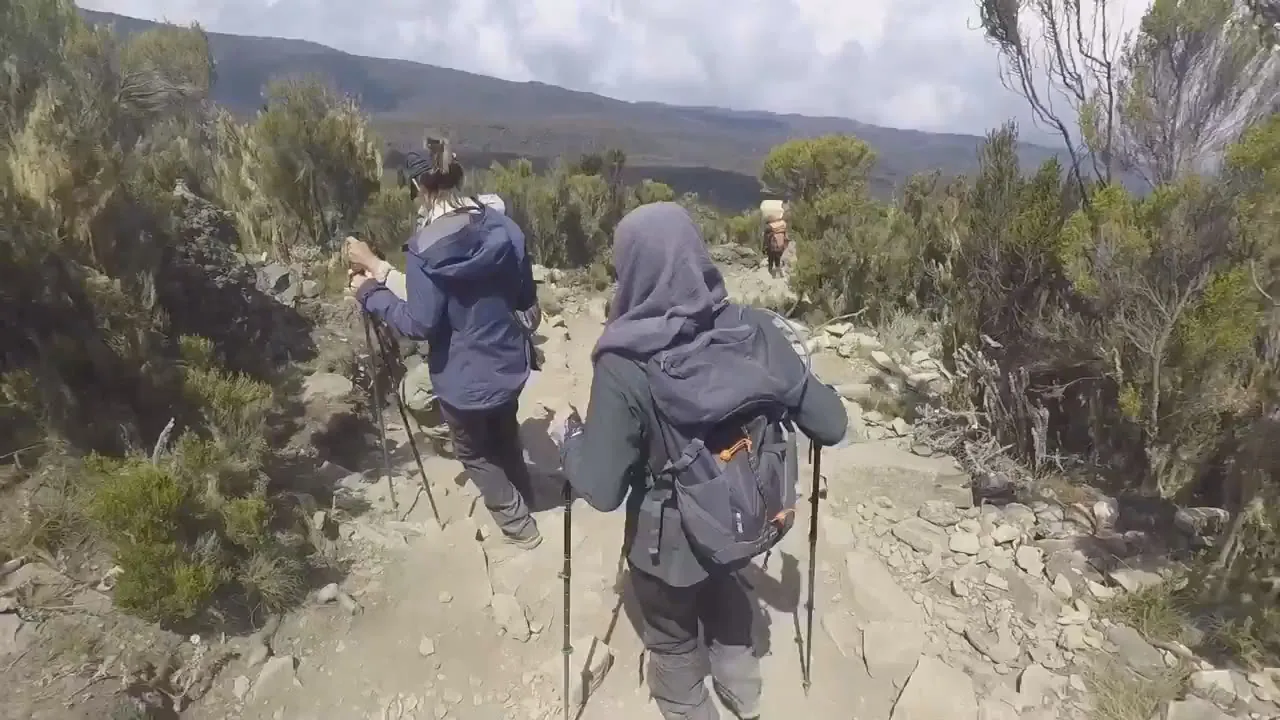
Trekkers walking down a rocky trail, seen from behind. This is a 2017 Kilimanjaro descent from Barafu Camp. Screen from Eric Anderson's video.
How far down do I need to go?
The sources give slightly different numbers, so here are all of them.
- The CDC says AMS improves with going down at least 300 m (1,000 ft).
- The American Family Physician summary of the Wilderness Medical Society's 2019 guideline says typically 300 to 1,000 m (1,000 to 3,300 ft), until the symptoms are gone.
- For severe symptoms, the UIAA says to go back to the last camp where the person felt well. Otherwise, go down at least about 500 m (1,650 ft), and up to 1,000 m (3,300 ft).
Basically, you don't have to go all the way home. The UIAA says a partial descent still lets you adjust again to the height. It also says to go back up only when you are fully well.
Sometimes going down isn't possible, or is delayed. For that case, the Wilderness Medical Society summaries and the UIAA name two backups: extra oxygen from a bottle, or a portable pressure bag called a Gamow bag. Those are for a guide or medic to use. So before you book, ask the operator what oxygen and medical help they carry.
How do I avoid altitude sickness?
Now the most important step is to go up slowly. The American Family Physician summary calls slowly raising your sleeping height the best way to prevent altitude sickness. The next sections cover how fast, what to do before you leave, and what to ask your doctor.
How fast can I go up each day?
The medical groups agree on the idea and differ on the exact numbers. Here is what each says.
| Source | How much higher to sleep each night | Rest and extra nights |
|---|---|---|
| CDC Yellow Book | Above 3,000 m (9,800 ft), no more than 500 m (1,600 ft) a night. | One extra night for every 1,000 m (3,300 ft) of sleeping height you gain. |
| Wilderness Medical Society 2019, as summarized by American Family Physician | No more than 500 m (1,600 ft) above the night before. Take at least two days to reach a sleeping height of 2,500 to 3,000 m. | A day to adjust after every 1,000 m (3,300 ft) of sleeping height you gain. |
| UIAA consensus statement | Above 2,500 to 3,000 m, 300 to 500 m (1,000 to 1,650 ft) higher than the night before. | Two nights at the same height after every 2 to 4 days of going up. |
| UIAA altitude sickness factsheet | Above 2,700 m (8,900 ft), no more than 400 m (1,300 ft) above the night before. | A rest day after every two days of going up "may also help." |
So these differences are not a fight about safety. They are different rules of thumb. My take, and this part is opinion: use the CDC's 500 m a night as the top limit. And treat 300 m as the more careful choice if you have had altitude sickness before or you're nervous.
The CDC adds two more rules. Avoid going from below 1,200 m (3,900 ft) straight to a sleeping height of 2,750 m (9,000 ft) or more in one day. And spend at least 2 to 3 nights at about 2,450 to 2,750 m (8,000 to 9,000 ft) before going higher.
What should I do before the trip?
- See a doctor before you book. This matters most if you have a heart, lung or blood condition, are pregnant, or have other long-term health conditions. The CDC names sickle cell anemia and severe pulmonary hypertension, which is high blood pressure in the lungs, as conditions where high-altitude travel should be avoided. Ask your own doctor about every condition you have.
- Sleep high before you go, if you can. The CDC says to spend at least 2 nights above 2,750 m (9,000 ft) in the 14 days before the trip. Closer to the trip is better.
- Keep your usual caffeine. The CDC says this keeps a caffeine-withdrawal headache from being mistaken for altitude sickness.
- Go easy for the first 48 hours at altitude. The CDC says to keep exercise mild and avoid alcohol. It also says not to use alcohol or opioid pain medicines to help you sleep.
- Drink enough water, but don't overdo it. The UIAA says dehydration headaches can look like AMS. It also says drinking too much can cause low blood sodium. The American Family Physician summary says forced overdrinking is not effective.
- Check the itinerary before you pay. The UIAA says "prevention starts before booking." Many trekking companies do not follow a recommended schedule of heights and days.
Children need separate advice from a doctor. This page covers adults.
Does being fit protect me from altitude sickness?
No. The UIAA factsheet says there is no evidence that physical fitness protects a person from altitude sickness. It says very fit people may be more at risk because they push harder, and that too much exertion is a risk factor.
The UIAA also says that having had altitude sickness before is the best known risk factor. And two people on the same schedule can get different results. So a fit person still has to go up slowly.
What does this mean for Kilimanjaro and Everest Base Camp?
Kilimanjaro is a good example of why the itinerary matters. The American Family Physician summary of the Wilderness Medical Society's 2019 guideline names "extremely rapid ascents" as high risk for AMS. Its example is climbing Kilimanjaro in fewer than seven days. The 2024 update, as summarized in the peer-reviewed summary, moves away from sorting travelers into tiers and recommends prevention steps for more people.
So my take is to pick the longer itinerary first. And for Everest Base Camp, check each night's sleeping height on the itinerary against the 500 m rule yourself. I compare the two treks in my guide to Kilimanjaro vs Everest Base Camp.
Which products do the medical groups not recommend?
Basically, many things get sold to people heading to altitude. Here is what the Wilderness Medical Society summaries (2024 and 2019) say about them for preventing altitude sickness.
- Ginkgo, a herbal supplement. Both summaries say ginkgo is not recommended.
- Acetaminophen, the pain reliever also called paracetamol. Both summaries say acetaminophen is not recommended as a way to prevent AMS.
- Altitude tents, which simulate high altitude for sleeping at home. The 2024 summary says altitude tents are not recommended, because two studies with a placebo group found no real reduction in AMS.
- Coca tea, coca leaves and other coca products. The 2019 summary says coca products have not been studied well enough and are not recommended.
- Canned oxygen and oxygen bars. The 2019 summary says no studies have looked at them, and they are unlikely to help.
What about the medicine acetazolamide (Diamox)?
Acetazolamide, sold under the brand name Diamox, is a prescription medicine. Your own doctor or a travel clinic decides whether you should take it, and how. This page gives no dose on purpose. Please do not take it, or any altitude medicine, because a website or a video said to.
Now the medical groups lean different ways, so here is what each says.
- The CDC says travelers at low risk don't need acetazolamide to prevent AMS, but should have it with them to treat early AMS if needed. It says medium-risk travelers would benefit, and strongly encourages high-risk travelers to take it.
- The 2019 Wilderness Medical Society guideline summary says to strongly consider acetazolamide for people at moderate or high risk. The 2024 summary says acetazolamide is still strongly recommended for prevention, and that the 2024 update applies prevention steps to more people.
- The UIAA says to plan a staged ascent first and keep drugs for special cases, such as flying straight to a high place, rescues, and people who adjust slowly. It names acetazolamide as the recommended drug for those cases.
Keep in mind that none of these groups treat acetazolamide as a replacement for going up slowly. The CDC suggests acetazolamide when a fast ascent can't be avoided, and the UIAA says to plan a staged ascent first.
So here is what to do. Ask your doctor or a travel clinic a few weeks before the trip, not the week before. The American Family Physician summary says a supervised trial of the medicine before the trip can be considered. Also tell your doctor about any serious allergic reaction you've had to a medicine, especially a sulfa drug. The CDC and the American Family Physician summary both mention allergies like this.
You may also hear about oxygen, a Gamow bag and other prescription drugs that guides or medics use for severe cases. A trained medic or doctor decides on those, not you.
Should I bring a pulse oximeter?
A pulse oximeter is a small clip that goes on your fingertip. A light inside reads how much oxygen your blood is carrying. The CDC says these devices cost under $30 and can help travelers gauge how well they are acclimatizing. Acclimatizing means your body adjusting to the height.
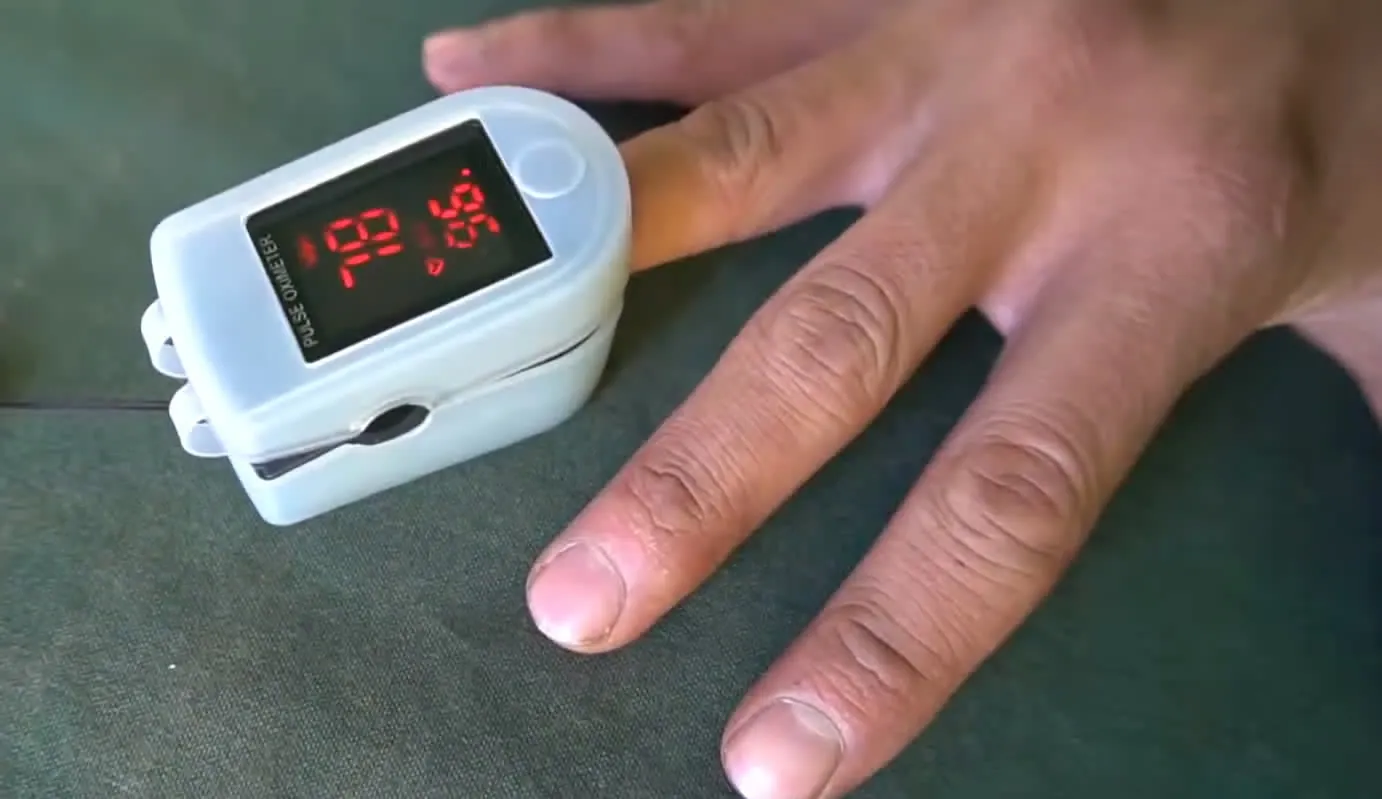
A fingertip pulse oximeter clipped on a hand. This is a different model from the Zacurate 500DL below. Screen from Peak Planet's video.
So a pulse oximeter is optional. If you bring one, here is how the CDC and the UIAA frame it.
- A pulse oximeter does not diagnose altitude sickness. The UIAA says AMS is diagnosed from symptoms, and its field guidance for AMS, HAPE and HACE doesn't use a pulse oximeter. So symptoms decide. A person with signs of HACE goes down whatever the reading says. And a person with a good reading and a worsening headache still does not go up.
- Readings at altitude are lower than at home. The CDC says readings at altitude are usually normal or slightly below normal for that height. This page gives no number to compare against, because the CDC does not publish a table of normal readings for each height.
- The best use is tracking your own trend. That means taking a reading at the same time each morning and watching how your reading changes day to day. The CDC describes it as a way to gauge your progress, not as a signal to act on one reading.
And the maker of the pick below says low blood flow can make readings less accurate, so it advises warming your hands and holding still. Cold fingers at altitude are common, so keep that in mind.
Which pulse oximeter should I look at?
I'm giving one pick, not a budget pick and a step-up pick. No CDC or UIAA page shows that a pricier pulse oximeter works better at altitude. The specs below come from the maker's own page.
| Pulse oximeter | Price, checked October 16, 2026 | Key specs, from the maker | Good at, and not good at |
|---|---|---|---|
| Zacurate 500DL Pro Series Fingertip Pulse Oximeter (the maker also sells the same model in purple and pink) | $19.99, in stock. That fits under the CDC's "under $30." | LED display, 2 AAA batteries and a lanyard included, 1 year warranty. The maker's page doesn't list a weight. | Good: the price, and taking a daily reading to track a trend. Not good: nothing shows how the 500DL performs at altitude, and the maker states low blood flow reduces accuracy. The maker's page says it follows "CE and FDA standards" but gives no clearance number, so this page doesn't call it FDA cleared. |
The CDC's advice on this page is about fingertip pulse oximeters, not watches with an oxygen sensor.
What is the Lake Louise score?
You may see this term when you read about altitude sickness. The Lake Louise score is a short questionnaire where a person rates symptoms like headache, stomach upset, tiredness and dizziness. Doctors and researchers use it to put a number on how bad AMS is.
Now the UIAA says AMS is a clinical diagnosis, meaning a doctor's judgment from symptoms. The diagnosis should not be based only on a scoring system. For field decisions, the UIAA says the symptom list is enough. So don't use a score to decide whether to keep going up or go down. Use the warning signs and the go-down steps above.
Videos worth watching about altitude sickness
And if you want to see more, here are two videos. You can play each one right here on the page, and YouTube's usual controls work, including skipping ahead, changing the speed and going full screen. Under each video is a short summary so you can decide if it's worth your time.
A short explainer from Dr. Michael Koehle, a physiologist at the University of British Columbia who studies the body in the environment.
- The symptoms: He lists headache, nausea, vomiting, tiredness and sleep problems as the common signs of AMS.
- The danger: He says AMS can progress to brain swelling, with confusion, poor balance, coma and death.
- The score: He explains the five-item Lake Louise questionnaire and a study of pilgrims in which the sleep question didn't fit with the other four.
- Worth knowing: The video is from 2014 and doesn't say when to go down. The percentage he gives for how many people get AMS depends on route and speed, so use the UIAA's figure above instead.
A trek guide gives three plain rules for going up safely, in a spoken, easy-to-follow way.
- Rule one: Never sleep more than 500 m higher than the night before. That matches the CDC's limit.
- Rule two: For every 1,000 m you gain, spend two nights at the same height, using the spare day to climb higher and come back down to sleep.
- Rule three: Never go up with symptoms, and go down if they get worse. He says even 300 m down helps, which matches the CDC. He says these rules apply above about 3,000 m.
- Worth knowing: He is a guide, not a doctor, and this is his opinion. He says to wait 6 to 12 hours at the same height with mild symptoms, and go down if they get worse. The UIAA says to go down if symptoms don't improve within 24 hours, or get worse. He also says that once mild symptoms ease, going higher is up to you. The UIAA says to stay at the same height until symptoms are completely gone. He says not to worry much below about 3,000 m, while the UIAA puts the AMS risk above about 2,500 m. And he recommends a medicine for first-timers. That choice belongs to your doctor, not to a video.
What's next after this page?
Now once you understand altitude sickness, the next step on the path is picking a big trip. My guide to Kilimanjaro vs Everest Base Camp covers which one is harder and which to do first. And if you want to keep building the fitness side, my guide to building up to big elevation days is the place to go.
My take
So ultimately, altitude sickness comes down to going up slowly and listening to the early signs. Above 3,000 m, raise your sleeping height by no more than 500 m (1,600 ft) a night, and add a night for every 1,000 m. And stop going up the moment you get symptoms.
But for me personally, the two decisions that matter most are made before the trip. Pick the longer itinerary, and talk to a doctor early about acetazolamide and any health condition you have.
And on the mountain, tell your guide at the first symptom. Going down when the signs get worse is always the right call.
Have a question about “Altitude sickness: how to avoid it, the warning signs, and when to go down”?
Ask it here. Every question comes to me first. I answer as many as I can, and each answered question goes on this page with my answer so other hikers and climbers can see it too. I don't ask for your email, so check back on this page for the answer.
More health and safety guides
Why your knees hurt going downhill, and how to fix it
A plain guide for hikers whose knees ache on the way down, with what medical sources say and when to see a doctor.
How to stop getting blisters on your heels when hiking
Why heel blisters form, what actually helps, what to do on the trail, and when a blister needs a doctor.
- CDC Yellow Book 2026, High-Altitude Travel and Altitude Illness (page dated April 23, 2025), checked October 16, 2026: ascent rates, symptoms, going down, acetazolamide, pulse oximeters.
- UIAA Medical Commission, Consensus Statement No. 2 on the field management of AMS, HAPE and HACE (version 3.3, 2012, updated 2024), checked October 16, 2026.
- UIAA Medical Commission, Factsheet on altitude sickness (undated), checked October 16, 2026.
- American Family Physician, summary of the Wilderness Medical Society's 2019 guideline (April 15, 2020), checked October 16, 2026.
- What Is New in Altitude- and Cold-Related Illnesses of Travel (2025), a peer-reviewed summary of the Wilderness Medical Society's 2024 update, checked October 16, 2026.
- Pulse oximeter price and details from the maker, checked October 16, 2026: Zacurate 500DL Pro Series.
- Videos: UBC Media Relations and Chase Mountains, checked October 16, 2026.
- Photos: screens from Peak Planet and Eric Anderson, checked October 17, 2026.
Everest Buddy is an independent site. No gear maker, store or guide company paid to be on this page. This guide gives general information, not medical advice, so see a doctor before you start a new training plan or travel to high altitude.