
Now this page is for you if you've done a few hikes of 5 to 8 miles with some climbing, and you want to go higher. If you're still on your first miles, start with my guide to starting from zero. And if you're thinking about a trek that sleeps very high, like Kilimanjaro, the altitude sickness page covers the altitude side that this plan doesn't.
Quick picks
What counts as a big elevation day?
Basically, elevation gain is the total height you climb from the start of a hike to the end. It is not the height of the summit. The Appalachian Mountain Club (AMC), a nonprofit hiking club, defines it that way on its Couch to 4K page.
That means a route's gain can be bigger than the peak's height above the trailhead. The YouTube channel Short Guys Beta Works says the Torreys Peak West Ridge route in Colorado gains about 5,500 feet, because the route goes over lower summits and back. That 5,500 foot number is the channel's own estimate.
On this page, a big elevation day means a hike with 3,000 to 5,000 feet of gain. For comparison, AMC's Couch to 4K levels put 2,000 to 3,000 feet of gain on its longer 5 to 8 mile hikes. Then AMC moves up to its first 4,000 foot peak. In metric, 1,000 feet is about 305 meters and 1 mile is about 1.6 kilometers.
How long does 3,000 feet of climbing take?
Rainier Mountaineering Inc. (RMI), a guide company, paces its climbs at about 1,000 feet of climbing per hour on average. RMI's pace is slower on steep or hard ground. RMI wrote this in its March 11, 2019 training article. So 3,000 feet of gain is about 3 hours of climbing, and 5,000 feet is about 5 hours. That doesn't count breaks or the walk down.
Keep in mind that 1,000 feet an hour is one guide company's benchmark. A reader commented on RMI's article asking whether 1,000 feet an hour is realistic for everyone. So treat the number as a rough guess.
In my plan below, I estimate 5 to 7 hours for the first 3,000 foot day. That is RMI's pace plus breaks and the walk down, and it's my own estimate.
For another benchmark, Alpine Ascents, a guide company, sets a goal of climbing 3,000 feet in three hours with a 25 pound pack on its training page for Kilimanjaro. Something to note is that the 3,000 foot goal is a target for a high altitude trek. It is not a requirement for an ordinary mountain day.
How much climbing should you add each week?
Add small amounts, and add one thing at a time. Wildland Trekking, a guide company, says to cut back on the other two things when you raise your climbing. The three things are climbing, distance and pack weight. Its trainer Ramsey Bergeron wrote that in a January 27, 2021 post. Short Guys Beta Works gives the same order in its video below: distance and climbing first, then pack weight.
And if a step feels too hard, drop back one step. AMC's Couch to 4K page puts it kindly: if you want to repeat a level, there's no shame in that.
What is the 10% rule, and does it work?
Basically, the 10% rule says to raise your weekly training by no more than about 10% from one week to the next. Alpine Ascents uses a version of it. Its training page says to increase hike time, distance and climbing by roughly 10% a week, and pack weight by no more than 10% a week during interval work. Basically, interval work means short hard climbs with easy recovery in between.
Now here is the part I want you to know. The 10% figure is a rule of thumb. It is not a proven safety limit, and the research on it is about running, not hiking.
- A 2008 trial of beginner runners: In a randomized trial of 532 novice runners, a 13 week plan built on the 10% rule did not lower injuries. The injury rate was 20.8% with that plan and 20.3% with a standard 8 week plan.
- A 2025 study of 5,205 runners: A British Journal of Sports Medicine study followed runners who tracked their runs on Garmin devices for 18 months. It found no link between week to week changes and injury. It did find more injuries when a single run was more than 10% longer than the longest run in the last 30 days. Basically, this kind of study shows a link, and it doesn't prove cause.
- A US government health body's list: The National Institute of Arthritis and Musculoskeletal and Skin Diseases (NIAMS) is part of the National Institutes of Health. NIAMS lists increasing your activity too quickly as a risk factor on its sports injuries page. It also lists overtraining, which means training too often or for too long.
So here is how I read those three. No one has shown that 10% a week is safe, and no one has shown that 25% is dangerous. Doing too much too fast is a real risk, though. And a jump in your single longest day looks like the bigger warning. I'd keep the weekly climbing and your longest day from jumping by much, and I'd repeat a week whenever a step feels big. That part is my opinion.
Should you see a doctor before you start?
If you have a long-term health condition, talk to a doctor first. The US Centers for Disease Control and Prevention (CDC) gives this advice. If you have a chronic health condition, such as heart disease, arthritis or diabetes, ask a doctor which types and amounts of activity are right for you. The CDC also says anyone who is inactive, has a disability or is overweight should talk to a doctor before starting vigorous activity. That advice is on the CDC's page on adding physical activity for adults.
A plan on a web page can't know your health, and I can't either, so a doctor is the right person to ask.
What does a suggested 15 week plan look like?
Here is a sample plan. It is my suggested plan, and it is opinion. It is not a medical rule or coaching advice. I built it from the ideas above: Alpine Ascents' step sizes and pack weights, Wildland's one-thing-at-a-time order and AMC's levels. No single source publishes it as written. Adjust it to how you feel, and repeat any week you need to.
The plan assumes you already hike 5 to 8 miles with 1,000 to 2,000 feet of climbing, and you walk or exercise most days. You do one long hike a week. The pack column is the weight of your daypack with water, food and layers. The weights are examples, so use whatever your real pack weighs.
| Week | Long hike, one day a week | Daypack weight | Other days | Note |
|---|---|---|---|---|
| 1 | 6 mi, 1,500 ft of gain | About 5 lb | 2 to 3 easy walks of 30 to 60 minutes | Your starting point. If it feels hard, repeat it. |
| 2 | 6 mi, 1,800 ft | Same | Same | Add climbing only. |
| 3 | 7 mi, 2,000 ft | Same | Same | |
| 4 | 5 mi, 1,500 ft | Same | Lighter | Easier week. |
| 5 | 7 mi, 2,300 ft | 8 lb | Add one step-up or stair session | Start adding water or gear weight. |
| 6 | 8 mi, 2,600 ft | 8 to 10 lb | Same | |
| 7 | 8 mi, 3,000 ft | 10 lb | Same | Your first 3,000 foot day. I estimate 5 to 7 hours with breaks. |
| 8 | 6 mi, 2,000 ft | 10 lb | Lighter | Easier week. |
| 9 | 9 mi, 3,300 ft | 10 to 12 lb | Same | |
| 10 | 9 mi, 3,800 ft | 12 lb | Add a short second hiking day | See the back-to-back section below. |
| 11 | 10 mi, 4,000 ft | 12 to 15 lb | Same | |
| 12 | 7 mi, 2,500 ft | 10 lb | Lighter | Easier week. |
| 13 | 10 mi, 4,500 ft | 15 lb | Back-to-back weekend | See the back-to-back section below. |
| 14 | 11 mi, 5,000 ft | 15 lb | Back-to-back weekend | Your first 5,000 foot day. |
| 15 | Easier week, then repeat a 4,000 to 5,000 foot day | Your real pack | Lighter | Repeat a big day before you call yourself ready. |
So the whole build is about 15 weeks, a little under 4 months. For comparison, Alpine Ascents says most people need at least 3 to 4 months of climb-specific training for Kilimanjaro. If you start from less than 5 miles of hiking, give yourself longer, and don't squeeze the plan. The six week sample plan on my out of breath page is a gentler place to start before week 1 here.
Keep in mind that several steps in my plan raise your longest hike by more than 10%. The 2025 running study above found more injuries after a single run that long. So if a week feels like a big jump, repeat the previous week. You can repeat any week without breaking the plan.
How do you know you're ready to move up a week?
Here is the plain test I'd use. If you finished your long hike with energy left, and the hike wasn't uncomfortable, you can move up. If you finished empty or sore in a way that lasts, repeat the week. That is my opinion, and it matches AMC's advice that there's no shame in repeating a level.
And aim for an easy effort on the long days. Outdoor Adventure Training, a YouTube channel, says easy "zone 2" effort is the one thing to do to prepare. Basically, zone 2 means an easy pace where you could still hold a conversation. If you're gasping, slow down. My page on being out of breath going uphill goes through pace and breathing.
How should you add pack weight?
Add weight last, after your distance and climbing feel comfortable. For ordinary 3,000 to 5,000 foot day hikes, I'd train with what you will really carry: water, food and layers. That is my opinion. Go heavier only if your trip needs it.
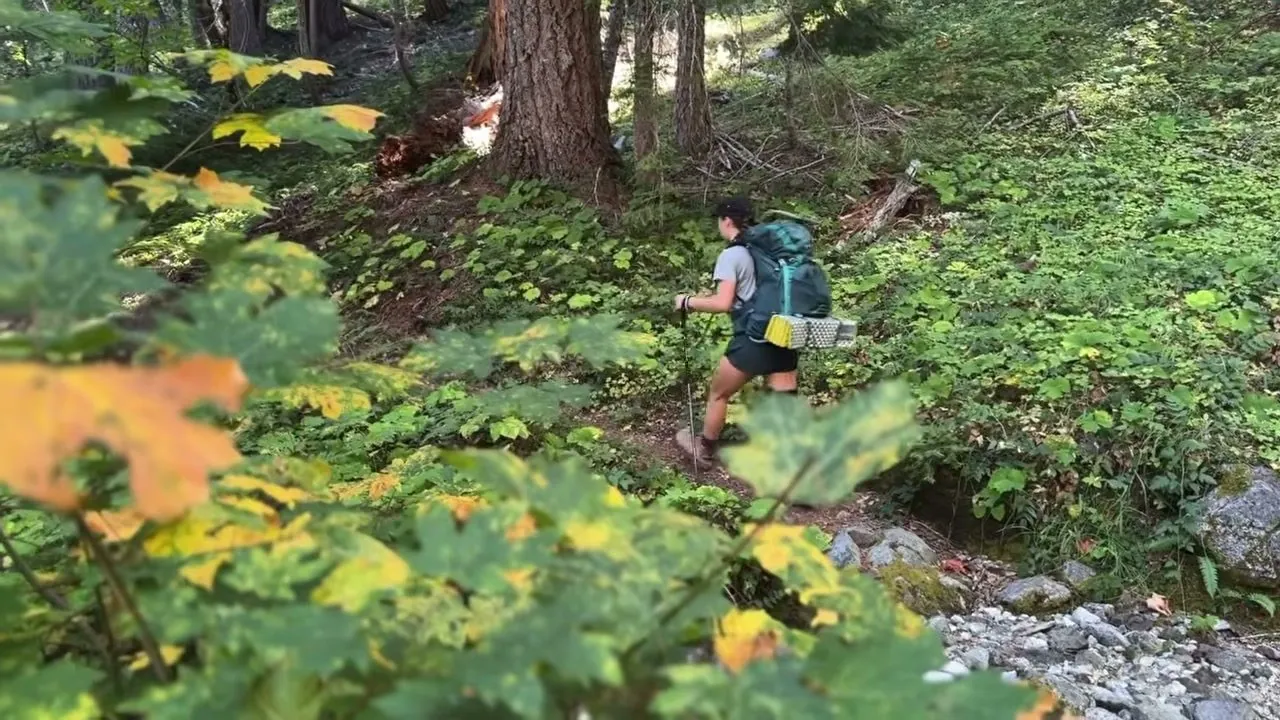
A hiker walks a forest trail with a loaded backpack and trekking poles. Frame from Outdoor Adventure Training's video.
- Heavier packs for Kilimanjaro: Alpine Ascents' training page starts with up to 1,000 feet of climbing over 4 to 6 miles with a 10 pound pack. It adds 2 to 3 pounds per hike until 20 pounds, then aims for 25 pounds. Its sample day pack range is 15 to 25 pounds. Something to note is that Alpine Ascents' plan is training for a high altitude trek, so its pack is heavier than a normal day hike needs.
- Carry your trip weight by the end: Wildland Trekking says to carry the weight you expect on your trip by the end of training. It also says to start without a pack on unfamiliar terrain.
- Use water as the weight: Alpine Ascents suggests gallon water jugs so you can pour water out at the top and lighten the walk down. Short Guys Beta Works says the same, so you can dump water if your knees complain.
- What extra weight costs: Short Guys Beta Works says 5 pounds on your back is "about 5%" more energy, and a 20 pound pack costs "well over 500 calories" extra on a 14er day. A 14er is a mountain over 14,000 feet. Those are the presenter's own figures, and a lab didn't measure them.
What are back-to-back hiking days, and when should you add them?
A back-to-back is two hard hiking days in a row. The point is to practice hiking on tired legs, because a multi-day trek or a summit push asks for that.
Alpine Ascents' Kilimanjaro sample gives one idea. Day 1 uses a 20 pound pack and at least 2,000 to 3,000 feet of gain. Day 2 uses a somewhat lighter pack and more miles, "to simulate your approach and summit days." In its sample week, Saturday is 6 to 8 miles with 20 pounds and 3,000 feet. Sunday is 8 to 10 miles with 15 pounds and 3,500 feet. Alpine Ascents says to start back-to-backs about one month before the climb.
For an ordinary hiker, here is my suggestion. Make your first back-to-back modest, for example 3,000 feet on day one and 1,500 to 2,000 feet on day two. And wait until you've done a loaded 3,000 foot day at least twice. That first back-to-back is my plan choice, and it isn't a medical rule.
How much rest do you need?
So take at least one full rest day a week. The European College of Sport Science and the American College of Sports Medicine wrote a joint statement on overtraining. The statement says athletes should have "at least one passive rest day each week." A passive rest day means a day with no training. The statement is by Meeusen and colleagues, 2013, and the link is a copy hosted by a sports medicine site.
The same statement also advises:
- Keep a record of how your training and performance go.
- Take a full rest day, or ease your training, when your performance falls or you feel excessively tired.
- Get enough sleep and food.
And from the guide companies, Alpine Ascents says to take at least one recovery day a week and stretch for 5 to 10 minutes after workouts. Both Alpine Ascents and Wildland Trekking say to taper, which means to train lighter, in the last week or more before a big trip.
Now count the walk down too. Chase Mountains, a trekking company's YouTube channel, says most trouble and injury reports come on the descent. So give going downhill its own practice, and read my page on knee pain going downhill.
What are the signs you're doing too much?
Here are the signs that health and sports medicine bodies list. I can't tell you what's wrong with you, and neither can a list. The joint statement says no single test or marker diagnoses overtraining.
- Tiredness that doesn't clear after a rest day or an easy week. The joint statement lists falling performance, lower energy and more fatigue as the first signs of long-lasting training distress. Hikes that used to feel fine now feel hard.
- Sleep that slips, a low mood or colds that keep coming. The same statement says mood changes are part of the picture, and sleep problems and illness, most often colds, may show up too. It says recovery can take weeks or months.
- Pain that keeps getting worse. NIAMS lists pain when you exercise, and swelling and a dull ache at rest, as signs of overuse injuries. It says overuse injuries can sometimes wear down tissue and joints and set the stage for a sudden injury. Don't push through pain that keeps getting worse.
- Dark, red or cola-colored urine, less urine, or muscle weakness, stiffness, aching or tenderness. MedlinePlus, the US National Library of Medicine's health site, lists these as signs of rhabdomyolysis. Basically, rhabdomyolysis is severe muscle breakdown, and severe exertion, such as marathon running, is one listed cause. MedlinePlus says to contact your health care provider if you have these symptoms.
So if you have any of those signs, take extra rest and ease off your plan. See a doctor if the tiredness or pain doesn't go away, or if you have the urine or weakness signs above.
Can you train for big climbs if you live somewhere flat?
Yes, you can build real climbing fitness without hills. But the sources disagree on how much machines help, so here is what each one says.
- Stairs: Wildland Trekking says stairs are the best substitute for trail climbing. RMI says moving your body uphill on stairs is like mountaineering, and its staff give a rough conversion of about 100 flights in an hour for 1,000 feet an hour. A flight means a story of about 10 feet.
- Incline treadmill: Most gym treadmills top out around 15% incline, according to RMI and Outdoor Adventure Training. Outdoor Adventure Training says to walk the incline with a loaded pack. Wildland says to use a steep incline and not hold the rails, because holding them takes away body weight. RMI says treadmill walking feels easier than the real thing, but a reader comment on RMI's page argues the opposite.
- Stair machines: Outdoor Adventure Training says a StairMaster copies elevation gain. Alpine Ascents lists stairs, an incline treadmill and a StairMaster as flat land options.
- The counter view: Chase Mountains, in its 2018 video below, says to avoid machines, because machines train you going up but not coming down, and not on uneven ground. It says real stairs, up and down, and a hill path are better.
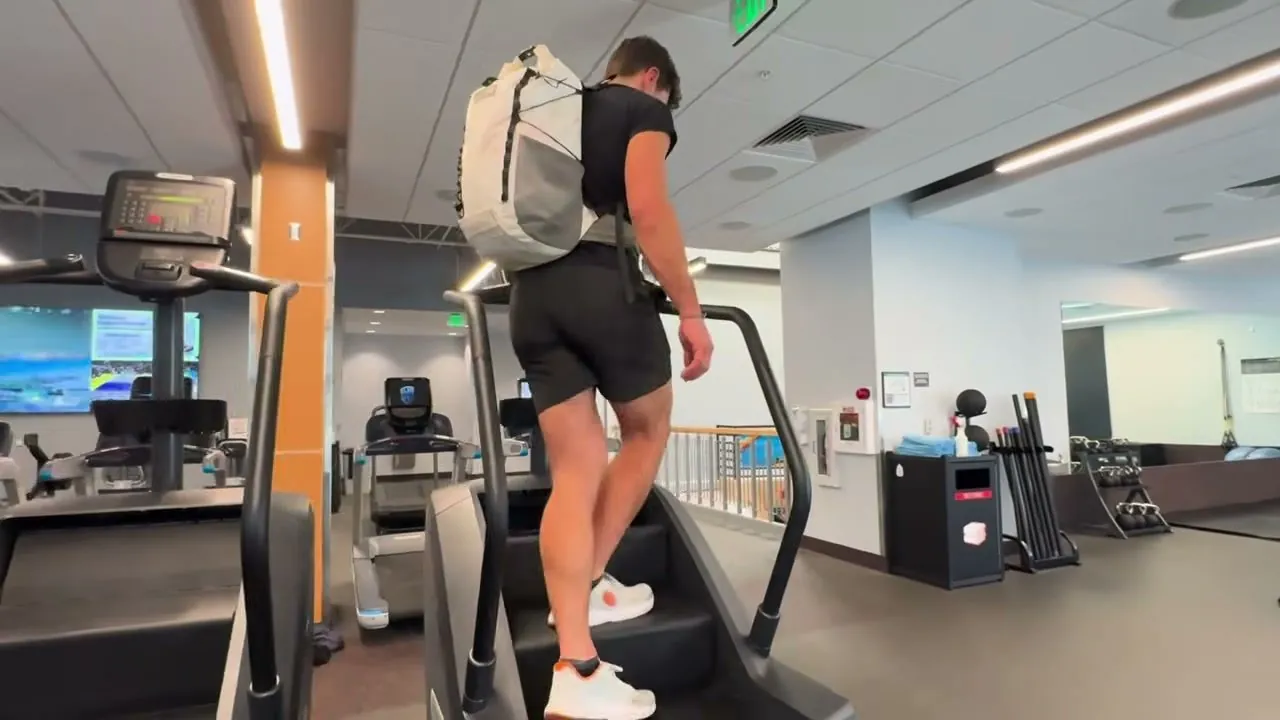
A person trains on a stair machine in a gym wearing a loaded backpack. Frame from Outdoor Adventure Training's video.
Where the sources agree: stairs and an incline add climbing fitness, and none of them replaces a long day on your feet. Going downhill needs its own practice. And start with no weight, then add a pack later. For altitude itself, Alpine Ascents suggests doing as many hikes at altitude as you can, to learn how your body reacts above 13,000 feet. The altitude sickness page covers that side.
Alpine Ascents' sample workout is hard hills or stairs for several minutes, then easy recovery on the way down, repeated for 20 to 45 minutes. Outdoor Adventure Training says strength work matters most when you can't hike, such as step-ups with good form for your glutes and hamstrings. Outdoor Adventure Training adds that a short hard session can't replace a long easy effort. If you're tired on stairs, hold the rail on the way down.
What gear do you need for big elevation days?
So you probably need less gear than you think. Boots and shoes are covered on the hiking boots vs hiking shoes vs trail runners page. Layers are on the how to layer page, and heel blisters are on the heel blister page. At this step, two things are worth a closer look: a daypack and trekking poles.
What you probably own already
Any comfortable daypack or school backpack with a chest strap or hip strap is fine for the first weeks. Trekking poles are optional until the downhills start to bother your knees. That is my opinion.
When is a new daypack worth it?
I'd upgrade your daypack when 10 or more pounds on a 6 hour day starts to hurt your shoulders, or the pack bounces as you walk. That is my opinion too. Below are picks tested by OutdoorGearLab, a gear review site. Prices are from each store page on October 16, 2026, so check the linked page before you buy.
| Pick | Price, checked October 16, 2026 | Weight | What the test found |
|---|---|---|---|
| Budget daypack: REI Co-op Flash 22. REI's Flash 22 page | $59.95 on REI's page, in stock | 17 oz measured | The Flash 22 is light and cheap. OutdoorGearLab says it is "not built for heavy loads or rough brush," so I'd use it for the lighter loads in the first weeks of the plan. |
| Step-up daypack: Osprey Sportlite 25. Osprey's Sportlite 25 page | $130 on Osprey's page, in stock | 27.2 oz measured | OutdoorGearLab tested the Sportlite 25. At 27.2 oz, the Sportlite 25 weighs about 10 oz more than the Flash 22. |
| For heavier loads: Gregory Zulu 24 LT. REI's Zulu 24 LT page. Gregory's own site now sells the Zulu 28 LT in its place. | $126.97 on sale at REI, down from $169.95, in stock. The Zulu 28 LT is $179.95 on Gregory's page. | 36.8 oz measured | OutdoorGearLab lists the Zulu 24 LT for heavier loads. The Zulu 24 LT is the heaviest of the three packs. Gregory no longer lists the Zulu 24 LT, and OutdoorGearLab didn't test the newer Zulu 28 LT. |
OutdoorGearLab's daypack test was updated November 18, 2025. The weights above are OutdoorGearLab's measured weights.
Do you need trekking poles?
Trekking poles are a pair of walking sticks. Hikers use them for balance with a pack and on long downhills. I'd wait until downhills hurt your knees before you buy poles, and then read the knee pain page first.
| Pick | Price, checked October 16, 2026 | Weight and size | What the test found |
|---|---|---|---|
| Budget poles: Trekology Trek-Z 2.0. Amazon page for the Trek-Z 2.0 | $34.84 for the pair on Amazon, in stock. OutdoorGearLab lists $56. | 19.1 oz per pair, 100 to 120 cm long | OutdoorGearLab named the Trek-Z 2.0 its best budget pick. The Trek-Z 2.0 isn't ultralight, and OutdoorGearLab notes some online complaints about its durability. |
| Step-up poles: Black Diamond Trail Back. Black Diamond's Trail Back page | $99.95 on Black Diamond's page, in stock | 18.25 oz per pair (OutdoorGearLab) | OutdoorGearLab named the Trail Back its best value pick and called the poles "practical, user-friendly, and one of the most durable." The Trail Back is heavy and bulky when collapsed. |
OutdoorGearLab's trekking pole test was updated October 2, 2026. Its top pick overall is the MSR DynaLock Ascent Carbon, at $189.95 on REI's page on October 16, 2026, and 15.7 oz, if you want a lighter step-up.
Videos worth watching about building up to big days
And if you want to see more, here are three videos. You can play each one right here on the page, and YouTube's usual controls work, including skipping ahead, changing the speed and going full screen. Under each video is a short summary so you can decide if it's worth your time.
A presenter's plan for building up to a 14er, a mountain over 14,000 feet, using distance, climbing and pack weight.
- Three things to train: Train distance, climbing and pack weight, each up to about 125% of your target.
- The order: Raise distance and climbing first, then add pack weight.
- The routine: Do about an hour of exercise a day and one progression workout a week. Step back if a step is too hard, and try lower peaks first.
- Worth knowing: The numbers are the presenter's personal opinion, and no research backs them.
A look at training for hiking when you don't live near mountains.
- Easy hours: Log easy zone 2 hours for endurance.
- Machines: Use an incline treadmill, which many gyms set up to 15%, with a loaded pack, and a StairMaster to copy climbing. A short hard session doesn't equal a 3 hour easy effort.
- Strength: Step-ups, glute and hamstring work and lunges fill in the rest, and downhill strength matters because you have to get down.
- Worth knowing: The channel gives charts of vertical feet per hour, and those are its estimates. It also sells a paid program, which this page doesn't promote.
A short counter view from a trekking company on gym machines.
- The claim: Machines only train going up, not coming down, and not uneven ground.
- The alternative: Use real stairs, up and down, plus a hill or path for practicing the descent.
- The reason: Most discomfort and injury reports come on the way down.
- Worth knowing: The video is from 2018, and Chase Mountains disagrees with the Outdoor Adventure Training video above.
What's next after you can do a big elevation day?
Once you can do a loaded 3,000 to 5,000 foot day and repeat it the next day, you're ready for the next steps on the path. If you plan a trek that sleeps high, read the altitude sickness page next, because altitude brings problems that this plan doesn't cover. And to see where this fitness leads, read Kilimanjaro vs Everest Base Camp.
And if the hike itself is hurting, these pages help: stopping heel blisters, knee pain going downhill and being out of breath going uphill.
My take
So ultimately, add one thing at a time, in this order: climbing, then distance, then pack weight. Take at least one full rest day every week, and make every fourth week an easier one if you follow my plan. Repeat any week that feels like too much.
The 10% a week figure is a rule of thumb, and my 15 week plan is my own suggestion, so use both as a guide and not a rule. And if you have a health condition, or tiredness or pain that won't clear, talk to a doctor.
Have a question about “How to build up from short hikes to big elevation days”?
Ask it here. Every question comes to me first. I answer as many as I can, and each answered question goes on this page with my answer so other hikers and climbers can see it too. I don't ask for your email, so check back on this page for the answer.
More training guides
- Appalachian Mountain Club, Couch to 4K, checked October 16, 2026: elevation gain, levels and repeating a level.
- Rainier Mountaineering Inc., Mountaineering Training: Training for Vertical Gain (March 11, 2019), checked October 16, 2026: climbing pace, treadmill and stairs.
- Alpine Ascents, climb training page, checked October 16, 2026: 10% steps, pack weights, back-to-back sample, recovery day, flat land options.
- Wildland Trekking, Training for Extreme Elevation Gain (January 27, 2021), checked October 16, 2026.
- Buist and colleagues, randomized trial in novice runners, American Journal of Sports Medicine, 2008, checked October 16, 2026.
- Frandsen and colleagues, How much running is too much?, British Journal of Sports Medicine, 2025, checked October 16, 2026.
- National Institute of Arthritis and Musculoskeletal and Skin Diseases, Sports Injuries (reviewed September 2024), checked October 16, 2026.
- Meeusen and colleagues, Prevention, diagnosis and treatment of the overtraining syndrome: joint consensus statement of the European College of Sport Science and the American College of Sports Medicine (2013), checked October 16, 2026.
- MedlinePlus, Rhabdomyolysis (reviewed September 2, 2025), checked October 16, 2026.
- US Centers for Disease Control and Prevention, Adding physical activity for adults, checked October 16, 2026.
- OutdoorGearLab, best trekking poles (updated October 2, 2026) and best daypacks (updated November 18, 2025), checked October 16, 2026.
- Black Diamond, Trail Back trekking poles, checked October 16, 2026.
- Store pages for prices and stock, checked October 16, 2026: REI Co-op Flash 22, Osprey Sportlite 25, Gregory Zulu 24 LT at REI, Gregory Zulu 28 LT, Trekology Trek-Z on Amazon and MSR DynaLock Ascent Carbon at REI.
- Videos, watched October 16, 2026: Short Guys Beta Works, Outdoor Adventure Training and Chase Mountains.
Everest Buddy is an independent site. No gear maker, store or guide company paid to be on this page. This guide gives general information, not medical advice, so see a doctor before you start a new training plan or travel to high altitude.