
So this page is for you if you've done a few short hikes and want to go higher and colder. It's also for you if you're buying outdoor clothing for the first time and the store staff just started talking about "layering systems." Basically, you'll learn what each piece does, so you can stop sweating and then freezing.
Keep in mind that prices change, and sales change them a lot. Every price on this page was checked on October 16, 2026, so check the linked page before you buy.
Quick picks
Why wear layers instead of one thick jacket?
So the reason to wear layers instead of one thick jacket is simple. On a mountain your body heat changes all the time. You make a lot of heat climbing uphill, and you lose it fast when you stop or the wind picks up.
The National Park Service's Rocky Mountain National Park page on hypothermia says to dress in wicking layers, so you can take off and add layers as needed. Wicking means the fabric moves sweat away from your skin. The same page says to always pack a waterproof layer. You can read it at nps.gov/romo/planyourvisit/hypothermia.htm.
The Centers for Disease Control and Prevention (CDC) page on preventing hypothermia says to wear several layers of loose-fitting clothing. It also says hypothermia can happen at cool temperatures if you get chilled from rain, sweat or falling into cold water. Hypothermia means your body temperature has dropped abnormally low, and the CDC calls it a medical emergency. That page is cdc.gov/winter-weather/prevention.
What does each layer do?
So there are four jobs, and each job gets its own piece of clothing.
What is a base layer?
The base layer is the thin shirt (and, in the cold, the thin leggings) that touches your skin. Basically, the base layer's job is to move sweat off your skin so the sweat can dry, and to add a little warmth.
Now in OutdoorGearLab's test of 21 base layers, the two main fabrics traded off like this.
- Merino wool stays warm when wet, resists odor and feels soft. But merino is delicate, less durable, slower to dry and costs more.
- Synthetic fabric (made from polyester or similar) dries fast, is tougher and costs less. But synthetic holds odor, is less warm than wool and breathes less.
- Blends try to give you some of both. Two examples are the Smartwool Intraknit Thermal Merino Base Layer Crew and the Ibex Woolies Pro Tech Crew ($120 on Ibex's page, checked October 16, 2026).
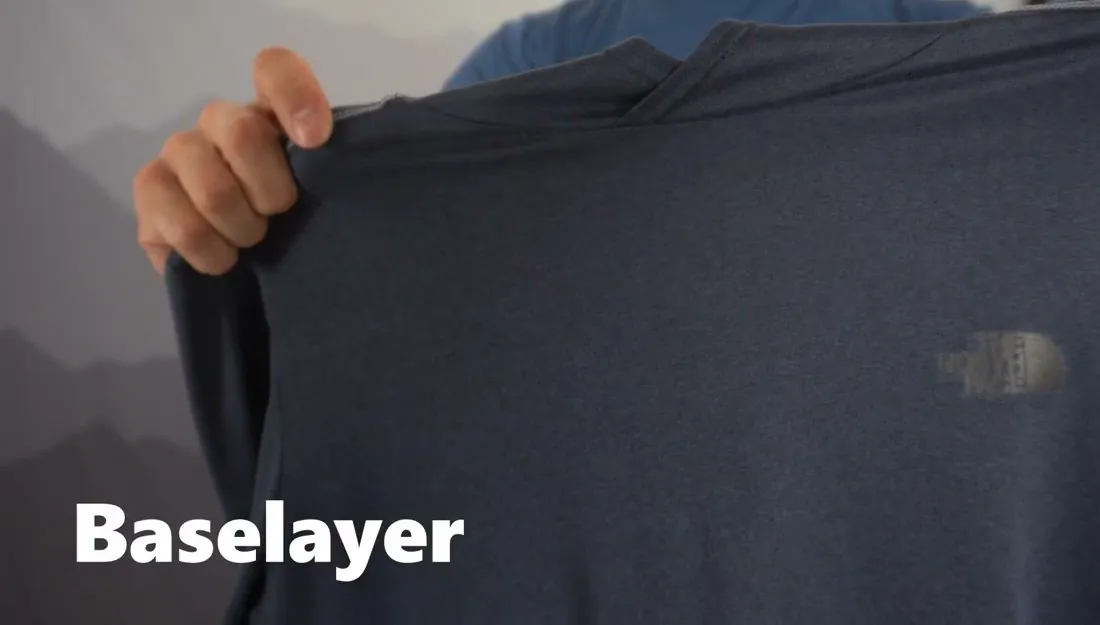
A base layer is a thin, close-fitting shirt like this one that sits against your skin. Screen from Ultimate Kilimanjaro's video.
What is a mid layer?
The mid layer goes over the base layer. The mid layer is usually a fleece or a thin insulated jacket. Basically, its job is to trap warm air next to your body while you're moving.
OutdoorGearLab's fleece testing found lightweight fleece is more breathable, and heavier fleece is warmer but less breathable. So a thin fleece suits hard uphill hiking, and a thick fleece suits standing around in the cold.
A thin insulated jacket is the other choice, and OutdoorGearLab says the thinner insulated jackets work well as breathable mid layers. So my take is that a fleece costs less and breathes well, but it's bulky and doesn't block wind. A thin insulated jacket is warmer for its weight and packs smaller, but it costs more and can trap sweat.
What is a shell?
The shell is the outer layer, and its job is to stop wind and rain. Something to note is that a shell is not where your warmth comes from. The warmth comes from the layers under the shell.
There are three kinds of outer jacket, and the names get mixed up in stores.
- A rain jacket is the light, cheaper waterproof jacket made for hiking.
- A hardshell is the tougher, more expensive version made for wind, snow and climbing. A hardshell has stronger fabric, a bigger hood and more pockets.
- A softshell is a stretchy, breathable jacket for wind and light drizzle. A softshell is not a rain jacket. OutdoorGearLab says a softshell shouldn't stand in for real hardshell or rain gear beyond a brief thunderstorm.
The National Park Service's Rocky Mountain page above says to always pack a waterproof layer. So for a mountain, carry a rain jacket or a hardshell. A softshell is an extra, not a replacement.
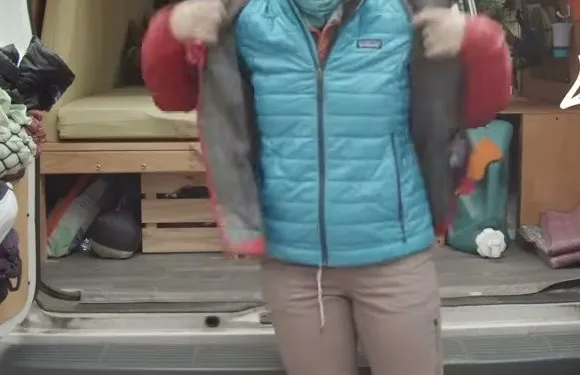
A hiker pulls a red hard shell on over a blue synthetic puffy vest, because the shell goes outside everything else. Screen from REI's video.
What is a puffy jacket?
A puffy is a thick insulated jacket, filled with down feathers or a synthetic fill. The puffy's job is warmth you add when you stop, or when it gets very cold. You wear it over your other layers.
Now in OutdoorGearLab's testing, down and synthetic fill trade off like this.
- Down gives the most warmth for its weight and squeezes down small. But down does not keep its fluffiness when wet, and it costs more.
- Synthetic fill stays warm when wet, dries fast and costs less. But a synthetic puffy is heavier and bulkier.
So my take is that if rain or wet snow is likely, you should keep a down puffy under your shell or inside a dry bag.
Why avoid cotton and jeans on a mountain?
Basically, cotton soaks up water and holds it. The National Park Service's Rocky Mountain page says to avoid clothing that absorbs and holds water, like cotton and jeans (source).
The National Park Service's page for Gauley River National Recreation Area says to avoid sweating by dressing in layers. The Gauley River page also says to replace clothes that get wet, and to carry an extra pair of dry clothes, especially dry socks (nps.gov/gari/planyourvisit/hypothermia.htm).
The National Park Service's Hike Smart page says to have your rain equipment packed and ready, and to bring wool or synthetic socks that wick moisture. I cover socks and blisters in my guide to stopping heel blisters.
Now the REI video I embed below, from REI's own channel, says the same thing in a gentler way. The host, Miranda, says to avoid cotton unless you're hiking in a really warm temperature. So my take is that a cotton T-shirt is fine for a short, warm, dry walk. But a cotton T-shirt is a bad idea once the day might turn wet, windy or cold.
What are the warning signs that someone is too cold?
The CDC page on preventing hypothermia lists these signs in adults: shivering, exhaustion or feeling very tired, confusion, fumbling hands, memory loss, slurred speech and drowsiness (source).
The CDC calls hypothermia a medical emergency. The CDC says that if you notice these signs, take the person's temperature, and if it's below 95°F, get medical attention immediately. Rocky Mountain National Park's page says to work to get professional medical help immediately.
Keep in mind that a mountain may have no phone signal, so plan for that before you leave. This page doesn't give treatment steps, so follow what emergency responders tell you. My altitude sickness guide covers when to go down.
What do you probably already own that works for first hikes?
Now you probably don't need to buy anything for your first hikes. This is my starting list, built from the advice above.
- Shirt: Any polyester or nylon athletic shirt works, as long as it isn't cotton.
- Warm layer: Bring a fleece or sweatshirt that isn't cotton, like a polyester fleece.
- Rain layer: Bring a basic rain jacket or windbreaker, and keep it in your pack if there's any chance of rain.
- Head and hands: Bring a hat and light gloves.
- Pants: Skip jeans, because the National Park Service's Rocky Mountain page lists jeans as clothing that holds water.
I cover footwear in my guide to hiking boots vs hiking shoes vs trail runners.
What should you upgrade first, and why?
So here is the order I'd go in. This is my opinion and not a tested ranking.
- The shell first. The National Park Service says to always pack a waterproof layer, and the shell is the layer that blocks rain and wind.
- A midweight fleece second. Your warm layer is what you reach for at every windy rest stop.
- A puffy third. You'll want a puffy once your hikes get cold or long.
- A better base layer last. A synthetic shirt you already own does most of the same job.
Which layers should you buy? Picks from gear tests, with prices
Now these picks come from OutdoorGearLab's hands-on tests, and the scores and quotes below are theirs. Each price is the regular price on the maker's or store's page, checked October 16, 2026, and sale prices are often lower. Weights are OutdoorGearLab's measured weights unless I say otherwise.
Which base layer should you buy?
| Pick | Price and weight | Good at | Not so good at | Links |
|---|---|---|---|---|
| Budget: REI Co-op Midweight Half-Zip Base Layer Top (men's), synthetic | $69.95 on REI's page, checked October 16, 2026. 10.0 oz (size L). Tall sizes showed as sold out. | The REI half-zip scored 77 and came second of 21. Testers said it is "more durable than most wool layers." | The REI half-zip is synthetic, so it holds odor and is less warm than wool. | REI's page, OutdoorGearLab review |
| Step-up: Smartwool Classic Thermal Merino Quarter-Zip (men's), 100% merino | $130 on REI's page, checked October 16, 2026. 11.3 oz (size L). | The Smartwool quarter-zip ranked first of 21 and won OutdoorGearLab's Editors' Choice award, with a score of 80. It air-dried in 70 minutes in testing. | Merino as a fabric is delicate and slower to dry than synthetic. | REI's page, OutdoorGearLab review |
| Cheaper merino: Merino.tech Crew (men's), sold by Merino.tech as the Men's Merino Long Sleeve 165 | $49.99 on Merino.tech's page, checked October 16, 2026. 6.8 oz. | The Merino.tech shirt is the lightest and cheapest of the three men's picks, and it's 100% merino. | The Merino.tech shirt ranked 20th of 21 with a score of 67. Testers called it "less durable." | Merino.tech's page, OutdoorGearLab review |
| Women's budget: REI Co-op Midweight Long-Sleeve Crew Base Layer Top (women's) | $64.95 on REI's page, checked October 16, 2026. OutdoorGearLab's roundup doesn't list the weight. | The REI women's crew won OutdoorGearLab's Best Buy award in the women's base layer guide. | The REI women's crew is synthetic, so it holds odor more than merino. | REI's page, OutdoorGearLab review |
| Women's step-up: Icebreaker Merino 200 Oasis Long Sleeve Crewe (women's) | $120 on Icebreaker's page, checked October 16, 2026. OutdoorGearLab's roundup doesn't list the weight. | The Icebreaker Oasis won OutdoorGearLab's Editors' Choice award in the same guide. | The Icebreaker Oasis is merino, so it costs about twice the REI women's crew. | Icebreaker's page, OutdoorGearLab review |
So ultimately, if you want one base layer for the money, my take is the REI synthetic half-zip. And if you can spend more and want a shirt that resists odor, the Smartwool merino quarter-zip is the one that tested best.
Which mid layer should you buy?
| Pick | Price and weight | Good at | Not so good at | Links |
|---|---|---|---|---|
| Budget: REI Co-op Trailmade Fleece Jacket (men's), midweight fleece | $69.95 on REI's page, checked October 16, 2026, with some sizes sold out. 13.0 oz (size M), and REI lists 12.7 oz. | The Trailmade is good value for cool weather and rest stops. | The Trailmade scored 73 and came ninth of 18. The tester said it has "limited breathability" and isn't well suited to high-output hikes or warm days, so hard uphill hiking makes you sweat in it. | REI's page, OutdoorGearLab review |
| Step-up: Patagonia R1 Air Full-Zip Hoody (men's) | $199 on Patagonia's page, checked October 16, 2026. 12.4 oz. The women's R1 Air Full-Zip Hoody is also $199 and weighs 10 oz. | The R1 Air won OutdoorGearLab's Editors' Choice award in the fleece guide. | The R1 Air costs nearly three times the Trailmade. | Patagonia's page, OutdoorGearLab review |
| Breathable alternative: Rab Ascendor Light Hoody (men's) | $130 on Rab's page, checked October 16, 2026. 12.8 oz, and Rab lists 10.9 oz (size M). | The Ascendor Light won OutdoorGearLab's Top Pick award. Testers say it's for "people who overheat in traditional fleece." | Testers say the Ascendor Light isn't very warm. | Rab's page, OutdoorGearLab's fleece guide |
Which shell should you buy?
Something to note is the "2.5-layer" and "3-layer" labels in this table. Basically, the labels describe how the waterproof fabric is built. REI's rainwear guide says a 2.5-layer jacket is light and the lowest priced, and a 3-layer jacket gives the best protection and breathability at the highest price.
| Pick | Price and weight | Good at | Not so good at | Links |
|---|---|---|---|---|
| Budget: REI Co-op Rainier Rain Jacket (men's), 2.5-layer | $99.95 on REI's page, checked October 16, 2026. 12 oz (size M). REI has replaced the older Rainier listing with a newer version, and REI lists the newer one at 11.3 oz. | The Rainier scored 71 and came 12th of 18. The Rainier kept the tester dry in short storms and long light rain. Its pit zips (zippers under the arms) dump heat quickly. | Heavy, sustained rain let moisture seep into the Rainier. OutdoorGearLab doesn't recommend it for multiple days of heavy rain far from help. | REI's page, OutdoorGearLab review |
| Step-up: Patagonia Torrentshell 3L (men's), 3-layer | $189 on Patagonia's page, checked October 16, 2026. 12.7 oz. | The Torrentshell scored 78, came third of 18 and won the Editors' Choice award. The tester called it "incredible value." | The Torrentshell is crinkly and less breathable. | Patagonia's page, OutdoorGearLab review |
| Climbing-level: Arc'teryx Beta SL Jacket (men's) | $500 on REI's page, checked October 16, 2026. REI lists 12 oz. | The Beta SL won OutdoorGearLab's Top Pick award. | The Beta SL costs five times the Rainier. | REI's page, OutdoorGearLab review |
| Lighter: Black Diamond Fineline Stretch Shell (men's) | $189 on REI's page, checked October 16, 2026. 9.4 oz, and REI lists 11.3 oz. | On OutdoorGearLab's scale, the Fineline weighed about 3 oz less than the Torrentshell. | The Fineline costs the same as the Torrentshell, so you're paying for the lighter weight. | REI's page, OutdoorGearLab review |
And OutdoorGearLab's rain jacket guide recommends a 3-layer build for the most storm protection. So if you expect real storms, the Torrentshell's 3-layer build is a better match than the Rainier's 2.5-layer build.
Do you need a softshell too?
Now a softshell is optional. A softshell is for windy or cold days where a rain jacket would be too sweaty, and it does not replace a rain jacket.
| Pick | Price and weight | Links |
|---|---|---|
| Budget: Rab Borealis Hooded Jacket (men's), softshell | $130 on REI's page, checked October 16, 2026. 9.2 oz (size M). | REI's page, OutdoorGearLab review |
| Step-up: Arc'teryx Gamma Hoody (men's), softshell | $300 on REI's page, checked October 16, 2026. 15.4 oz. | REI's page, OutdoorGearLab review |
Both softshells come from OutdoorGearLab's softshell guide, and the weights are OutdoorGearLab's measured weights.
Which puffy jacket should you buy?
| Pick | Price and weight | Good at | Not so good at | Links |
|---|---|---|---|---|
| Budget: Eddie Bauer CirrusLite Down Hooded Jacket (men's), 650-fill down | $149 on Eddie Bauer's page, checked October 16, 2026. 9.9 oz (size S). Eddie Bauer's page confirms 650-fill down. | The tester called the CirrusLite an "excellent price for a lightweight puffy." | The tester noted "less heat retention" and said the CirrusLite "lacks abrasion resistance." | Eddie Bauer's page, OutdoorGearLab review |
| Step-up: REI Co-op Magma 850 Down Hoodie (men's), 850-fill goose down | $259 on REI's page, checked October 16, 2026. 12.5 oz (size M), and REI lists 13.1 oz. An older Magma 850 Down Hoodie 2.0 listing shows as not available. | The tester called the Magma "the puffy I recommend most often." | The tester said the Magma is "not the absolute warmest." | REI's page, OutdoorGearLab review |
| Women's budget: Decathlon Simond MT100 Hooded Down Puffer Jacket (women's), 800-fill down | $119 regular on Decathlon's page, checked October 16, 2026, and on sale for $80 that day. 11.3 oz (size L). | The Simond MT100 won OutdoorGearLab's Best Buy award. | The Simond MT100 is down, so keep it dry under a shell in wet weather. | Decathlon's page, OutdoorGearLab review |
| Ultralight: Mountain Hardwear Ghost Whisperer Down Hoody (men's), 800-fill down | $399 on REI's page, checked October 16, 2026. Between 8.3 and 9 oz, because OutdoorGearLab's page gives both numbers, and REI lists 8.8 oz. | The Ghost Whisperer is very light for a down jacket. | The Ghost Whisperer scored 70 and came 11th of 23, so it costs a lot and tested in the middle of the pack. | REI's page, OutdoorGearLab review |
| Warmest tested: Feathered Friends Helios Hooded Down Jacket | $519 on Feathered Friends' page, checked October 16, 2026. | OutdoorGearLab calls the Helios the warmest jacket it tested. | The Helios is the most expensive puffy on this page. | Feathered Friends' page, OutdoorGearLab review |
The number after "fill" (650-fill, 850-fill) rates the quality of the down, and a higher number is better. So for most people the Magma is the one I'd pick, because the tester recommends it most often and it costs less than the ultralight and warmest options.
How do you add and remove layers while you walk?
Basically, the goal is to stay a little cool while you move and warm while you stop. Keep in mind that the tips from the videos are a guide's opinion, not a rule.
- Start a little cool. Miranda, the host of the REI video, says to dress as if it's 10 degrees warmer than it really is. Starting cool leaves room to warm up as you walk.
- Take a layer off before you start sweating. The National Park Service's Gauley River page says to avoid sweating by dressing in layers. And the CDC says getting chilled from sweat can lead to hypothermia.
- Open the vents before you take the shell off. A shell blocks wind, and pit zips are zippers under the arms. OutdoorGearLab's review of the REI Co-op Rainier says its pit zips dump heat quickly.
- Put a layer on before you feel cold. For me personally, this is the easy one to forget, and it's much easier than warming up after you've already gotten chilled.
- At every rest stop, put the puffy on first. Ultimate Kilimanjaro, a guide company, says to put the down jacket on before you eat, drink or fiddle with gear. Before you start walking again, take the down jacket off and put it at the top of your pack.
- Keep one dry layer in your pack. The National Park Service's Gauley River page says to replace wet clothes and carry an extra pair of dry clothes, especially dry socks.
- Take layers off on the way down. Ultimate Kilimanjaro says to strip layers on the descent as the sun rises. The company also says to keep long underwear on, because it's a hassle to remove on the trail, and to carry a spare pair of gloves.
How do your layers change from a first hike to a cold summit?
Now the layers get heavier and more numerous as the cold and the height go up. This table is my starting point, and it's opinion unless a source is named.
| Where you are on the path | What to wear |
|---|---|
| First short hikes in mild weather | Wear a synthetic or wool shirt and whatever non-cotton fleece you own, and keep a rain jacket in the pack if there's any chance of rain. |
| Longer day hikes, mountains and wind | Add a fleece, a real rain jacket, a hat and light gloves. |
| A cold day or an overnight trip | Add a warm puffy for stops, and a proper base layer for your top and your legs. |
| A cold summit like Kilimanjaro | Ultimate Kilimanjaro (2025) recommends 4 to 6 layers on top and about 3 on the legs, with a down jacket over everything for stops. |
| High-altitude expeditions | This page doesn't cover expedition clothing. |
What does the layer list look like on Kilimanjaro summit night?
Ultimate Kilimanjaro lists these upper body layers as the standard summit night outfit: 1 or 2 base layers, 1 or 2 mid layers, 1 hardshell and 1 down jacket. For the legs, the company lists long underwear, hiking pants and rain pants. The same video says the down jacket is more likely for rest breaks.
Keep in mind that this list is one guide company's opinion, and conditions change. The video also warns against trusting strangers who sound sure about summit gear, and it says a light down jacket is not appropriate for Kilimanjaro. My Kilimanjaro vs Everest Base Camp guide covers that trip.
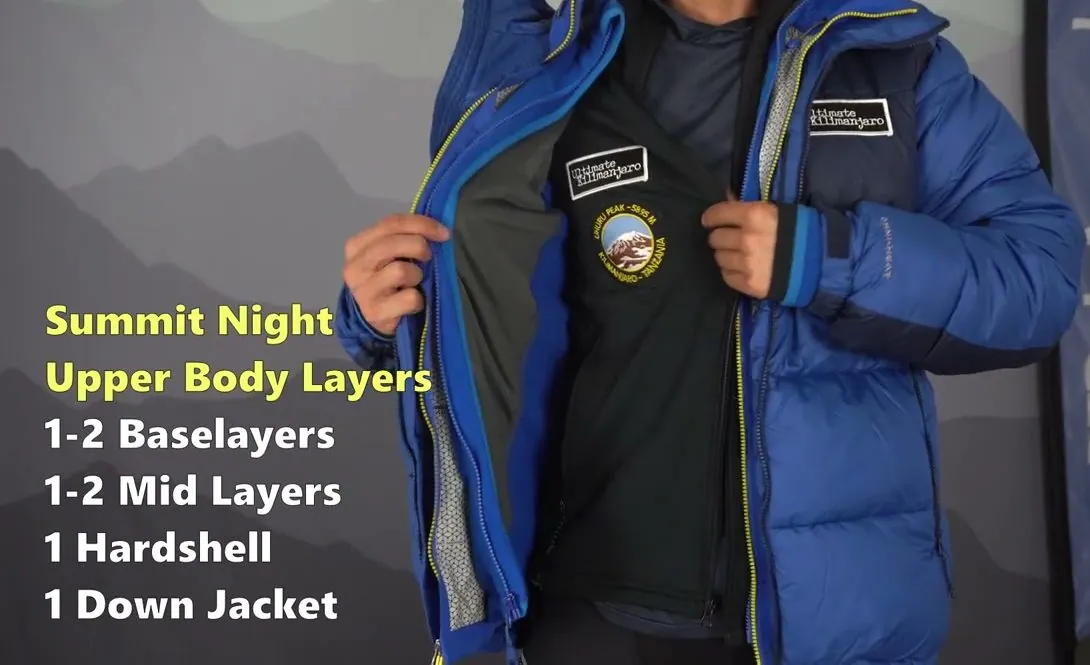
A guide opens the down jacket to show the layers under it, with the company's summit night list on screen. Screen from Ultimate Kilimanjaro's video.
How does a guide pick layers for different heights?
Ryan Tilley, a guide in Washington state, keeps different weights of pants and puffy jackets for different height bands. Tilley uses one set below 9,000 feet, one for 10,000 to 12,000 feet, and one for around 14,000 feet on Mount Rainier. Tilley says the Rainier set can be pushed higher. And Tilley also says "by no means do you need all this clothing."
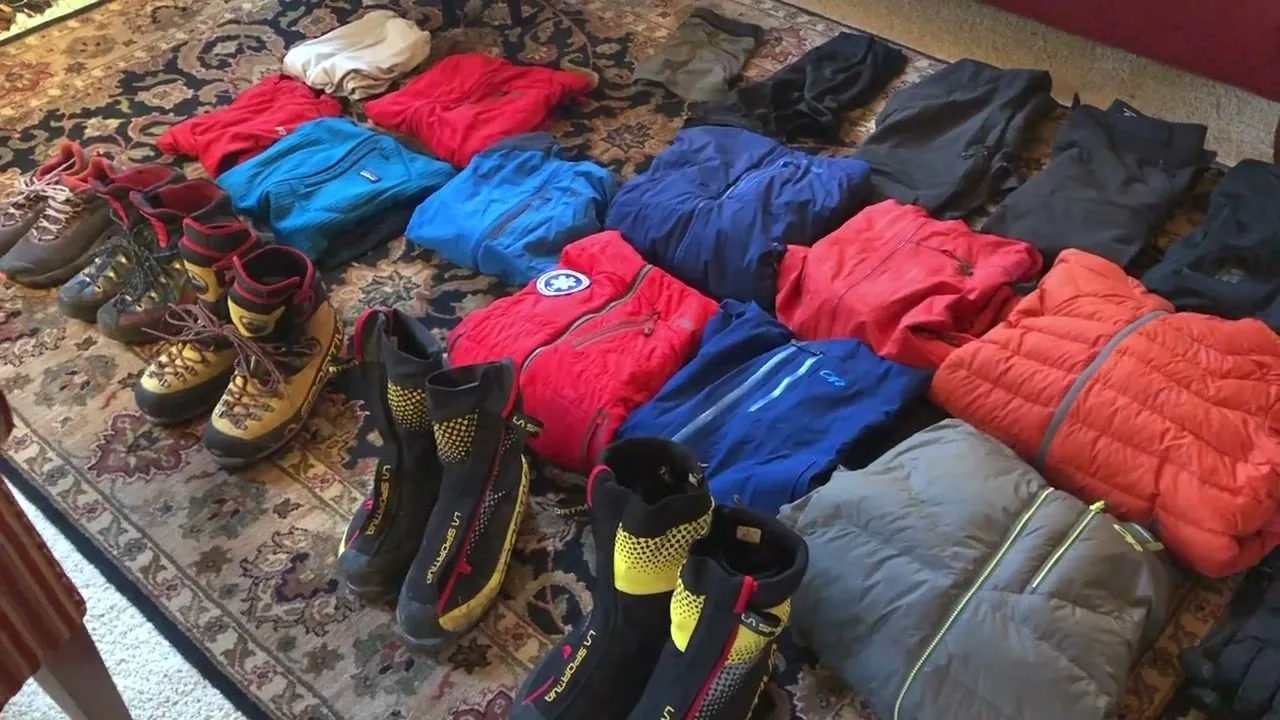
A guide's mountaineering clothing for several height bands, up to Mount Rainier, laid out on a floor with jackets and boots. Screen from Ryan Tilley's video.
Videos worth watching about layering
And if you want to see layering in action, here are three videos. You can play each one right here on the page, and YouTube's usual controls work, including skipping ahead, changing the speed and going full screen. Under each video is a short summary so you can decide if it's worth your time.
I'd start with this video if you're a beginner. Miranda, a host on REI's own channel, walks through the layers.
- Cotton: Miranda recommends avoiding cotton and explains that cotton holds moisture. Miranda says even a temperature that doesn't feel very cold can be dangerously cold when you're wet.
- Fabrics: Miranda says wool and synthetics are the answer, and explains the base, mid, insulating and outer layers.
- Rule of thumb: Miranda says to dress as if it's 10 degrees warmer than it actually is.
- Worth knowing: The video shows a summer set, a cool-weather set and a winter set. Keep in mind this is a store's own channel, and the advice is opinion.
A guide company shows what its guides recommend for the coldest night of a Kilimanjaro climb.
- The layer list: The company recommends 4 to 6 layers on top and 3 on the bottom, with the down jacket over everything for stops.
- Rest stops: The down jacket goes on first, before eating or drinking, and comes off before you walk again.
- The way down: The guide says to take layers off as the sun rises, keep long underwear on and carry spare gloves.
- Worth knowing: This is one company's opinion. The video says a light down jacket is not appropriate for Kilimanjaro, and it warns that conditions vary.
A long, detailed video from a Washington state guide, for people ready to go beyond day hikes.
- The sets: Tilley lays out clothing sets for below 9,000 feet, for 10,000 to 12,000 feet, and for Mount Rainier level.
- The key point: Tilley says "by no means do you need all this clothing."
- The format: The video shows a lot of Tilley's own gear laid out on a carpet.
- Worth knowing: The video is from 2019 and shows one guide's choices, so brands and models have likely changed.
What's next after layering?
Now you know the four layers. Your feet need the same thought, so start with my guide to stopping heel blisters, which covers socks and cotton socks. And if you haven't picked footwear yet, read my hiking boots vs hiking shoes vs trail runners guide.
And when your hikes start climbing higher, read my altitude sickness guide for the warning signs and when to go down. If you're thinking about a big trip, my Kilimanjaro vs Everest Base Camp guide covers where layers matter most.
This page covers the body layers, and it gives hats, gloves and socks only a short mention.
My take
So ultimately, wear thin layers you can add and take off, skip cotton, and carry a waterproof layer. For first hikes in mild weather, use the polyester shirt, non-cotton fleece and rain jacket you already own.
But for me personally, the shell is the first thing worth paying for, then a midweight fleece, then a puffy. If it fits your budget, the REI Co-op Rainier at $99.95 is my starting shell, and the Patagonia Torrentshell 3L at $189 is the step up. Both prices were checked October 16, 2026, so confirm them on the linked page.
And if you or anyone with you shows the warning signs above, like shivering, confusion, fumbling hands or slurred speech, treat it as a medical emergency and get help.
Have a question about “How do you layer for a mountain? Base layer, mid layer, shell and puffy, from a first hike to a cold summit”?
Ask it here. Every question comes to me first. I answer as many as I can, and each answered question goes on this page with my answer so other hikers and climbers can see it too. I don't ask for your email, so check back on this page for the answer.
More gear guides
- National Park Service, Rocky Mountain National Park, hypothermia (last updated March 6, 2026), checked October 16, 2026.
- National Park Service, Gauley River National Recreation Area, hypothermia (last updated January 30, 2015), and Hike Smart (last updated June 13, 2024), checked October 16, 2026.
- Centers for Disease Control and Prevention, Preventing Hypothermia (reviewed August 25, 2026), checked October 16, 2026.
- OutdoorGearLab guides, checked October 16, 2026: base layers (updated April 1, 2026), fleece jackets (updated September 30, 2026), rain jackets (updated May 1, 2026), insulated jackets (updated May 7, 2026), down jackets (updated June 16, 2026) and softshell jackets (updated October 9, 2026). OutdoorGearLab review dates: the REI half-zip and Smartwool quarter-zip, January 28, 2025. The Trailmade and Rainier, May 1, 2026. The Torrentshell, March 5, 2025. The CirrusLite, October 17, 2025. The Magma, April 12, 2025. The Ghost Whisperer, December 23, 2024.
- REI, rainwear layer descriptions on the REI Co-op Rainier page ("How to Choose Rainwear" section), checked October 16, 2026.
- Maker and store pages for every pick are linked in the tables, all opened and checked October 16, 2026.
- Videos, checked October 16, 2026: REI, Ultimate Kilimanjaro and Ryan Tilley.
Everest Buddy is an independent site. No gear maker, store or guide company paid to be on this page. This guide gives general information, not medical advice, so see a doctor before you start a new training plan or travel to high altitude.