
The story in brief. K2 is the second highest mountain in the world, at 8,611 meters, on the border of Pakistan and China. By 2020, all 14 of the world's mountains over 8,000 meters had been climbed in winter except K2. Its winter wind and cold had turned back every team, and nobody had climbed higher than 7,750 meters.
In December 2020, several teams arrived at K2 base camp, each hoping to be first. John Snorri of Iceland came with Ali Sadpara and his son Sajid Sadpara of Pakistan, and they arrived first, on December 5. Two Nepali teams, led by Nirmal "Nims" Purja and Mingma G, arrived later, after weeks of climbing in Nepal. A large commercial team from Seven Summit Treks came too, along with independent climbers such as Juan Pablo Mohr of Chile.
In mid January, a short spell of good weather opened. Ten Nepali climbers from the two Nepali teams and Seven Summit Treks joined up and reached the summit together on January 16, the first winter climb of K2. Snorri's team was not part of that push, and its members say they were told it wasn't happening. The same day, Sergi Mingote of Spain died in a fall low on the mountain.
After nearly two weeks of high wind, forecasts showed a short window around February 5. About 20 climbers, including Snorri's team and many Seven Summit Treks clients, reached Camp 3 on February 4 and spent a sleepless night crowded into a few small tents. They set off for the summit that night. Several climbers turned back, and Sajid turned back when his oxygen regulator leaked. Atanas Skatov of Bulgaria died in a fall. Snorri, Ali Sadpara and Mohr were last seen climbing near the Bottleneck, about 400 meters below the summit, and never came back. Their bodies were found in July 2021. Whether any of them reached the top, and what happened to them, is still unknown.
This article walks through that season in order. It explains how acclimatization works, which is the key to why the Nepali team could move so fast. Then it looks at what each team faced, what an expedition company normally provides and how that compares with what happened on K2, what is known about the five deaths, and what climbers can learn.
The 2026 documentary The Last First: Winter K2, on Apple TV, tells this story, and Where to watch the winter K2 documentary, near the end, covers how to see it. If you're new to big mountains, the guide to the 14 peaks over 8,000 meters explains where K2 fits.
K2 in winter: the last 8,000 meter peak nobody had climbed
K2 is 8,611 meters (28,251 feet) tall, on the border of Pakistan and China, and it's the second highest mountain on Earth. By 2020, every one of the 14 peaks over 8,000 meters had been climbed in winter except K2. Before the winter of 2020 to 2021, the highest anyone had reached on K2 in winter was 7,750 meters, by Denis Urubko and Marcin Kaczkan in the winter of 2002 to 2003.
Winter brings stronger wind and deeper cold to K2, and the air holds less oxygen than in summer, which I explain further down. Storms can also pin climbers at base camp for weeks, leaving only short breaks of calmer weather, called weather windows, to go for the top.
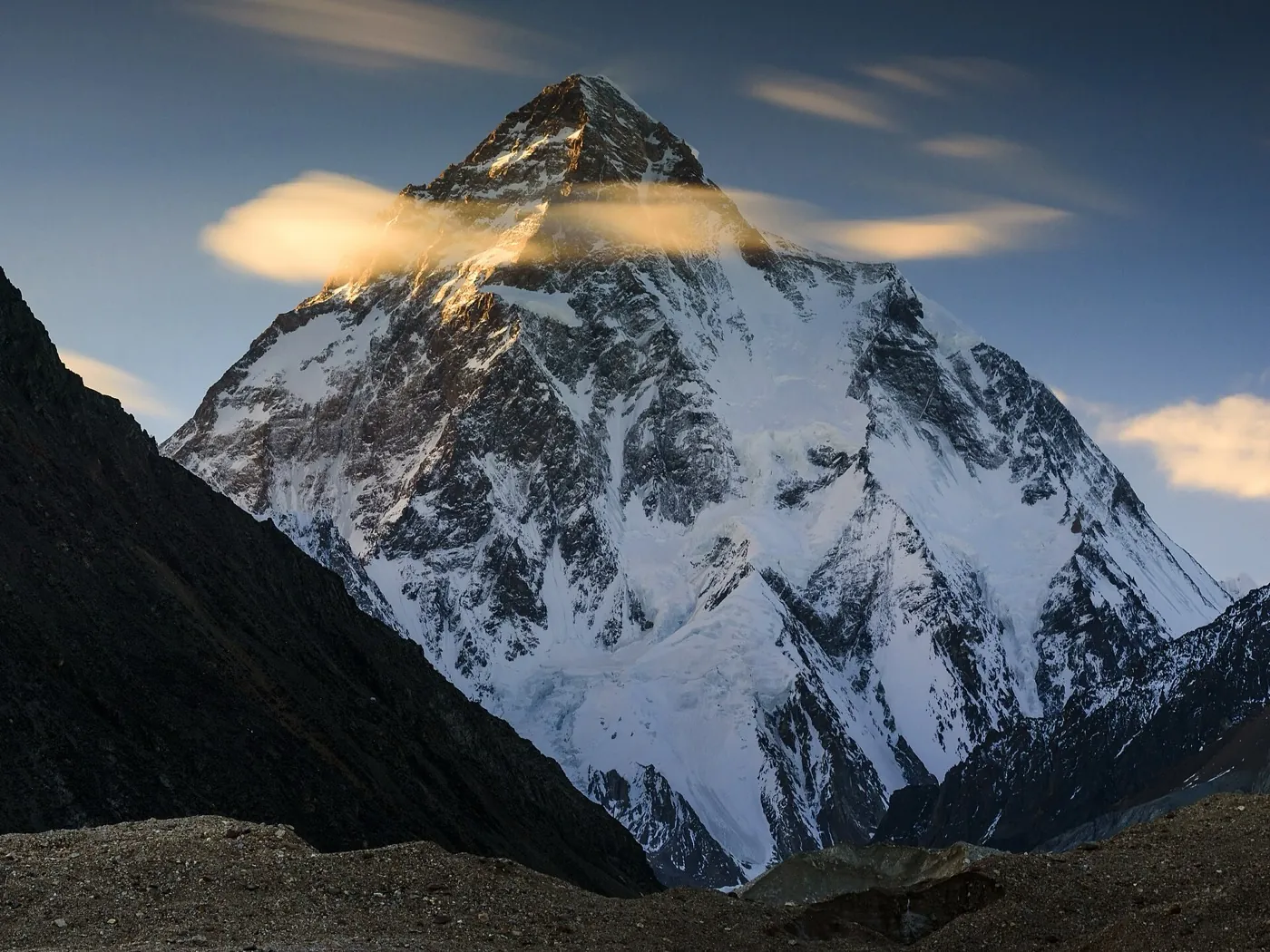
K2's south side at dusk, seen from the glacier on the way to base camp. Photo: Maqsood aktar, CC BY-SA 4.0, via Wikimedia Commons.
The route every team used: the Abruzzi Spur
All the teams that winter climbed the same route, the Abruzzi Spur on K2's southeast ridge, with camps on the way up. Base camp sits around 5,000 meters, and Camp 3 sits at about 7,400 meters. On the steep parts, climbers tie long ropes in place, called fixed ropes, so everyone behind can clip in and hold on. Near the top, the route squeezes through the Bottleneck, a narrow gully at about 8,200 meters.
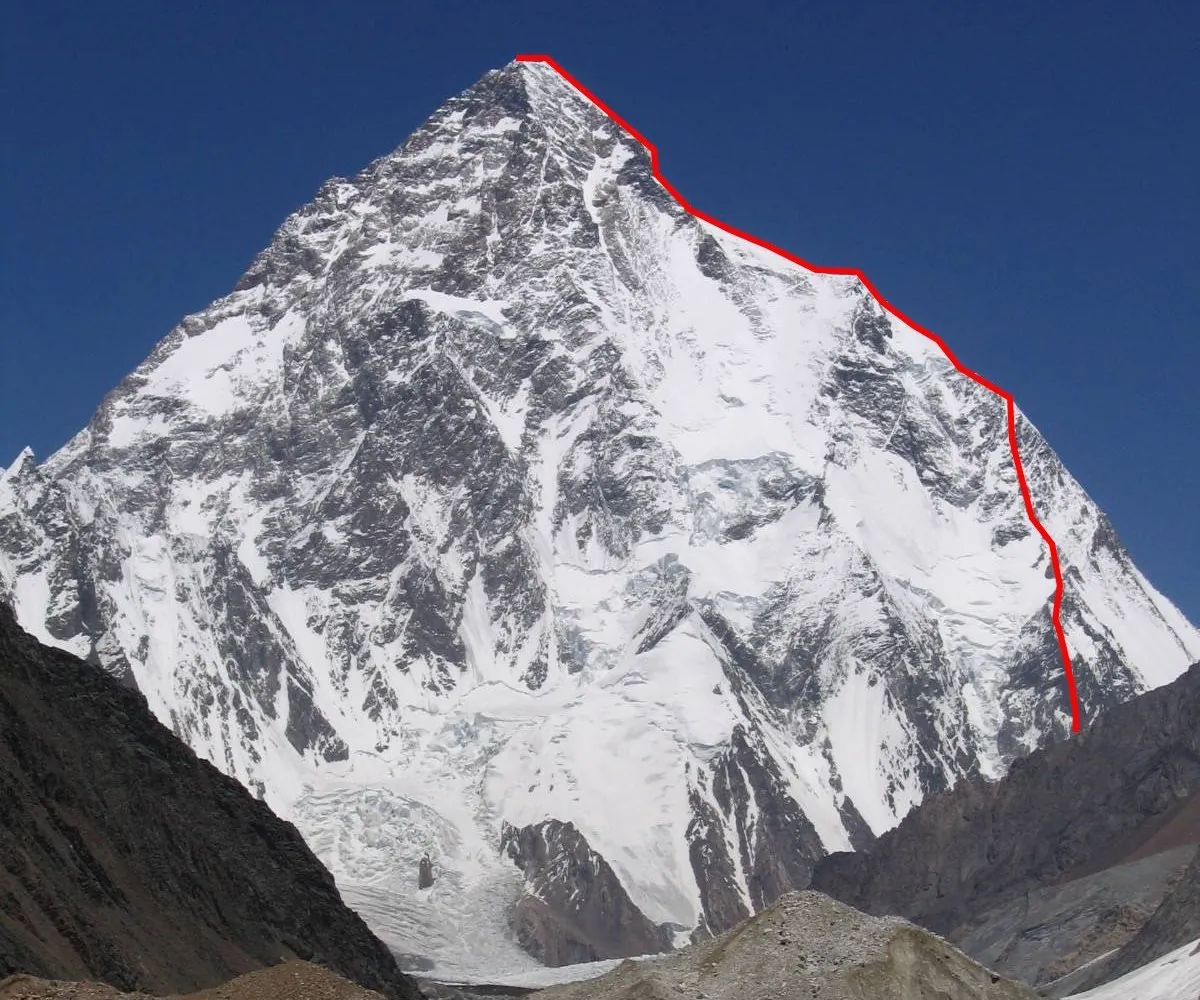
The red line shows the Abruzzi Spur, the route every team used in winter 2021. Photo: EMajor, from a photo by Svy123, CC BY 3.0, via Wikimedia Commons.
The teams racing to be first on K2 in winter
In the winter of 2020 to 2021, several teams went for the first winter climb of K2 at the same time. These are the teams that matter to what happened.
- Nirmal "Nims" Purja's Elite Exped team: Nims climbed with a group of Nepali climbers. Five of them went to the top with him: Gelje Sherpa, Mingma David Sherpa, Mingma Tenzi Sherpa, Dawa Temba Sherpa and Pem Chhiri Sherpa.
- Mingma Gyalje Sherpa's Imagine Nepal team: Mingma Gyalje Sherpa, known as Mingma G, climbed with Kili Pemba Sherpa and Dawa Tenjing Sherpa.
- Seven Summit Treks, a Nepali expedition company: Seven Summit Treks brought the biggest group on the mountain, 49 people. That was 22 paying clients and 27 Sherpa climbers, led by Chhang Dawa Sherpa with the Dutch guide Arnold Coster.
- John Snorri's team: John Snorri from Iceland climbed with Muhammad Ali Sadpara and his son Sajid Ali Sadpara from Pakistan, three people in all.
- Other independent climbers: These included Juan Pablo Mohr from Chile and Tamara Lunger from Italy.
What happened on K2 from December 2020 to July 2021
Snorri's team reached base camp first, nearly three weeks before the Nepali teams, yet the Nepali teams reached the top first. The table shows how the season unfolded.
| Date | What happened |
|---|---|
| Dec 5, 2020 | Snorri, Ali Sadpara and Sajid Sadpara reach base camp, the first winter team there. About a day later, wind flattens most of their tents. |
| Dec 13 to 17 | Snorri's team fixes about 600 meters of rope on the lower route and reaches Camp 1. |
| Dec 25 | Nims's team reaches base camp on Christmas evening, after weeks of climbing in Nepal. |
| Dec 30 to 31 | Nims's and Mingma G's teams fix rope to about 7,000 meters, the top of a steep rock section called the Black Pyramid. |
| Jan 3 to 4, 2021 | Snorri's team climbs to Camp 2 (6,700 m) and comes back down to base camp. |
| Jan 10 | Climbers find Camp 2 wrecked by wind. Seven Summit Treks reports five tents, oxygen bottles, fixed ropes and gear damaged or swept away. |
| Jan 14 to 15 | The Nepali climbers move up for the top. Snorri's team doesn't join them. The two sides tell this part differently, which I cover below. |
| Jan 16 | Ten Nepali climbers reach the top together at 4:58 pm local time. The same day, Sergi Mingote of Spain dies in a fall below Camp 1. |
| Jan 24 to 25 | Snorri's team climbs 17 hours from base camp to about 6,812 meters. Strong wind blows Ali Sadpara's backpack away, and they turn back. |
| Late January | Nearly two weeks of high wind. Nobody leaves base camp. |
| Feb 1 | Seven Summit Treks briefs its climbers on a fast plan. They'd reach Camp 1 on Feb 2, Camp 2 on Feb 3 and Camp 3 on Feb 4. Then they'd go straight to the top with no Camp 4. |
| Feb 4 | About 20 to 25 people reach Camp 3, which has far too few tents. Most spend a sleepless night packed into the tents there. |
| Feb 4 to 5, overnight | Snorri's team leaves Camp 3 between about 11 pm and midnight. |
| Feb 5 | Atanas Skatov of Bulgaria dies in a fall just below Camp 3. About 10 am, Sajid turns back near the Bottleneck, a narrow gully at about 8,200 meters. Snorri, Ali Sadpara and Juan Pablo Mohr keep climbing and never come back. |
| Feb 6 to 8 | Helicopters search. Sajid comes down to Camp 1. |
| Feb 18 | Snorri, Ali Sadpara and Mohr are declared dead. |
| Jul 26, 2021 | A Nepali Sherpa team fixing ropes for a summer expedition finds the bodies of Snorri, Ali Sadpara and Mohr high on the route. Sajid is on the mountain at the time, searching for his father. |
The season had two halves. The first half ended in a historic success in mid January. The second half was a crowded, rushed push in early February into a short weather window, and that push went badly wrong. As far as the reports show, nobody has climbed K2 in winter since 2021. A team in the winter of 2021 to 2022 turned back from Camp 3.
The ten Nepali climbers who reached the top on January 16, 2021
The ten who reached the top were Nirmal Purja, Gelje Sherpa, Mingma David Sherpa, Mingma Gyalje Sherpa, Sona Sherpa, Mingma Tenzi Sherpa, Pem Chhiri Sherpa, Dawa Temba Sherpa, Kili Pemba Sherpa and Dawa Tenjing Sherpa. Nims posted that they waited about 10 meters below the top so they could step onto it together, singing Nepal's national anthem, as the Kathmandu Post reported.
An all-Nepali first mattered a lot in Nepal. For decades, Nepali climbers did much of the hardest work on the 8,000 meter peaks while visitors got most of the credit. This time the first winter climb of K2 was theirs.
Nirmal Purja died in an avalanche on Broad Peak, K2's neighbor, on July 30, 2026, along with members of his team. His company confirmed his death on August 1, as Dawn reported.
To understand why the Nepali team could arrive late and still move so fast, you first need to know how the body adjusts to thin air.
How does the body adjust to thin air?
Acclimatization is your body slowly adjusting to air with less oxygen in it. High up, each breath brings in less oxygen, so your body has to change how it works to keep going.
What the body does at altitude, day by day
- The first 3 to 5 days: You breathe deeper and faster, and the oxygen in your blood improves. The CDC Yellow Book says this early stretch matters most for altitude sickness.
- The first few days, in your blood: Your blood gets thicker with red cells because your body sheds some of the liquid part of the blood, called plasma. New red cells play no part in that early change.
- The first week: A 2010 review by Muza and colleagues found that 70 to 80% of the breathing change happens in 4 to 10 days. After about 7 days at one height, the oxygen in your blood is close to normal for that height.
- Weeks to a month: Low oxygen makes your kidneys release a hormone called EPO, which slowly raises your red cells, according to a BMJ review. The 2010 review puts 80 to 90% of full acclimatization at 2 weeks to a month.
Acclimatization has a ceiling. Given time, the body can adjust up to about 5,200 meters (17,000 feet), according to the CDC, and the tops of K2 and Everest are both far above that. In 2007, doctors drew blood from four climbers at 8,400 meters on Everest who were breathing no bottled oxygen. Their blood held 26% less oxygen than at 7,100 meters, according to the study in the New England Journal of Medicine.
How climbers build acclimatization on a big mountain
Climbers build acclimatization by climbing higher, sleeping there a night or two, then coming back down to rest. This is called "climb high, sleep low", and each trip up and back is called a rotation. On Everest, the usual plan is a few rotations to the higher camps before the summit push.
Rotations take time. A 2020 review in the Journal of Travel Medicine puts the standard way of acclimatizing for Everest at about 8 weeks. The medical rules on how fast to go up, like the CDC's 500 meters a night above 3,000 meters, are on my altitude sickness page.
Winter makes rotations much harder, because they only happen when the weather lets you climb. On winter K2, storms kept everyone at base camp for days and sometimes weeks. Sitting at base camp, around 5,000 meters, doesn't build you up for 8,000 meters.
How fast acclimatization fades after you come down
Acclimatization fades over days to weeks after you come down, and the 2010 review notes this hasn't been well studied. The studies that exist point the same way.
- In US Army studies, people spent 16 days at 4,300 meters, then 7 days at sea level. When they went back up, they still had about half of their breathing change and no altitude sickness.
- Climbers tested 10 days after leaving Everest base camp still had better blood oxygen at altitude than before their trip.
- In the Alps, climbers who had spent 5 or more days above 3,000 meters in the previous 2 months got altitude sickness about half as often at 4,559 meters.
- The 2010 review concludes that well acclimatized people keep it for at least a week, and that the next climb should come as soon as possible.
That is why the Nepali team's timing mattered so much. They went from climbing in Nepal to K2 within weeks, so they arrived with their acclimatization still working.
Can a low-oxygen tent at home replace time on real mountains?
Some climbers sleep in a low-oxygen tent at home before a trip. The tent pumps in air with less oxygen, so it feels like sleeping higher up, and some companies build fast Everest trips around these tents. Alpenglow Expeditions' plan has clients sleep 8 weeks in a Hypoxico tent at home, starting at a setting that feels like 5,000 feet and working up to 13,000 feet and more.
The medical evidence is less sure. The Wilderness Medical Society's 2024 guideline, in this peer-reviewed summary, says these tents did not clearly lower altitude sickness in two careful studies. The society doesn't recommend them for preventing altitude sickness. The 2010 review found that short daily sessions do start the breathing change, but most of those studies used pressure chambers, not tents. The 2020 review says nobody yet knows the best tent schedule.
Why winter makes K2 feel higher
On winter K2, the air itself also holds less oxygen than in summer. Air pressure on a mountaintop changes with the seasons, and lower pressure means less oxygen in each breath. A 2021 study by Szymczak and colleagues used 41 years of weather data to compare the seasons.
- In July, the normal climbing month, K2's top feels like about 8,640 meters.
- In January and February, K2's top feels like about 9,100 meters, roughly 450 meters higher.
- The authors estimate that on K2, winter cuts the most oxygen a climber's body can use by about 14%, and slows climbing by about 24%, compared with summer.
Those are monthly averages from a weather model, not readings taken on the day. Even so, they mean K2's top in winter feels about as high as Everest's top does in winter, which is higher than Everest feels on average in its May climbing season.
How much bottled oxygen helps
Because the body can't fully adjust to that height, many climbers make up the difference with bottled oxygen. Bottled oxygen adds oxygen to each breath through a mask. A BMJ review says climbers usually breathe 2 to 3 liters a minute while climbing above 8,000 meters, and 1 to 2 liters while sleeping. Most climbers start using bottled oxygen around 6,500 meters.
Bottled oxygen also changes who comes home. A study in JAMA by Raymond Huey and Xavier Eguskitza looked at people who reached the top. On K2, 22 of 117 summiters without bottled oxygen died on the way down, which is 18.8%. None of the 47 who used oxygen died on the way down. On Everest from 1978 to 1999, it was 8.3% without oxygen and 3.0% with it.
With acclimatization, winter air and bottled oxygen in mind, the difference between the two teams on K2 makes sense.
Why the Nepali team could arrive late and still reach the top first
The Nepali teams reached base camp nearly three weeks after Snorri's team, and still stood on top first. Four things worked in their favor.
- They arrived already acclimatized. Nims's team reached base camp on December 25 after "climbing in Nepal for the last few weeks," as ExplorersWeb reported. Acclimatization lasts at least a week or two after coming down, so they started K2 with their bodies already adjusted.
- They were one big, strong team. Three groups joined up on the mountain: Nims's six, Mingma G's three, and Sona Sherpa from Seven Summit Treks. Ten strong climbers can fix rope and break trail through deep snow much faster than three.
- Most of them used bottled oxygen. Mingma G told Alan Arnette that he used it, and Arnette wrote that he strongly believed the other eight did too. Only Nims said he went without, which I cover below.
- They were in position for the one good window. They had fixed rope to about 7,000 meters by the end of December, so they were ready when a good weather window came in mid January.
People often add a fifth reason, that Sherpa bodies are built for altitude. The research on that is real, but it's narrower than most people think.
Are Sherpa bodies built differently for altitude?
Partly, and on average. These are the main findings.
- A gene called EPAS1: A 2010 study in Science found one version of this gene is 78% more common in Tibetans than in Han Chinese. The authors called it the fastest change seen in any human gene at the time. The Tibetan version goes with lower red cell counts, not higher.
- Where EPAS1 came from: A 2014 study in Nature found the Tibetan version came from Denisovans, an extinct group of ancient humans, through interbreeding long ago.
- Sherpas share it: A 2017 study of 582 Sherpas by Bhandari and colleagues found that Sherpas with the highland versions of EPAS1 and a second gene, EGLN1, had lower hemoglobin. Hemoglobin is the protein in red cells that carries oxygen. Not every Sherpa carries those versions.
- How their muscles use oxygen: A 2017 study in PNAS followed 15 Sherpas and 10 lowlanders up to Everest base camp. The Sherpas' muscles used oxygen more efficiently and burned less fat.
None of these studies tests how well one person climbs. They compare group averages, and some use small groups. The genes link to lower hemoglobin and better oxygen use, not to some kind of superhuman strength.
Adaptation isn't immunity either. On Everest from 1921 to 2006, 5 of 1,231 Sherpas who reached the top died on the way down, according to a BMJ study. That's 0.4%, compared with 2.7% of other climbers, so lower but not zero. Many expedition workers in Nepal also come from other groups, not only Sherpas.
The Nepali team's speed came from several things together: their bodies, their acclimatization from Nepal, their numbers, bottled oxygen, and years of experience. Genes alone don't explain it.
Did Nims really climb K2 in winter without bottled oxygen?
Nims said he did. "I took a calculated risk this time and I pressed on without supplementary O2," he posted, as quoted by Alan Arnette. He had slept no higher than Camp 2, about 6,600 meters, before the summit day. His teammate Mingma David Sherpa backed him in an ExplorersWeb interview.
Some in the climbing world wanted more detail, because he kept pace with teammates who were using bottled oxygen. In its 2021 year-end review, ExplorersWeb said there was no reason to doubt his word, but also that he never answered its questions about the climb. Nobody found evidence that he used oxygen, and nobody ever checked his claim independently.
Why John Snorri's team couldn't move as fast
Snorri's team got to K2 first and didn't sit still. They fixed rope early and reached Camp 2 by January 3. Five things held them back.
- They had to acclimatize on K2 itself, in winter. They arrived December 5 without weeks of climbing elsewhere first. All their acclimatization had to come from rotations on K2, and storms kept cutting those short.
- Storms took their camps and gear. Wind wrecked Camp 2 before January 10. Snorri told Dawn an avalanche had destroyed their tent. On their January 24 attempt, the wind blew Ali Sadpara's backpack away.
- They were a small team. Three people can't fix rope and break trail as fast as ten.
- They wanted to climb without bottled oxygen. Snorri believed winter K2 should be climbed without bottled oxygen, and climbing without it takes the most acclimatization of all.
- They weren't part of the January push. The Nepali teams went for the top without them. The two sides disagree about how that happened.
Tomaz Rotar, a Slovenian climber with Seven Summit Treks, later said the long wait took a toll. In his words, Snorri "was maybe a little bit too tired on the summit push because he spent like two whole months already at base camp."
Was Snorri's team left out of the January summit on purpose?
The January summit plan is the part of the story people argue about most, and the people involved tell it differently.
- Snorri's side, as Tomaz Rotar told it: Rotar said Snorri told him what the Nepali climbers said on January 14. They were "not going for the summit, but just to check the tents at Camp 3." Rotar added, "I can't help thinking that if John had joined the Nepalis, he may have summited that day and come back alive" (ExplorersWeb, February 26, 2021).
- Sajid's account: On January 15, up at Camp 3, Sergi Mingote asked Sajid, "Are you guys not going to the summit with the Nepalis?" By then it was too late for Snorri's team to join (ExplorersWeb, February 24, 2021).
- Mingma G's side: He compared it to a World Cup team whose coach keeps the strategy secret. "We had our plan to become first but we never threatened to cut ropes," he said. He also said, "I didn't exchange a single word with Snorri." And he said Snorri's team's weather forecast was wrong, so they couldn't reach Camp 3 on January 15 (ExplorersWeb, February 23, 2021).
The February 5 summit push and the night at Camp 3
After nearly two weeks of wind in late January, forecasts showed a short window around February 5. "When we started the summit push, we knew there was a small weather window," Arnold Coster of Seven Summit Treks told Arab News.
A short window meant a fast plan. Seven Summit Treks planned to climb from Camp 3 straight to the top, with no Camp 4, and get back to Camp 2 early on February 5.
The fast plan put everyone at Camp 3 on the same night. On February 4, about 20 to 25 people reached Camp 3. Antonios Sykaris, a Greek climber, counted 21 people and only four tents for two, as Lacrux reported. "The big problem for all of us was that there were no tents," he told ExplorersWeb.
Climbers begged for space. Rotar was taken in by Mohr, then had to leave when Lunger came back. Colin O'Brady, an American client, let Rotar into a tent that already held others, six people in all. Snorri's tent, meant for three, held three or four extra people. The crowding made it nearly impossible to rest, melt snow for water or eat before a summit night.
The gear was failing too. Rotar said stoves broke down and oxygen regulators failed. Why Camp 3 had so few tents, and what went wrong with the oxygen gear, are covered in the section on what climbers can expect from an expedition company, after the summit night.
What happened on the night of February 4 to 5
Climbers left Camp 3 late in the evening, into the coldest part of the night, and several turned back. O'Brady turned back, saying "something doesn't feel right." Rotar was stopped by a big crevasse, a deep crack in the ice, near 8,000 meters.
That crevasse became its own argument. Rotar said nobody shared photos or information about the January climb. Sajid said the Nepali team did tell them about the crevasse, and that the three of them jumped it without a rope. Mingma G said his team went around it on a steeper line, and that the crevasse was fixed with rope.
Sajid was climbing without oxygen but carried a bottle for emergencies. Near the Bottleneck, his father told him to put it on. "When I was putting the regulator on, the oxygen started to leak because it didn't fit well," Sajid said, as Alan Arnette reported. His father sent him down. Around noon, looking back, Sajid saw the three climbers near the top of the Bottleneck. He has said he isn't sure whether that memory is real.
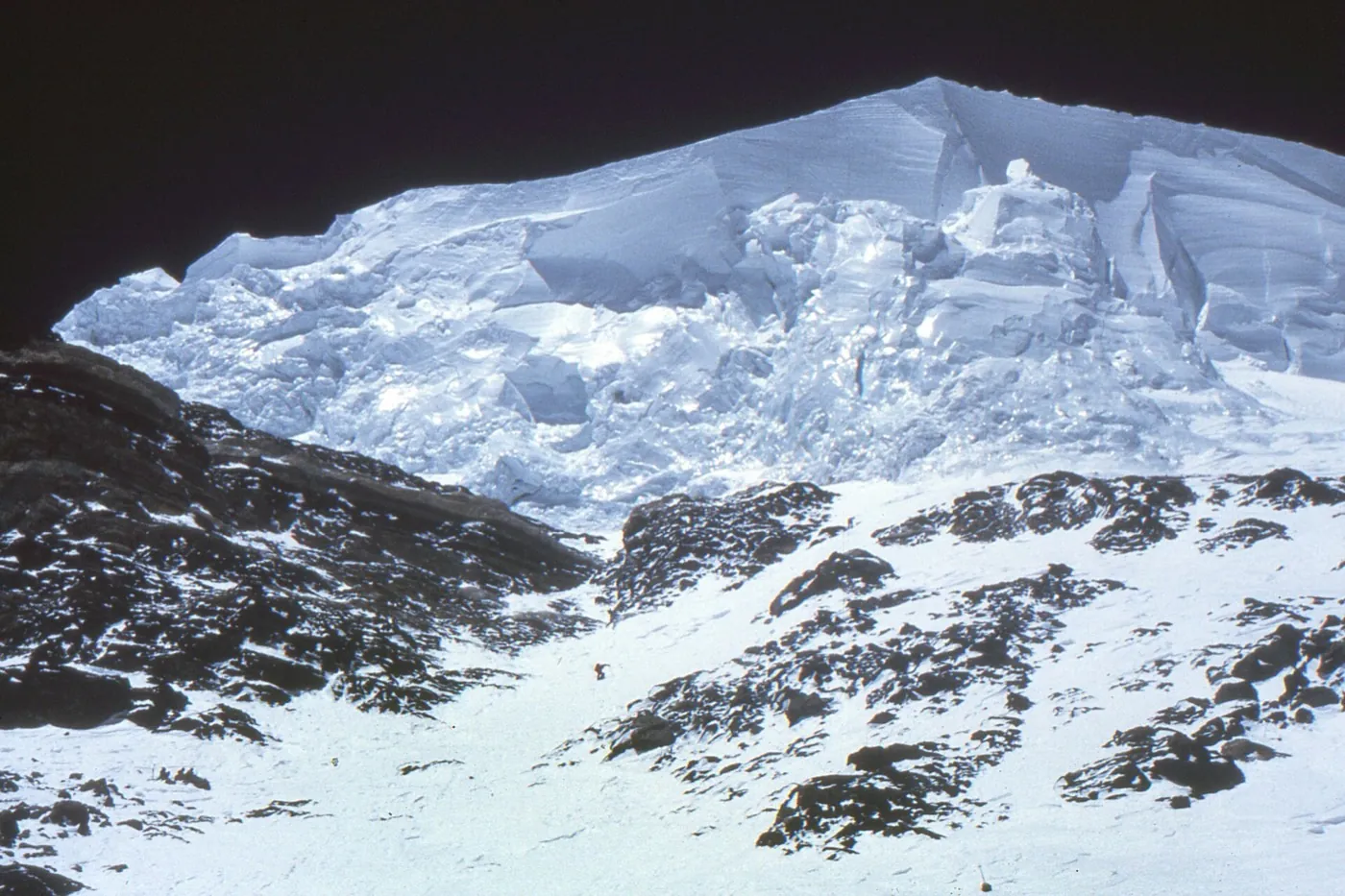
The Bottleneck, a narrow gully at about 8,200 meters, right under a hanging ice cliff called a serac, photographed in summer. Photo: Adha65, CC BY-SA 3.0, via Wikimedia Commons.
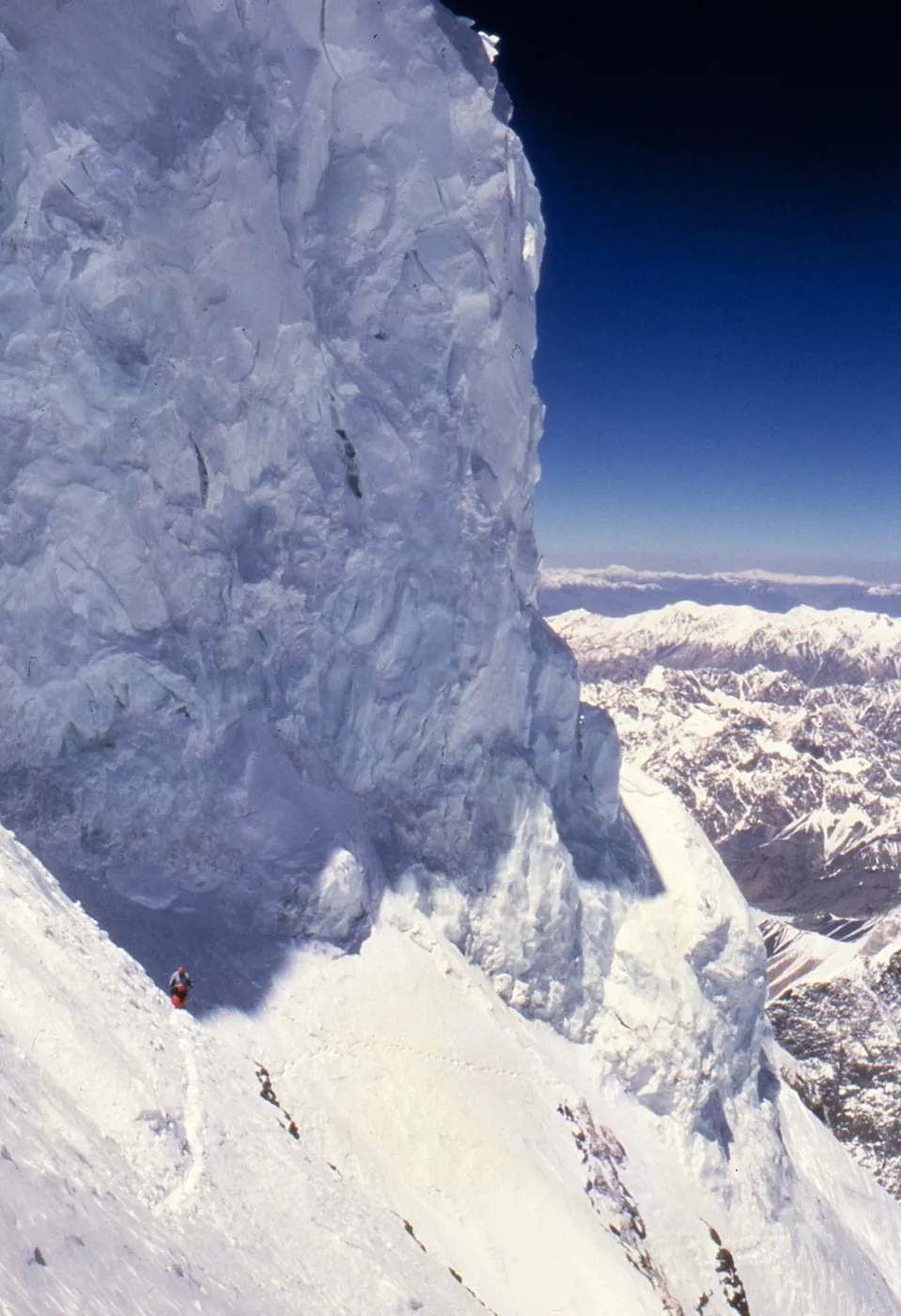
Above the Bottleneck, the route crosses a steep slope right under the serac, shown here in summer. Photo: Rolf Zemp, CC BY-SA 3.0, via Wikimedia Commons.
What climbers can expect from an expedition company, and what happened on K2
Much of the argument about winter K2 comes down to who was responsible for what. Each part below starts with what expedition companies normally provide on 8,000 meter peaks, then shows what happened on K2 against that standard. That way you can weigh the blame for yourself, and you'll know what to ask a company before you sign up for your own climb.
Who supplies the high camp tents, and why Camp 3 had so few
Companies that run trips on 8,000 meter peaks sell a few kinds of package. The biggest difference between them is who provides the tents, stove gas and food at the camps above base camp.
- A full board package: The company supplies the tents, stove gas and food at every high camp, plus bottled oxygen, and usually one Sherpa for each client. There's usually no Western guide. Seven Summit Treks' current K2 full board package says "Members will share tents in high camps (2 members: 1 tent)." Imagine Nepal's K2 package, at $45,900, lists the "necessary number of tents" at Camps 1 to 4. Elite Exped's K2 package, priced on request, says "All communal equipment is included ie. high quality ropes, stoves, tents."
- A Western guided package: The client gets the same high camp tents, food and fuel, usually two clients to a tent, plus a Western guide or an IFMGA guide (certified by the international federation of mountain guide associations) who decides when the team goes up and when it turns around. Madison Mountaineering's K2 expedition, at $75,500, promises "our own dedicated tents in each camp." Furtenbach Adventures' K2 expedition gives "1 tent for two members each for approach and high camp."
- A logistics only package: This sits in the middle, with the high camps included but no guide. Climbing the Seven Summits' Everest Logistics Only package, at $62,995, includes "High mountain camps (Camp 1, Camp 2, Camp 3, Camp 4)" with no guide.
- A base camp service package: The company handles the permit, travel, porters and base camp, and nothing higher. Climbers bring their own tents, food and fuel above base camp. Apricot Tours' K2 expedition page strikes out "Lodging above base camp" and "Meals above base camp" for its base camp tier.
The guiding standard for high camps comes from the IFMGA's 2012 guidelines on treks and expeditions. On what the IFMGA calls a guided trip, the guide should "site all camps" and "check rope fixings and other aspects of security on the mountain." On a led trip, Sherpas place the camps "as instructed by the IFMGA guide," and the guide has "no responsibility above base camp for the safety" of clients. The IFMGA also says a company must tell its clients which kind of trip they're buying and what service comes with it. No guiding body or government has a written rule that a company must check its high camps after a storm. The mountaineer and writer Alan Arnette says on his page of questions for choosing a guide company that a company falls short "if they do not have spare tents in case of a huge storm that destroys a camp." He says the best companies keep "several Sherpas on standby at a high camp for emergencies."
Seven Summit Treks sold winter K2 as one "All inclusive" package, with the climbing period marked "Full Board Service." Its trip page, archived on January 16, 2021, showed no base camp only option. The list of what the price included promised "1 veteran and Government Licensed Nepalese Sherpa per member," and this line for the high camps: "High camp service: High Altitude Tent, Necessary cooking EPI gas, cooking pot, High food for member, Sherpa and other crews at (C1) (C2) (C3) and (C4)." The page showed no price. Arnette reported that clients paid $35,000 to $45,000 each. The Telegraph reported that clients signed up after seeing winter K2 advertised on the Seven Summit Treks website as a VIP package.
Not everyone on Seven Summit Treks' climbing permit was on that package above base camp. Nims's team was on the permit but ran its own climb. Mohr carried a small two-person tent for himself and Lunger, and O'Brady's own Sherpas carried his tent to Camp 3. Noel Hanna, a client, called the trip "a commercial but non-guided expedition." In this package, non-guided meant each client had a Sherpa but no Western guide at their side. It didn't mean clients brought their own tents, because the written package included the high camp tents.
By early February, the high camps had been through two hard weeks. Around January 10, wind wrecked Camp 2, and Seven Summit Treks reported five tents, oxygen bottles, fixed ropes and gear at its high camps damaged or swept away. After the January 16 summit came nearly two weeks of high wind, and Rotar said that during that time "SST didn't check or carry supplies to the camps." At the February 1 briefing, Seven Summit Treks' plan was for eight of its Sherpas to go up ahead of the clients, "recheck all the equipment left in higher camps," repair the ropes, leave oxygen at Camps 2 and 3, and set up Camp 3 on February 3, as ExplorersWeb reported that day. Hanna said three tents were supposed to be waiting at Camp 3, left there by the Sherpa team that had summited two weeks earlier.
On February 4, Sykaris said he was told "there are three [buried?] tents and stakes, and we need to find them." ExplorersWeb wrote on February 16, 2021 that it was not known "where the other tents were, or how the lead Sherpa team tried to deal with the issue." By Sajid Sadpara's account, at least three of the four tents standing at Camp 3 had been carried up by climbers who weren't relying on Seven Summit Treks for tents: Mohr's, Ali Sadpara's and O'Brady's. "One Sherpa reportedly had another tent," ExplorersWeb added in its account of Sajid's story. That is how about 20 to 25 people ended up in the four small tents described above. Rotar said "the lack of tents was a serious problem," and that Chhang Dawa Sherpa apologized for what happened at Camp 3.
The Camp 3 tents, laid out as a case
- What Seven Summit Treks promised: its written winter K2 package included high altitude tents, stove gas and food at Camps 1 to 4 for clients on that package.
- What it planned: at the February 1 briefing, eight of its Sherpas were to go up ahead of the clients, recheck the equipment left in the higher camps and set up Camp 3 at 7,300 meters on February 3.
- What happened: when about 20 to 25 people reached Camp 3 on February 4, there were four small tents. By Sajid Sadpara's account, at least three of them had been carried up by independent climbers, not by Seven Summit Treks. Sykaris said climbers were told to dig for "three [buried?] tents" left from the earlier summit. Outside's account of the film says the company's guides arrived without tents.
- What is not known: no report says whether the eight Sherpas reached Camp 3 on February 3, or whether anyone looked at the old tents before the clients climbed up from Camp 2. ExplorersWeb wrote that it was not known "where the other tents were, or how the lead Sherpa team tried to deal with the issue."
- What follows from the known facts: by every account available, Seven Summit Treks did not have tents of its own set up at Camp 3 for its clients. Its plan for that night rested on tents another team had left two weeks earlier, through two weeks of wind, after a storm had already destroyed the company's own high camp gear, and after a stretch in which, by Rotar's account, nobody checked the camps. Relying on another team's leftover tents is not how any of the packages reviewed above work. Every full board and guided package lists the company's own tents at each high camp, and no guide or company quoted in this page describes counting on another team's tents as normal practice. In practice, Seven Summit Treks' clients spent the night before the summit in tents that independent climbers had carried up for themselves, including the tent Snorri's team had planned to share and the tent Mohr carried for himself and Lunger. Those climbers then had to give up their own rest so the company's clients had shelter. Sending clients to the last camp before the summit with no tents of the company's own in place broke the promise in Seven Summit Treks' own written package, and no package reviewed here offers other climbers' tents as the shelter a client is paying for.
- Was it dangerous? Yes, on the evidence. Camp 3 sits at about 7,300 meters, and in winter it was the last place to rest, melt snow for water and warm up before an all night summit push. Without a tent, climbers had no shelter from the winter wind and no way to rest or make water. The people who were there describe it as life threatening. Rotar, turned away from tent after tent, was let in only after O'Brady told his Sherpas, "We cannot leave him outside to die," and Rotar said, "I owe that guy my toes, if not my life." Sykaris said, "We all stayed outside and tried to figure out how to survive." Snorri's team spent that night sharing its tent with three or four extra people, which by Rotar's account left them no way to rest or melt water properly before their summit push.
- Is there a reason it wasn't reckless? None has been given. Seven Summit Treks' public responses addressed clients missing the turnaround time and how experienced its members were. Neither explains sending clients to Camp 3 without confirmed shelter. Hanna's view, that "nobody was left outside, everybody got into a tent," is true only because independent climbers who had carried their own tents took the company's clients in.
A tire shop is a simple way to picture the two separate questions here. Say a shop promises in writing to mount your wheels and tighten the lug nuts. It sends you onto the highway without checking the nuts, a wheel comes loose, and the shop says you were driving too fast. Whether the shop did what it promised and whether you drove too fast are two different questions, and both answers can be yes. On K2, the written package is the shop's promise, and the pace and turnaround rules covered next are the speed limit.
How Seven Summit Treks and its clients responded
- Arnold Coster, the company's co leader: In the film, Coster blames clients and guides for missing their turnaround time, the set time to turn back no matter where you are. He also told Arab News, "all our members were experienced 8000-meter climbers."
- Noel Hanna, a client: Hanna said, "Nobody was left outside, everybody got into a tent." He also said, "if you sign up for a non-guided expedition, you can't expect to be guided" (ExplorersWeb, March 8, 2021). Hanna died at Camp 4 on Annapurna in April 2024, on another Seven Summit Treks expedition, as The Himalayan Times reported.
- Antonios Sykaris, a client: Sykaris remembers that night differently from Hanna. "We all stayed outside and tried to figure out how to survive," he told ExplorersWeb.
- Magdalena Gorzkowska, a client: "We were trusting too much the agency," she told The Telegraph in 2026.
- Tomaz Rotar, a client: Rotar said that he would still climb with the company again.
Who decides when a climber turns around
A turnaround time only works if somebody has the power to enforce it. Arnette writes that the decision lies "with both the client and the guides," and that good companies give the guide full authority in the contract, including the right to send down clients who are "too slow, unhealthy, or lack the necessary skills" (Alan Arnette, October 13, 2023). On a full board trip, the person next to the client is usually a personal Sherpa, and a personal Sherpa can advise a client but can't order them down. On Everest in May 2024, a client's Sherpa had "no authority or means to force him to turn around," as ExplorersWeb reported.
On K2, at the February 1 briefing, Coster set a pace check: climbers "unable to get to Camp 1 in six hours should turn back." That rule is the only early pace check on record for the February push. Rotar said "several people ignored that instruction." Hanna saw turning back as each climber's own decision. "Everyone should know their own limitations," he said. After Snorri, Ali Sadpara and Mohr went missing, Coster told Arab News that the safe window closed at noon on February 5, and said of the three, "I assume they continued for the summit push."
How oxygen gear should be checked, and what failed on K2
A regulator is the part that meters oxygen from the bottle to the mask, so when it fails, the climber gets no oxygen. No guiding body has a written rule for testing oxygen gear, so it comes down to each company. Alpenglow Expeditions says its oxygen systems are "new, clean, tested," that it carries a second of every part, and that above 8,000 meters "10% of regulators/bottles/masks fail." On Everest in 2018, about "25 out of 500 to 1,000" Summit Oxygen regulators failed, from humidity and leaking O-rings, and some failures came from climbers stepping on hoses with crampons. Those batches were recalled. Nobody was hurt, and nearly every team that had failures carried enough spares to keep its summit push going (Alan Arnette, August 26, 2018).
Seven Summit Treks' winter K2 package included five 4-liter oxygen bottles for each member and "1 Set of Summit Oxygen mask & regulator for each member and high-altitude Sherpa," made by Summit Oxygen. Spares were listed as "Back up Oxygen Cylinder, mask and regulator (with appropriate charge)," which reads as spare gear at extra cost.
On the February push, Rotar recalled regulators "exploding" and some bottles with low pressure. Josette Valloton's regulator didn't work, and the oxygen system of a Sherpa named Temba failed, as High Asia Herald reported from Rotar's interview. Rotar also said the team was not short of oxygen. Sajid Sadpara, who wasn't with Seven Summit Treks, turned back at about 8,200 meters when his regulator leaked, as told in the summit night section above.
How teams usually share the work on K2, and how they did in 2021
On K2, fixing rope is normally shared work. The largest team usually brings most of the rope, other teams add some, and climbers whose team didn't help fix usually pay a few hundred dollars each (Alan Arnette, January 23, 2021). Pakistan has no group like Nepal's Expedition Operators Association to organize this, so teams agree among themselves, which ExplorersWeb says "has been a frequent source of conflict." Seven Summit Treks' winter package promised a "Rope Fixing Team: The team of experienced Sherpas will fix the route on K2."
In January 2021, the Nepali teams stopped sharing their plans, and most people on the mountain assumed they would only set up Camp 4. How that went is covered in the January summit section above, and the argument over the crevasse near 8,000 meters is in the summit night section. Mingma G said, "I was the last one rappeling down so I know all the ropes were left." Sykaris and O'Brady said some of those ropes were buried under snow by February 4.
What rescue looks like on K2 in winter
In Pakistan, Askari Aviation, a military-owned company, is the only operator that flies rescue helicopters. It wants a deposit before a helicopter takes off, and insurance alone won't start a flight. Its own briefing gives 5,000 meters as the highest a helicopter will land, which is about the height of K2 base camp (Alpinist, August 7, 2018). Seven Summit Treks' winter K2 package left rescue and evacuation costs to the client, and listed rescue insurance as "Mandatory."
On February 6 and 7, 2021, two army helicopters searched up to "their maximum limit of 7,800 metres" for about an hour before weather stopped them, as PTI reported. Dawn put the height at about 7,000 meters. Both figures are well below the Bottleneck, at about 8,200 meters. From February 9 to 11, searchers asked for a C-130 plane with an infrared camera, satellite radar images came from ICEYE and the Iceland Space Agency, and four porters from Sadpara village searched on foot, as the Associated Press of Pakistan reported. Pakistan suspended winter climbing permits, according to AP. On February 18, Snorri, Ali Sadpara and Mohr were declared dead, as Dawn reported.
Seven Summit Treks since winter K2
Seven Summit Treks is still one of the biggest expedition companies on the 8,000 meter peaks. Its own 2025 year in review calls 2025 one of its busiest years, and 22 climbers and guides reached the top of Everest with the company in spring 2026, as Nepal News reported. In autumn 2026, Seven Summit Treks called off its Manaslu expedition after deadly avalanches, as Outside reported. The 2026 film brought new criticism of Seven Summit Treks and Coster. No penalty against Seven Summit Treks over winter K2 has been reported.
Questions to ask before you hire an expedition company
Everything above turns into questions you can put to any company before you pay. Get the answers in writing where you can.
- What does my package include, in writing? Ask whether it's full board, guided, logistics only or base camp service, and get the list of what the company supplies at each high camp.
- Who carries the high camp tents and sets them up? Ask whether the company carries its own tents to every camp or counts on tents from other teams, how many people it plans for each tent, and whether it has spare tents if a storm destroys a camp.
- Who checks the camps after a storm? Ask who goes up to check and restock each high camp before clients climb to it. Then ask the plain question: will you confirm by radio that my tent is standing at the next camp before I leave the camp below? On K2 in 2021, about 20 people climbed to Camp 3, and there is no record that anyone confirmed there was shelter for them first.
- How many Sherpas per client on the summit push? Arnette says the best companies keep "1:1," with fewer than 8 clients on each push.
- Who can turn me around, and is that in the contract? Ask who the lead guide is, whether they've climbed this peak, whether the guide will turn around with you, and whether the guide has the final say in writing.
- How is the oxygen gear tested, and how many spares go up? Ask how many bottles you get and at what flow, and whether a spare mask and regulator go up on summit night. Alpenglow carries "2 of each component."
- Who fixes the ropes? Ask whether the company's own Sherpas fix the route, and how it shares that work with other teams.
- What happens if I need a rescue? Ask who flies rescues on that mountain, how much deposit the company or you must put down, and what insurance you need. Carry your own radio.
- What happened in the company's past accidents? Ask what happened and whether the company ever left a client alone. Talk to past clients, including ones who didn't reach the top.
Garrett Madison, who runs Madison Mountaineering, says to decide first whether you need a guided team or logistics only, and not to let price make that choice for you, as he told ExplorersWeb in 2019. On a guided team, a leader decides when to go up and when to turn around.
The five climbers who died on K2 that winter
Five people lost their lives on K2 in the winter of 2020 to 2021. Each had climbed big mountains for years, and each left family and friends behind.
| Climber | Country | Date | What happened |
|---|---|---|---|
| Sergi Mingote | Spain | Jan 16, 2021 | Fell while coming down from Camp 1. He was co-leader of the Seven Summit Treks expedition. |
| Atanas Skatov | Bulgaria | Feb 5, 2021 | Fell just below Camp 3 at the start of his descent. Reports disagree on why. |
| Muhammad Ali Sadpara | Pakistan | Feb 5, 2021 | Last seen high on the mountain near the Bottleneck. Found on July 26, 2021. |
| John Snorri Sigurjónsson | Iceland | Feb 5, 2021 | Last seen high on the mountain near the Bottleneck. Found on July 26, 2021. |
| Juan Pablo Mohr | Chile | Feb 5, 2021 | Climbing without bottled oxygen. Last seen near the Bottleneck. Found on July 26, 2021. |
Ali Sadpara's son Sajid was with him on that last push. In the summer of 2021, Sajid went back up K2 with the filmmaker Elia Saikaly and Pasang Kaji Sherpa to search for him. A Nepali Sherpa team fixing ropes for Madison Mountaineering found the bodies of Snorri, Ali Sadpara and Mohr on July 26, as Dawn and ExplorersWeb reported.
What's still unknown about winter K2
Some questions about that winter may never be answered.
- Did Snorri, Ali Sadpara or Mohr reach the top? No evidence has been found that they did. When the bodies were found in July 2021, all three were on the way down. Snorri was highest, still clipped to the fixed rope just below 8,300 meters, Ali Sadpara was a few rope lengths below him, and Mohr was much lower, near Camp 4. Being on the way down shows they were descending, but not whether they turned back below the summit or after reaching it. Sajid Sadpara searched Snorri's body for evidence of a summit and brought back his GPS, phone and GoPro. The files were damaged, and only one corrupt video frame could be recovered, showing a fixed rope on the way up (ExplorersWeb, August 2, 2021, and Montagna.tv, August 2, 2021).
- Were Snorri and Ali Sadpara using bottled oxygen on February 5? Reports disagree. Alan Arnette wrote it was unclear, while ExplorersWeb's account of Sajid's story says both used it.
- Why did Atanas Skatov fall? ExplorersWeb reported he apparently wasn't clipped to the ropes. Chhang Dawa Sherpa pointed to a preliminary government report that blamed a broken fixed rope.
- How did the January team get past the crevasse near 8,000 meters? Rotar, Sajid and Mingma G each tell it differently, as covered above.
- Did Nims climb without oxygen? His claim was never checked independently, as covered above.
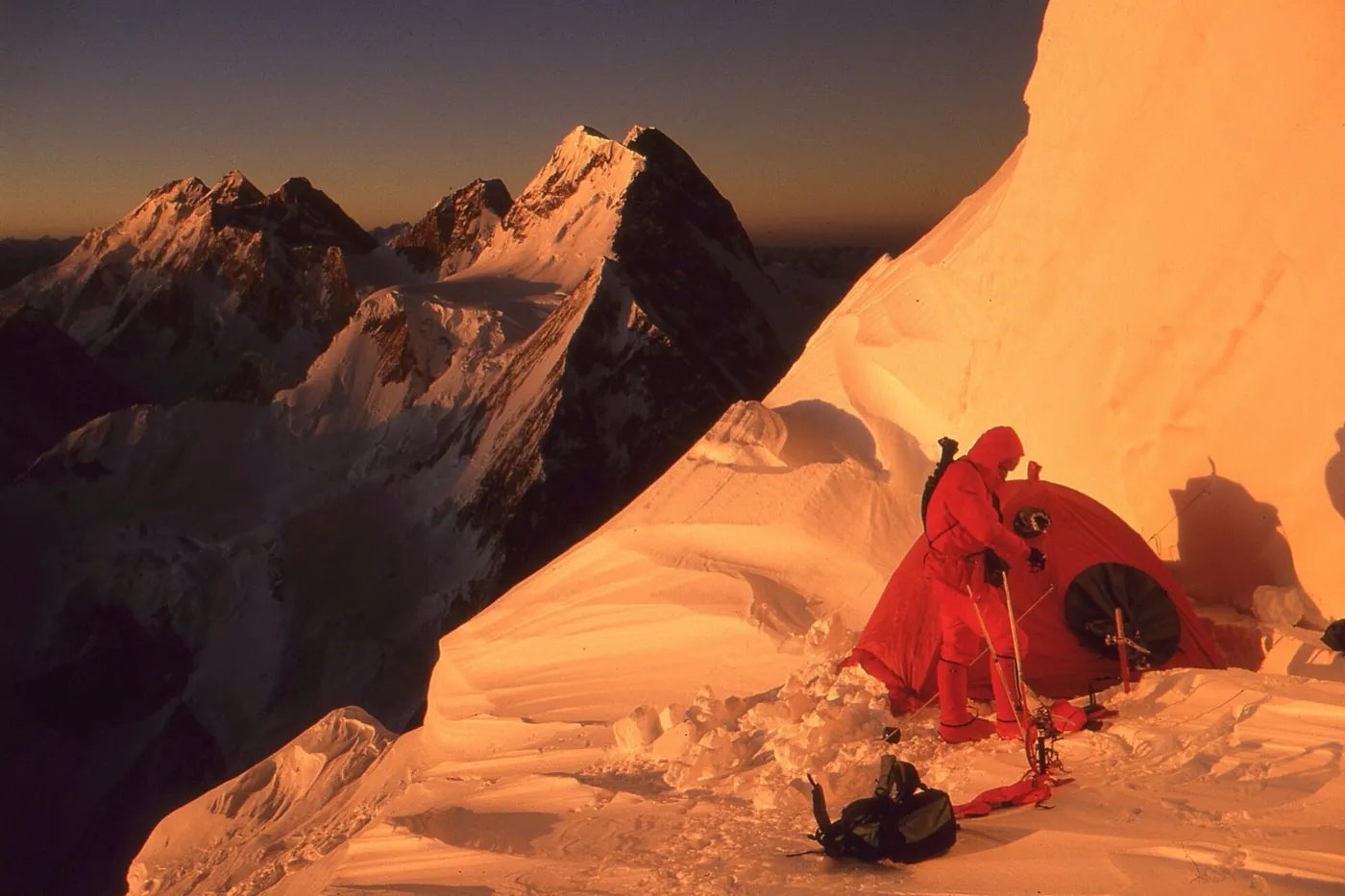
A tent dug into the snow at about 7,700 meters on K2, with Broad Peak lit behind it, in summer. High camps on K2 have room for only a few small tents. Photo: Adha65, CC BY-SA 3.0, via Wikimedia Commons.
What climbers can learn from winter K2
Everest in spring is not K2 in winter. But most of what went wrong on K2 can go wrong on any big mountain, from a first high peak to Everest. These are the lessons from winter K2.
- Acclimatization is earned on the mountain, and it fades. The Nepali team's head start came from weeks of climbing just before K2. If you're building toward Everest, keep your big climbs close together, because the gains fade over days to weeks after you come down.
- Altitude sickness can kill, and going down is the treatment. The CDC Yellow Book says to go down if symptoms get worse or if you see signs of HACE (swelling around the brain) or HAPE (fluid in the lungs). My altitude sickness page lists the warning signs and when to turn around.
- Bottled oxygen is a safety tool, not just a style choice. On K2, summiters who skipped bottled oxygen died on the way down far more often, as the JAMA numbers above show.
- Vet the company before you pay. The tents at Camp 3, the oxygen spares and the power to turn a client around all came down to what the company promised and did. The questions to ask before you hire an expedition company cover each one.
- Turnaround times only work if you obey them. Agree on yours before you leave, and turn around at that time even if the top looks close.
- A short window means a rushed push. When the weather gives you one narrow day, everyone crowds into it.
- Small teams have less margin. Three people can't carry, fix rope or rescue the way a bigger team can.
Where to watch the winter K2 documentary
The film is The Last First: Winter K2 on Apple TV. Amir Bar-Lev directed the film. It premiered at the Sundance Film Festival in January 2026 and came out on Apple TV on October 2, 2026. It runs about 97 minutes and is rated TV-MA.
The official trailer for the film, with voices from people who were on K2 that winter.
- The warning: Colin O'Brady records himself saying he's worried people will die that night.
- The crowd: Arnold Coster says half the group were experienced climbers and the other half were there for social media.
- The altitude: Elia Saikaly says up there your body breaks down faster than it can recover.
- Camp 3: Tamara Lunger hears people asking to come into her tent, and Tomaz Rotar says there were no tents and no food.
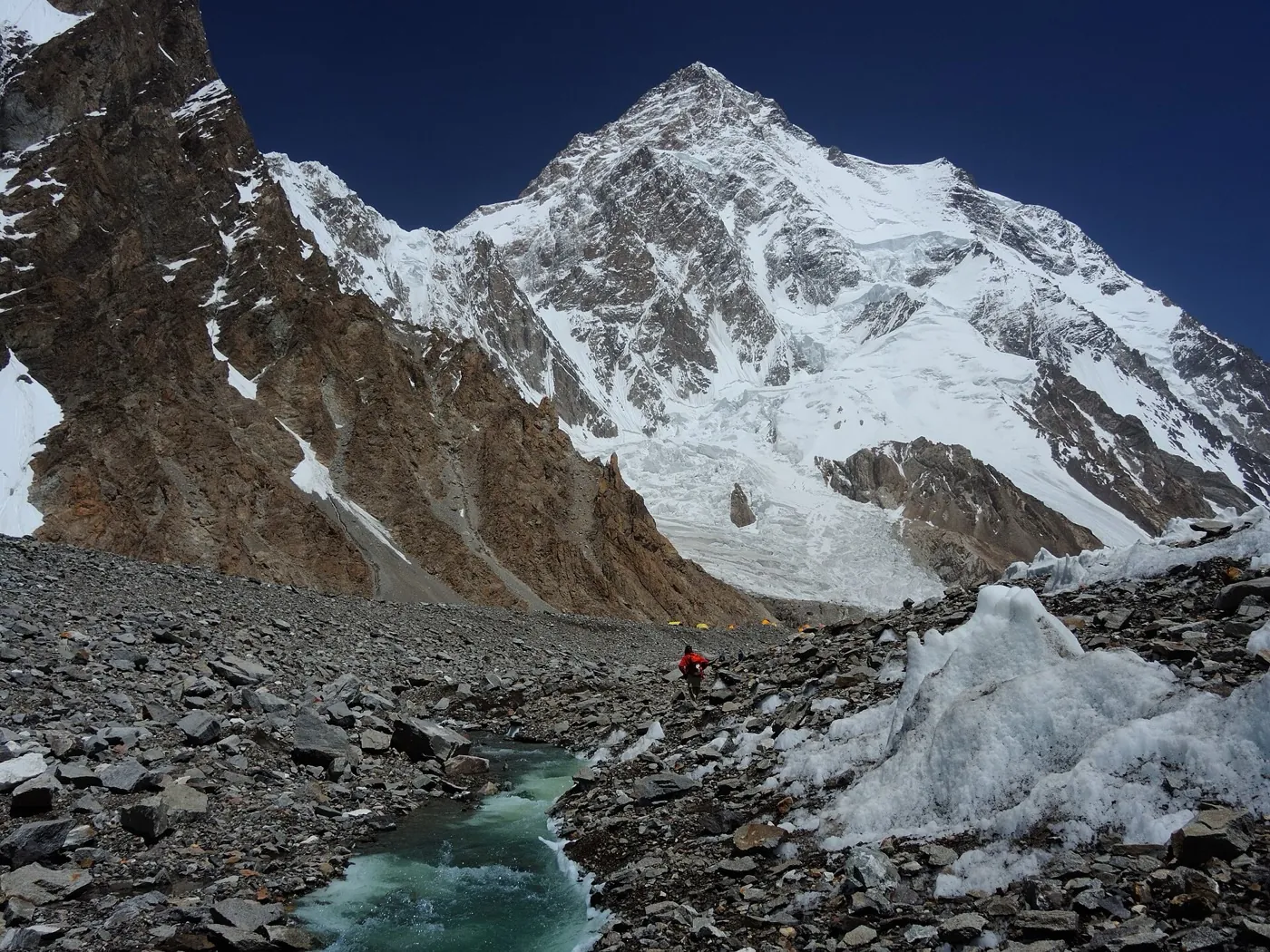
Walking up the Godwin-Austen Glacier toward K2 base camp in summer. The tents sit at the foot of the mountain, around 5,000 meters. Photo: Zacharie Grossen, CC BY-SA 4.0, via Wikimedia Commons.
Questions people ask about winter K2
Who were the first people to climb K2 in winter?
Ten Nepali climbers, on January 16, 2021. Their names are listed above.
How many people died on K2 in the winter of 2021?
Five: Sergi Mingote on January 16, then Atanas Skatov, Muhammad Ali Sadpara, John Snorri and Juan Pablo Mohr on February 5.
Were John Snorri, Ali Sadpara and Juan Pablo Mohr ever found?
Yes. A Nepali Sherpa team fixing ropes found all three on July 26, 2021, high on the route above Camp 4.
Did the Nepali team use oxygen on K2?
Mostly, yes. Mingma G said he did, and the others are understood to have used it. Nirmal Purja said he climbed without it, and his claim was never independently checked.
Why is K2 so much harder in winter?
Winter brings stronger wind, deeper cold and lower air pressure, so K2's top feels about 450 meters higher in January and February than in July. Storms also leave only short windows to climb.
Is K2 harder than Everest?
The mountaineer and writer Alan Arnette calls K2 arguably the world's most difficult mountain. That's one writer's view, not an official ranking. My 14 peaks page covers how he describes each peak.
Where to go next
If you want to understand altitude better, start with the altitude sickness page. If you're earlier on the path, the guide to starting mountaineering from zero walks through the steps. The Everest cost page covers what a guided trip with bottled oxygen and Sherpa support actually costs. And the guide to the 14 peaks over 8,000 meters shows where K2 sits among the other giants.
Have a question about “Winter K2, 2021: the first winter climb, the five deaths, and what climbers can learn”?
Ask it here. Every question comes to me first. I answer as many as I can, and each answered question goes on this page with my answer so other hikers and climbers can see it too. I don't ask for your email, so check back on this page for the answer.
More big trips guides
What does it cost to climb Everest in 2026, and where does the money go?
Nepal's government fee, six companies' own prices, the costs the trip fee leaves out, and a budget you can redo with your own numbers.
Kilimanjaro vs Everest Base Camp: which is harder, and which should you do first?
A plain comparison for someone choosing a first big trip, with the same facts for both side by side.
What are the 14 peaks over 8,000 meters, and which one do people climb before Everest?
All 14 in one table, what the death numbers do and don't say, the usual first 8,000 meter climbs, and where the real prices and permit fees are published.
- What was found with the bodies: ExplorersWeb, K2 Climbing Ends, Mystery-Solving Begins (August 2, 2021), and Montagna.tv, Invernale al K2, le poche risposte trovate nella GoPro di Snorri (August 2, 2021).
- Medical and safety: CDC Yellow Book, High-altitude travel and altitude illness, and the Wilderness Medical Society 2024 guideline peer-reviewed summary, checked October 19, 2026.
- Acclimatization studies: Muza, Beidleman and Fulco, Altitude preexposure recommendations for inducing acclimatization, High Altitude Medicine & Biology (2010). Peacock, Oxygen at high altitude, BMJ (1998). Grocott and others, Arterial blood gases and oxygen content in climbers on Mount Everest, NEJM (2009). Tannheimer and Lechner, Rapid ascents of Mt Everest, Journal of Travel Medicine (2020). Szymczak and others, Environmental conditions on Everest and K2 in climbing and midwinter seasons (2021). Huey and Eguskitza, JAMA (2000), via the University of Washington.
- Sherpa and Tibetan adaptation: Yi and others, Science (2010). Huerta-Sanchez and others, Nature (2014). Bhandari and others, Sherpas share genetic variations with Tibetans (2017). Horscroft and others, Metabolic basis to Sherpa altitude adaptation, PNAS (2017). Firth and others, Mortality on Mount Everest, 1921 to 2006, BMJ (2008).
- Alan Arnette, 2018 Everest oxygen regulator failures, for how a regulator works.
- Company and guide pages: Alpenglow Expeditions, Everest Hypoxico letter and Hypoxico.
- ExplorersWeb: First team arrives at K2 base camp (December 8, 2020), Purja and Co. reach K2 base camp (December 26, 2020), Winter K2 preparations (November 3, 2020), Interview with Antonios Sykaris (February 9, 2021), Mingma G answers K2 summit questions (February 23, 2021), Sajid Sadpara's story (February 24, 2021), Tomaz Rotar, it's time to tell the truth about K2 (February 26, 2021), Noel Hanna on K2 (March 8, 2021), O'Brady turns back (February 4, 2021), Two bodies found (July 26, 2021), Mingma David Sherpa on winter K2 (November 29, 2021), The first winter ascent of K2 (December 30, 2021), Flashback: the 48 hours of drama on winter K2 and Winter K2's deadly anniversary.
- Alan Arnette: December 31, 2020, January 10, 2021, January 11, 2021, January 18, 2021, January 19, 2021, January 25, 2021 and February 7, 2021.
- News: Associated Press of Pakistan (January 16, 2021), Kathmandu Post (January 16, 2021), Outdoor Journal, Guinness World Records, first winter ascent of K2, Dawn on Camp 2 (January 14, 2021), the bodies found (July 26, 2021) and Nirmal Purja's death (August 1, 2026), Arab News (February 16, 2021) and Lacrux (March 12, 2021).
- The film: Apple TV press page, Apple TV watch page, Outside's review and the official trailer (September 2026).
- Seven Summit Treks' winter K2 page, archived by the Wayback Machine on January 16, 2021 and January 28, 2021.
- Expedition packages, from each company's own page: Seven Summit Treks, K2, Imagine Nepal, K2, Elite Exped, K2, Madison Mountaineering, K2, Furtenbach Adventures, K2, Apricot Tours, K2 and Climbing the Seven Summits, Everest cost guide (2026).
- Guiding standards and advice: IFMGA, Guidelines on Treks and Expeditions (2012). Alan Arnette, questions to ask a guide company and the best guides for an 8,000 meter mountain (October 13, 2023). Alpenglow Expeditions, questions to ask before joining an Everest expedition and its oxygen system. ExplorersWeb, How responsible are Sherpas for the lives of their clients? (August 14, 2024) and interview with Garrett Madison (September 10, 2019).
- Oxygen gear: Summit Oxygen, Alan Arnette, 2018 oxygen failure on Everest and regulator recall (August 26, 2018), and High Asia Herald (March 2, 2021).
- The winter K2 company story: Alan Arnette, Is what's happening on winter K2 wrong? (December 20, 2020) and ropes on K2 (January 23, 2021). ExplorersWeb, K2 final summit push has begun (February 1, 2021), Winter K2 wraps up with many unanswered questions (February 16, 2021) and Mingma G criticizes rope parasites. The Telegraph, Death on K2, via Yahoo (October 3, 2026).
- Rescue and search: Alpinist (August 7, 2018), Tribune India and PTI (February 7, 2021), AP (February 10, 2021), Associated Press of Pakistan (February 11, 2021) and Dawn (February 18, 2021).
- Seven Summit Treks since 2021: Seven Summit Treks, Year in Review 2025, Nepal News (May 18, 2026), Outside on Manaslu (2026) and The Himalayan Times on Noel Hanna (April 2024).
- Wikimedia Commons photos: K2 at dusk by Maqsood aktar (CC BY-SA 4.0), Abruzzi Spur line by EMajor from Svy123 (CC BY 3.0), approaching base camp by Zacharie Grossen (CC BY-SA 4.0), the Bottleneck and high camp at sunrise by Adha65 (CC BY-SA 3.0), and above the Bottleneck by Rolf Zemp (CC BY-SA 3.0).
Everest Buddy is an independent site. No gear maker, store or guide company paid to be on this page. This guide gives general information, not medical advice, so see a doctor before you start a new training plan or travel to high altitude.